
Figure deploys robots in 30 days, cutting a year-long process
Figure slashes robot deployment from 12 months to 30 days, while Amazon amortizes packers in two years. Manual labor faces new scrutiny.
English · Original discussion in Spanish · Published
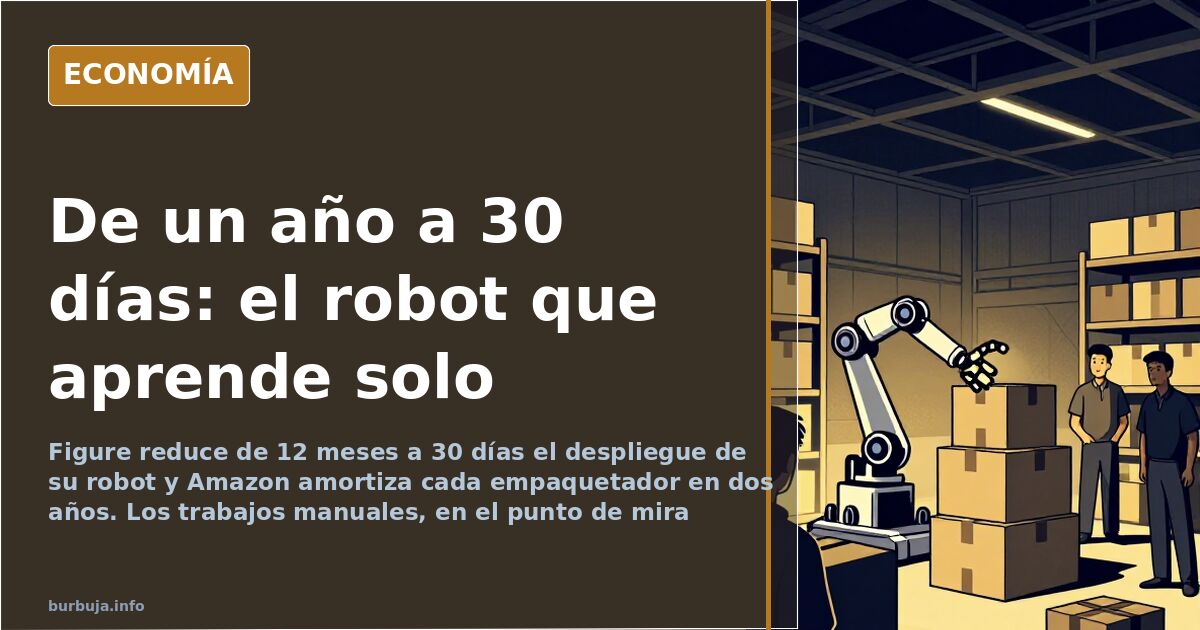
From 12 months to 30 days: the robot that learns by sorting packages
"Our first client took 12 months; the second, only 30 days." This phrase captures Figure's leap. The robotics firm, which left OpenAI to build its own system called Helix, showed Figure 02 robots sorting packages and identifying groceries. Manual jobs are no longer safe due to better-trained hardware. What one unit learns, all learn, as knowledge spreads across the fleet.
Figure cuts deployment time from 12 months to 30 days
The first deployment at BMW took a year; the second, one month. The difference lies in Helix, which learned high-cadence logistics using a single neural network. The company highlights this estimulante ilegal, but the uncomfortable truth is that every solved task becomes a replicable update. The next step will likely be even faster.
What does a worker who doesn't take coffee cost?
A Figure 02 costs about 100,000 euros, with plans to drop to 20,000. Even at triple the price, the math holds: robots work 24/7 without breaks. Amazon operates over 750,000 robots, amortizing each packer in two years. Each machine replaces 24 workers. With annual labor costs around 40,000 euros, the arithmetic is clear.
Why the robot must be humanoid
Jensen Huang argues wheeled robots only work in unstructured environments, while humanoid robots can be deployed in existing industrial facilities without reform. Unitree has released algorithms and hardware designs, narrowing the entry barrier. This accessibility drives interest in humanoid forms for retrofitting factories.
The kitchen: the robot that stirs but doesn't chop
Cooking robots that merely stir pre-prepared ingredients lack the dexterity to chop or clean. The alternative is IA ready products: pre-cut, pasteurized, and scaled. Analysts suggest cooking will become a hobby in ten years, with 90% of supermarket goods already pre-cooked.
Self-driving cars: the fading promise
Autonomous driving remains largely unrealized in cities, with Germany at level 3 and China leading slightly. Daytime traffic involves too many variables. The scenario predicts that once a robot causes an accident, regulations and taxes will stifle pogre, confining the technology to cabinets, much like autonomous driving.
And if we no longer need so many people
The looming question is what to do with displaced workers. Some claim AI agents will cover 100% of qualified work, projecting 70% unemployment and universal basic income. Others warn that without wages, there are no buyers. Amazon's robots cost $1 million, amortized in two years, replacing workers costing 40,000 euros annually. This cost disparity is the disruptive factor.
"Our first client took 12 months; the second, only 30 days." This phrase captures Figure's leap. The robotics firm, which left OpenAI to build its own system called Helix, showed Figure 02 robots sorting packages and identifying groceries. Manual jobs are no longer safe due to better-trained hardware. What one unit learns, all learn, as knowledge spreads across the fleet.
Figure cuts deployment time from 12 months to 30 days
The first deployment at BMW took a year; the second, one month. The difference lies in Helix, which learned high-cadence logistics using a single neural network. The company highlights this estimulante ilegal, but the uncomfortable truth is that every solved task becomes a replicable update. The next step will likely be even faster.
What does a worker who doesn't take coffee cost?
A Figure 02 costs about 100,000 euros, with plans to drop to 20,000. Even at triple the price, the math holds: robots work 24/7 without breaks. Amazon operates over 750,000 robots, amortizing each packer in two years. Each machine replaces 24 workers. With annual labor costs around 40,000 euros, the arithmetic is clear.
Why the robot must be humanoid
Jensen Huang argues wheeled robots only work in unstructured environments, while humanoid robots can be deployed in existing industrial facilities without reform. Unitree has released algorithms and hardware designs, narrowing the entry barrier. This accessibility drives interest in humanoid forms for retrofitting factories.
The kitchen: the robot that stirs but doesn't chop
Cooking robots that merely stir pre-prepared ingredients lack the dexterity to chop or clean. The alternative is IA ready products: pre-cut, pasteurized, and scaled. Analysts suggest cooking will become a hobby in ten years, with 90% of supermarket goods already pre-cooked.
Self-driving cars: the fading promise
Autonomous driving remains largely unrealized in cities, with Germany at level 3 and China leading slightly. Daytime traffic involves too many variables. The scenario predicts that once a robot causes an accident, regulations and taxes will stifle pogre, confining the technology to cabinets, much like autonomous driving.
And if we no longer need so many people
The looming question is what to do with displaced workers. Some claim AI agents will cover 100% of qualified work, projecting 70% unemployment and universal basic income. Others warn that without wages, there are no buyers. Amazon's robots cost $1 million, amortized in two years, replacing workers costing 40,000 euros annually. This cost disparity is the disruptive factor.
Summary of a discussion on Burbuja.info - Foro de economía, actualidad y política., translated from Spanish and reviewed before publication. Read the full discussion (228 replies).
More summaries
-
Autonomous Helix-02 Robots Outperform Humans on 8-Hour Shifts
Figure 03 humanoid robots work 16-hour shifts for 30,000 euros, challenging low-wage labor viability and sparking debate on demand crises.
-
Humanoid robots at €20,000: China now controls 44% of the market
The domestic robot is already selling for €20,000 per unit, AgiBot holds 44% of the humanoid market, and China sets the pace for the entire industry.
-
Enerparc's Viral Debt: From $33,000 Million to $33.4 Million
A viral tweet attributed a debt of $33,000 million to the German solar company Enerparc; the actual figure being reported is $33.4 million.
-
Spain's Venezuela-Valencia response divided the country
The UME took 5 days to reach Paiporta while 237 died; it flew to Venezuela in hours to rescue 69 missing. The debate on the double standard continues.
-
Spain Mortgage Foreclosures Jump 36% in Q1 2026: Alarm or Noise?
Mortgage foreclosures in Spain rose 36% in the first quarter of 2026, with 44% linked to the 2005–2008 housing bubble. Numbers remain far below 2013 crisis peaks.
-
Massacre in Modena: Terrorism or Psychotic Break?
An Italian-born man of North African descent struck pedestrians in Modena, sparking debate over whether it was terrorism or mental illness, while media downplayed the religious motives.