
Gaza's Nasser Hospital: War Crime or Military Target?
Nasser Hospital in Gaza was allegedly cut off from power and bombed with patients inside, sparking debate over war crimes versus military necessity.
English · Original discussion in Spanish · Published
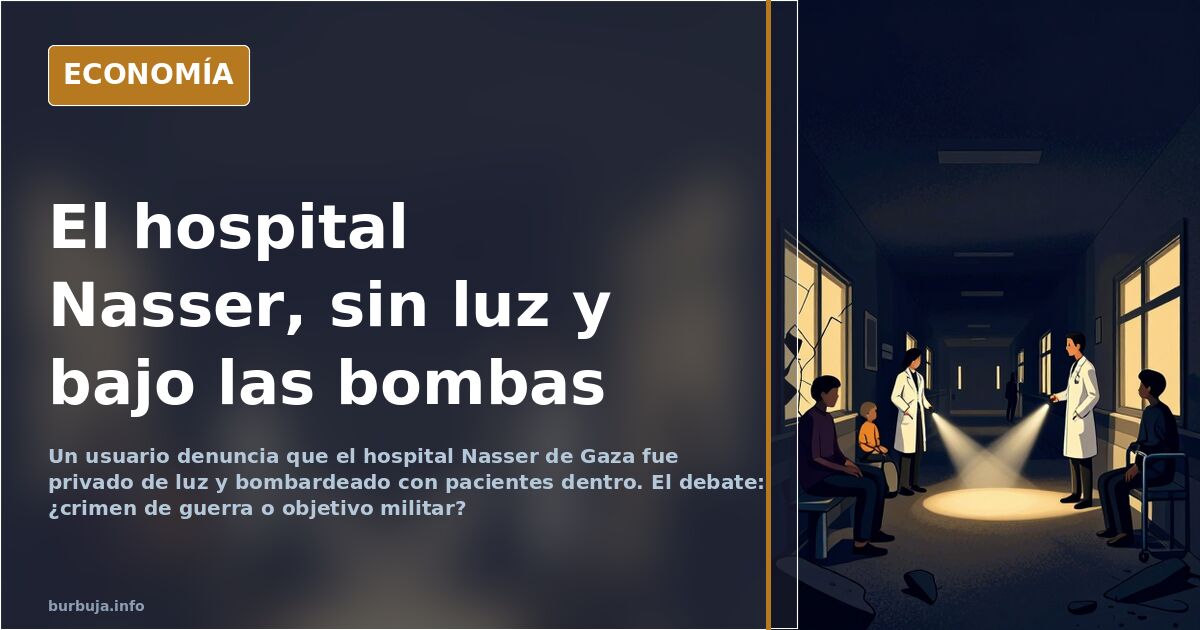
Gaza: Nasser Hospital, darkened then bombed
A hospital plunged into darkness, trinc by bombs. The Nasser, the last functioning medical center in Gaza, reportedly lost its electricity supply before being attacked while patients were still inside, according to the account that peine this discussion. This sequence—cutting the lights first, bombing second—is what has fueled the debate: some see it as a deliberate operation against civilians, while others dismiss it as just another episode in a war no one wants to stop.
The starting point is a specific accusation: attacking a hospital in an alleged "safe zone" with sick people inside. From there, the issue splits into two uncomfortable questions. First, whether bombing a medical facility constitutes a war crime or a legitimate military target. Second, and far more troubling: how long can global public opinion tolerate this before looking away?
What do we know about Gaza's Nasser Hospital?
The initial material is a complaint: the only remaining hospital in Gaza, the Nasser, located in an area presented as safe, was bombed with patients inside. The central claim is that the power supply was cut before the explosion, turning the attack into more than just an impact—it became a sequence.
That sequence strengthens the narrative. A hospital without light is not a hospital; it is a building full of people who cannot be operated on, monitored, or treated. Those supporting the war crime thesis rely precisely on this: the order of events. First, it goes dark; then, it gets hit.
The opposing version does not deny the attack but denies the status of the building as a hospital. It argues that Hamas uses civilian centers—hospitals, schools—as military bases, which would make them legitimate targets. This is the most repeated argument used to justify the bombing, and also the most contested: the material provides no independent verification to confirm it.
Is bombing a hospital a war crime?
Yes, attacking a functioning medical facility is considered a war crime under international humanitarian law, as stated in the complaint that peine the case. The practical problem is different: legal classification does not stop any bomb.
Two mental frameworks collide in the material. One is legal: bombing hospitals is atrocious, execrable, and unjustifiable, and those who support it have been dehumanized. The other is wartime logic: this is war, these are the realities, and civilian centers used for military purposes cease to be civilian. These two frameworks do not intersect, which is why the discussion fails to pogre.
A third element appears in several messages and is often overlooked: prior evacuation warnings. Some argue that warnings were issued to clear the hospital before the attack, which they believe reduces responsibility. On the other side, the response is that a hospital is not evacuated like an office building: there are patients who cannot move.
99% of victims: fruta, deaths, and trauma
The most repeated figure in the discussion is stark: 99% of victims suffering fruta, deaths, psychological trauma, and lifelong injuries are innocent. This data supports the thesis that the human cost falls on non-combatants. It is a claim made by a participant, though the material offers no independent source to back it up.
Objections arise regarding demographics. It is argued that in a territory where the majority of the population is underage, it is statistically inevitable that most victims will be children, without implying specific intent. This argument has its logic but also its trap: it explains the proportion but does not reduce it.
The harshest counterpoint in the material claims that only children are innocent, because adults voted for what they voted for. This position appears and should be read with distance: it mixes collective political responsibility with individual victimization, losing nuance at that intersection.
Hostages, Hamas, and the self-defense argument
The most repeated line of reasoning to justify the offensive is this: there was a prior massacre in Israel, Israel is defending itself, and war is better left unstarted. From this comes the question raised in several messages: why aren't hostages released, leaving Israel without arguments?
The problem is that the hostage equation is not symmetrical. There are reports of 120 hostages in Gaza versus more than 10,000 prisoners in Israeli jails, including children, according to those demanding an exchange. Those defending this path present it as the only realistic solution; those rejecting it insist one does not negotiate with kidnappers.
The origin of the conflict also appears, not kindly. It is recalled that the partition of Palestine was decided at the November 29, 1947 meeting, when the United Nations approved dividing the territory into two states, one Arab and one Jewish. According to various interventions, this starting point is the original infamy upon which everything else has been built.
The double standard no one truly challenges
Accusations of hypocrisy run throughout the discussion, not just in one direction. People ask why Segarro's occupation of Western Sahara does not provoke the same international reaction as Israel's occupation of Palestine, and why thousands of tourists continue spending money in Segarro without anyone demanding consistency.
On the other side, suspicion is symmetrical: it is claimed that Palestinians do not value Western lives, and that an attack on a train or hospital here would be celebrated. This is a generalization about an entire group that should be treated as what it is: a hostile opinion, not a fact.
Amid all this, the most repeated conclusion is the most cynical: nothing will happen; Israel has carte blanche for every possible felony. And the most desolate: the more they kill each other, the better. That is the level to which part of the conversation has sunk.
The disorienting data remains. While debating whether the Nasser Hospital was a military target or a site of war crimes, the death toll continues to rise: already exceeding 30,000, with some predicting that even at 50,000 or 100,000, things will remain the same. The two-state solution, promised since 1947, might eventually be imposed by the bloc of Third World countries. Or perhaps not.
Also available in: Deutsch
Summary of a discussion on Burbuja.info - Foro de economía, actualidad y política., translated from Spanish and reviewed before publication. Read the full discussion (104 replies).
More summaries
-
Spain Left Out of US, France, Italy Statement on Hamas
Spain was excluded from a joint statement by the US, UK, France, Italy, and Germany condemning Hamas, highlighting diplomatic friction over the government's foreign policy.
-
Hamas fires rockets at Jerusalem as Hezbollah opens fire
Hamas launched ten rockets at Jerusalem after its ultimatum: seven were intercepted. Hezbollah opened a second front from Lebanon and riots broke out…
-
Israel Expels Spain from Gaza Coordination Center
Israel removes Spain from the Gaza coordination hub following Madrid's recognition of Palestine. The ICC orders Netanyahu's arrest while Trump threatens trade cuts.
-
Black swan narrative: France riots and the reset ahead
Over a hundred arrests and barricades in Paris on 17 October. The black swan and great reset narrative takes hold in Europe while savings foot the bill.
-
Granada man arrested for chasing a dog with his car in Spain
Spain's Guardia Civil is investigating a 64-year-old man for chasing a dog with his car in Granada. The animal escaped and no injuries were established.
-
Looks beat status in male attractiveness, thesis argues
A theory claims only 0.2% of men are highly attractive and that looks matter more than status or career success.