
Granada man arrested for chasing a dog with his car in Spain
Spain's Guardia Civil is investigating a 64-year-old man for chasing a dog with his car in Granada. The animal escaped and no injuries were established.
English · Original discussion in Spanish · Published
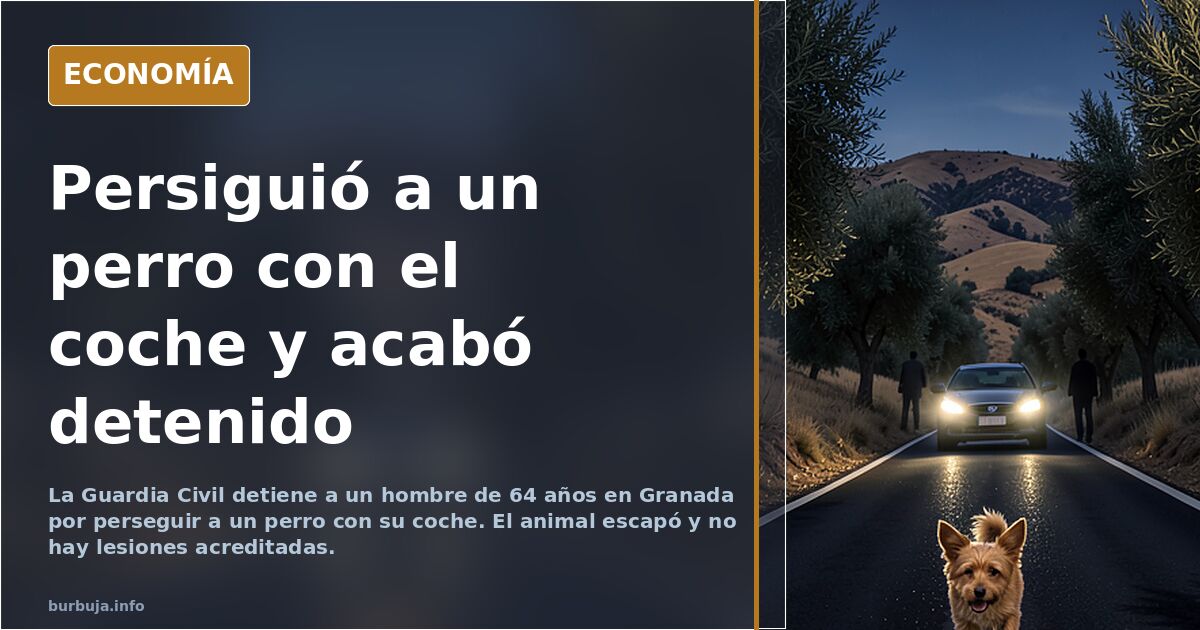
Arrested in Granada for chasing a dog with his car
A 64-year-old man was identified by the Guardia Civil (Spain's civil guard police force) as the suspected perpetrator of an animal cruelty offence. The reason: he had chased a dog with his vehicle across a rural property in the Granada metropolitan area. According to the force, the events date back to mid-September, although the investigation began after officers received a complaint with footage of what peine. The video shows the animal running across open ground while the car trinc behind, correcting its course each time the dog changes direction to escape.
The paradox lies in the outcome. The dog managed to flee. Neither the animal nor any carcass or injured specimen was found in the area, so no injuries could be established. Even so, the driver's behaviour was enough to open proceedings for animal cruelty. And that's where the trouble starts: can intent be punished without proven harm?
What being arrested actually means in this case
It's worth toning down the word arrest. In practice, the driver was brought before a judge: the Guardia Civil took his details, peine proceedings for a suspected offence against animals, and the case went to the on-duty court in Granada. He was released on charges and slept at home. No custody, no precautionary measures. It's the usual script in this kind of investigation, even if the official account sounds more forceful than it actually is.
The animal, according to the Benemérita (as the Guardia Civil is popularly known), was feral and could not be located afterwards. That detail matters: with no dog, no injuries and no carcass, the accusation rests on the driver's conduct and the footage, not on any harmful outcome.
The video as evidence and the debate over punishment without harm
The footage released by the Guardia Civil shows the dog changing direction to avoid the car, and the vehicle adjusting its course to trinc it. That pattern —correcting the trajectory rather than holding it— is what turns an accident or an anecdote into an animal cruelty investigation. Some argue that deliberate chasing is already cruelty even if the animal escapes; against that weighs the argument that without a proven injury, the incivil reproach is on shaky ground.
The discussion quickly splits. One camp holds that chasing an animal to exhaustion for fun deserves censure even without bloodshed; another considers it disproportionate to deploy the Guardia Civil over an episode with no verifiable victim. And a third, more uncomfortable one, points to the asymmetry of resources: how effective the same institution that fast-tracks this case is on matters of greater gravity is left to everyone's judgement.
The shadow of hunting: training or cruelty?
In the background, the hunting world appears. Some voices in the debate claim that chasing greyhounds with a vehicle is a widespread training practice before hare season, with the car acting as a mechanical hare. If that were true, the case would not be about a psychopath on the loose but a normalised routine. The Guardia Civil has not linked the events to any hunting party or hunting activity; it speaks of a feral animal and a private complaint.
What remains, as of this discussion, is a suspect, a missing dog and an uncomfortable video. No trial, no conviction and no proven injuries. The question is not whether the driver is a sadist —the court will decide that— but how much of our relationship with animals fits into a Penal Code that requires harm to punish cruelty.
Summary of a discussion on Burbuja.info - Foro de economía, actualidad y política., translated from Spanish and reviewed before publication. Read the full discussion (46 replies).
More summaries
-
Guardia Civil agent collapses at protest, reignites fitness debate
A Guardia Civil agent collapses during a protest in Granada, sparking calls for mandatory physical fitness tests for all officers.
-
Guardia Civil commander allegedly opened the Ceuta border fence in Spain
A commander of the Guardia Civil in Ceuta allegedly opened the border fence to let migrants through, according to the accusation. The case raises questions about superior orders and accountability.
-
Pirated Football Stream Ad Threatens Barcelona, Paris, and Amsterdam
A pirated stream ad threatens Barcelona, Paris, and Amsterdam. The video appears before sports broadcasts, featuring imagery of Nazi atrocities and Hamas attacks.
-
Alvise's party triples its electoral endorsements across Spain
Alvise Pérez's party claims to have tripled its electoral endorsements across Spain and is asking for help to continue. We explain what these endorsements are and why they matter.
-
Spain: Barcelona residents born in Spain now a minority under 45
According to ABC, immigrants and their children are now the majority in Barcelona under 45; between 25 and 44, those born in Spain are a minority. The figure that…
-
Alvise is the ONLY one denouncing the Moroccan agitator from Ceuta who works for the PSOE
Alvise Pérez posts a video on X of a scuffle with the PSOE's number one candidate for Congress in Ceuta. The National Police subdue him. What is known and what is not.