
Gaza Flotilla Activist Faces Scrutiny Over Luxury Luggage and Airbnb Income
Social media highlights luxury luggage and tourist rentals owned by a Gaza flotilla activist, contrasting with her housing advocacy.
English · Original discussion in Spanish · Published
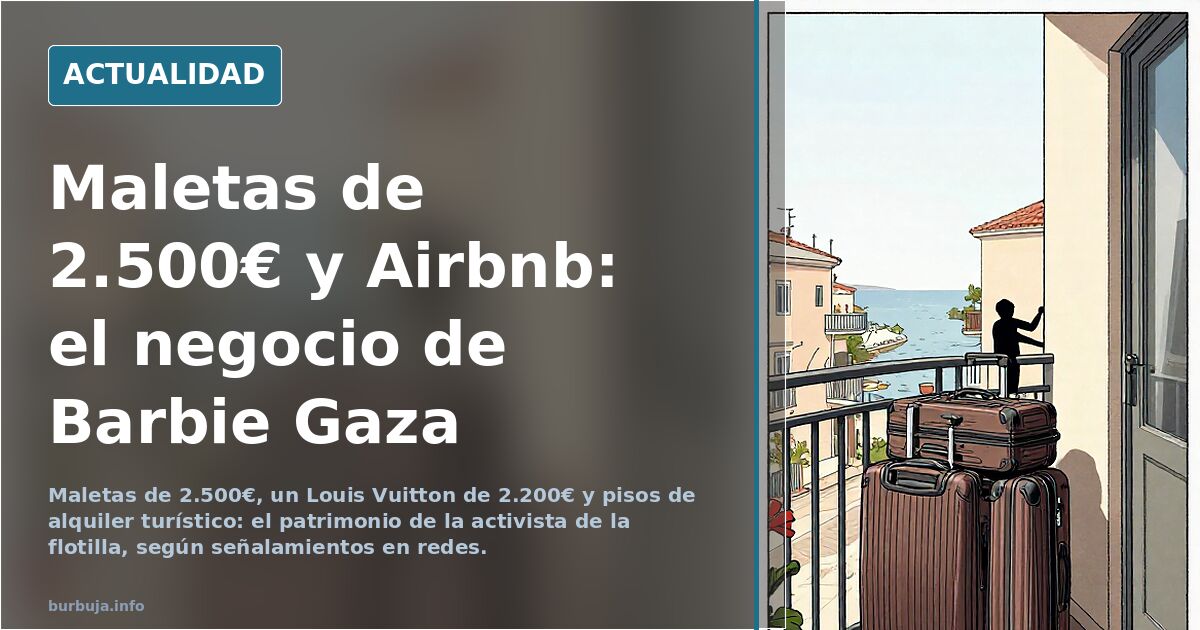
"Barbie Gaza": Luxury Luggage and Tourist Rentals While Advocating for Housing
How is an activist who spends weeks on a ship without a set arrival date funded? The narrative circulating online rests on three pillars: a wealthy family, a short-term rental business, and Ibiza airport. The activist known as "Barbie Gaza" has shifted from being the face of the Gaza solidarity flotilla to becoming the subject of numerous allegations regarding her assets. The latest trigger: images at Ibiza airport showing suitcases valued between €2,500 and €3,500 each, and a Louis Vuitton handbag worth approximately €2,200–€2,500, according to a breakdown attributed to image analysis tools. The contrast between this luggage and the discourse of solidarity with the Palestinian cause fueled the controversy.
What is Known About the Flotilla Activist's Assets
The most repeated detail concerns real estate. The activist and her partner, a local police officer stationed in Ceuta, allegedly own properties dedicated to short-term tourist rentals. This is not a minor point: criticizing the housing crisis while profiting from daily rentals exposes one to obvious contradictions. Some summarize it with a viral phrase: "Do as I say, not as I do."
The second pillar is familial. An old interview with the activist herself, resurfaced in discussions, places her origins in humble circumstances: parents from deep rural Andalusia, a father who started working on ships at eleven and later in agriculture, stating "we were very poor." This narrative clashes directly with the image of luxury luggage. Some claim the family had money; she said otherwise. These two versions cannot coexist in the same paragraph.
The third pillar is the most uncomfortable: suspicion that the real estate business serves for money laundering. In border cities like Ceuta, it is argued, property is the usual vehicle for opaque funds. This is an accusation without any proof in available material and must be treated as such: as suspicion, not fact.
How Much Was the Luggage Worth in Ibiza?
The circulating breakdown is striking for its specificity. The suitcases are identified as Gucci Ophidia GG trolleys, priced between €2,500 and €3,500 each. The bag is a Louis Vuitton Keepall, around €2,200–€2,500. The sneakers are Adidas Yeezy Boost 350 V2 Citrin, with a retail price of €220 and resale values between €180 and €200. Adding up only the visible luggage, the total comfortably exceeds the minimum wage of any collective agreement.
Many ask where this money comes from. The most common answer is not drug trafficking or an international scheme: it is short-term rentals. A flat in a high-demand city, rented by the day during peak season, generates income that does not appear on any payslip. Combined with long sea voyages, the resulting profile is that of someone with time and capital, not a precarious worker.
The Ceuta Police Officer and the Short-Term Rental Business
The activist's partner is a local police officer in Ceuta. This fact, linked to the tourist rental business, has fueled all kinds of theories. The most extreme claims suggest that in border cities, security forces are involved in drug trafficking. This is an unsubstantiated generalization that should remain where it belongs: in the realm of suspicion, not fact.
What is verifiable is the discomfort generated by this profile. A public official with significant real estate assets and a partner engaged in international activism is not exactly the portrait of the average civil servant. And when that activism is partly funded by public cooperation money, the question becomes inevitable.
The Flotilla, Activism, and Public Funds
The Gaza solidarity flotilla has been for years a showcase for activists of very different backgrounds. The most repeated criticism is not against the cause, but against the method: weeks of sailing without an arrival date, with photogenic stops and a media return that many interpret as a personal image operation. "Who can afford to leave their job to go on Mediterranean adventures?" asks the discussion. The answer, they point out, is rarely the working class.
The underlying argument is more serious than it seems. If activism professionalizes and becomes a source of income—via grants, NGOs, donations, or simple fame—it ceases to be activism and becomes a business model. And business models, like tourist flats, are judged by their profit and loss accounts.
In the end, the question is not whether the activist has the right to carry expensive luggage. The question is whether she can continue giving lessons on housing while renting hers out by the day. With these elements, the basket stands on its own.
How is an activist who spends weeks on a ship without a set arrival date funded? The narrative circulating online rests on three pillars: a wealthy family, a short-term rental business, and Ibiza airport. The activist known as "Barbie Gaza" has shifted from being the face of the Gaza solidarity flotilla to becoming the subject of numerous allegations regarding her assets. The latest trigger: images at Ibiza airport showing suitcases valued between €2,500 and €3,500 each, and a Louis Vuitton handbag worth approximately €2,200–€2,500, according to a breakdown attributed to image analysis tools. The contrast between this luggage and the discourse of solidarity with the Palestinian cause fueled the controversy.
What is Known About the Flotilla Activist's Assets
The most repeated detail concerns real estate. The activist and her partner, a local police officer stationed in Ceuta, allegedly own properties dedicated to short-term tourist rentals. This is not a minor point: criticizing the housing crisis while profiting from daily rentals exposes one to obvious contradictions. Some summarize it with a viral phrase: "Do as I say, not as I do."
The second pillar is familial. An old interview with the activist herself, resurfaced in discussions, places her origins in humble circumstances: parents from deep rural Andalusia, a father who started working on ships at eleven and later in agriculture, stating "we were very poor." This narrative clashes directly with the image of luxury luggage. Some claim the family had money; she said otherwise. These two versions cannot coexist in the same paragraph.
The third pillar is the most uncomfortable: suspicion that the real estate business serves for money laundering. In border cities like Ceuta, it is argued, property is the usual vehicle for opaque funds. This is an accusation without any proof in available material and must be treated as such: as suspicion, not fact.
How Much Was the Luggage Worth in Ibiza?
The circulating breakdown is striking for its specificity. The suitcases are identified as Gucci Ophidia GG trolleys, priced between €2,500 and €3,500 each. The bag is a Louis Vuitton Keepall, around €2,200–€2,500. The sneakers are Adidas Yeezy Boost 350 V2 Citrin, with a retail price of €220 and resale values between €180 and €200. Adding up only the visible luggage, the total comfortably exceeds the minimum wage of any collective agreement.
Many ask where this money comes from. The most common answer is not drug trafficking or an international scheme: it is short-term rentals. A flat in a high-demand city, rented by the day during peak season, generates income that does not appear on any payslip. Combined with long sea voyages, the resulting profile is that of someone with time and capital, not a precarious worker.
The Ceuta Police Officer and the Short-Term Rental Business
The activist's partner is a local police officer in Ceuta. This fact, linked to the tourist rental business, has fueled all kinds of theories. The most extreme claims suggest that in border cities, security forces are involved in drug trafficking. This is an unsubstantiated generalization that should remain where it belongs: in the realm of suspicion, not fact.
What is verifiable is the discomfort generated by this profile. A public official with significant real estate assets and a partner engaged in international activism is not exactly the portrait of the average civil servant. And when that activism is partly funded by public cooperation money, the question becomes inevitable.
The Flotilla, Activism, and Public Funds
The Gaza solidarity flotilla has been for years a showcase for activists of very different backgrounds. The most repeated criticism is not against the cause, but against the method: weeks of sailing without an arrival date, with photogenic stops and a media return that many interpret as a personal image operation. "Who can afford to leave their job to go on Mediterranean adventures?" asks the discussion. The answer, they point out, is rarely the working class.
The underlying argument is more serious than it seems. If activism professionalizes and becomes a source of income—via grants, NGOs, donations, or simple fame—it ceases to be activism and becomes a business model. And business models, like tourist flats, are judged by their profit and loss accounts.
In the end, the question is not whether the activist has the right to carry expensive luggage. The question is whether she can continue giving lessons on housing while renting hers out by the day. With these elements, the basket stands on its own.
Also available in: Deutsch
Summary of a discussion on Burbuja.info - Foro de economía, actualidad y política., translated from Spanish and reviewed before publication. Read the full discussion (57 replies).
More summaries
-
Police seize Hanan Alcalde's phone in Ceuta; prosecutors review data
Spanish police seized Hanan Alcalde's phone in Ceuta; prosecutors will review how she handled data on minors.
-
Sol Bells Ring Every 15 Minutes During Madrid Protest Camp
Debate erupts in Madrid over whether the Puerta del Sol clock chimes every quarter-hour during a protest camp, or if it is a routine sound people only now notice.
-
Pig Fury Operation: Coordinated Trolling Attack on Spanish Gossip Forum
Internet users plan a coordinated trolling attack on a Spanish gossip forum using fake profiles. Manual registration blocks the assault.
-
South Korea and Spain: Demographic Collapse Calculations
A debate uses South Korean (0.68) and Spanish (1.19) fertility rates to project population drops of 96% and 78.94% over three generations.
-
Spain: Key moments cited for anti-feminist backlash
The 2004 gender violence law, the 2010 World Cup summer, and the pandemic are the most frequently cited milestones marking the shift against feminism in Spain.
-
User Claims 6 Likes on Tinder Premium vs 1,000 Elsewhere
A user reports getting nearly 1,000 likes in a month on another app versus only 6 on paid Tinder Premium, blaming the algorithm.