
Gas water heater noise that pointed to limescale in the coil
A user reports that his Cointra water heater started making noise after he cleaned the filters: he traced it to a limescale plug in the coil and dissolved it with muriatic acid.
English · Original discussion in Spanish · Published
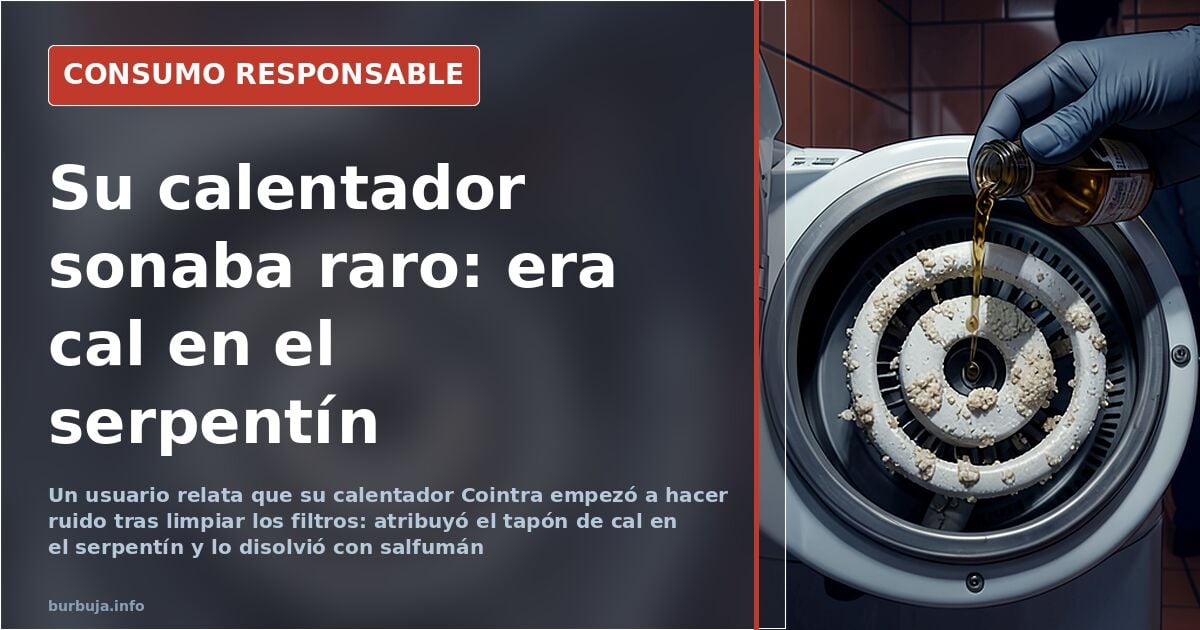
The heater noise that gave away limescale in the coil
Shut off the main valve, remove the shower tap, clean the filter and let the water run for a few seconds so the pipe would spit out the muck. Textbook maintenance, the kind done in any home on a Sunday. And from then on, the gas water heater started roaring. The case is described by the owner of an apartment with a Cointra Godesia located just over a metre from the nearest tap, on the same floor, who started the thread looking for someone who had been through the same thing.
The symptoms, clearly defined: the noise appears with hot water at any point in the house, whether the burner is on or off, always above a certain flow rate. It is not gradual — either silence or a racket — it takes three or four seconds to kick in, and it does not change when the flow regulator wheel is turned. That last detail rules out half the armchair diagnoses: if it were the burner or the combustion, changing the flow would alter it.
What lies behind a noise that only appears with hot water
The first hunch going around pointed to air in the circuit: a trapped bubble that vibrates as the water passes and that can be purged by opening a small valve at the top of the unit, after removing the casing. It fits the story — the system was handled, air got in — but it falls short when the flow rate drops steadily.
The second, more prosaic theory pointed to a heat exchanger clogged with limescale. A part that, according to one user, costs around 200 euros and that in a five-litre open-flue water heater accumulates years of scale. The outcome proved this line right: when the coil inlet was disconnected, it turned out the water was arriving with far more flow than was leaving the unit. The plug was inside.
Muriatic acid, an accepted risk and an ending without a technician
The fix was not signed off by an official service. The owner, with bad past experiences — a hundred euros for a diagnosis and an invitation to buy another unit — dismantled the heater and poured a diluted muriatic acid solution into the coil to dissolve the limescale. It worked: the unit performed like on day one. It should be said clearly: tampering with a gas appliance and handling acid without training is reckless, no matter how well it turned out in this case.
The story has an epilogue that borders on the absurd. Another affected user, with no hot water and strange noises after a bathroom renovation, discovered that the workman had connected a cold-water hose to the hot water line. A short circuit of circuits. The heater had nothing wrong with it; the installation had everything.
Servicing, warranty and the underlying debate
Underneath it all remains the uncomfortable question: how much of these troubles is maintenance, and how much is a stock of old heaters that nobody checks? The periodic gas inspection is, in practice, limited to checking that combustion does not produce carbon monoxide; it does not diagnose a clogged coil. And users only call when the tap stops delivering water.
The full calculation of what a technician costs versus a new unit, fine print included, is another matter entirely. What was proven here is that the ear, sometimes, detects what the bill does not yet show.
Summary of a discussion on Burbuja.info - Foro de economía, actualidad y política., translated from Spanish and reviewed before publication. Read the full discussion (13 replies).
More summaries
-
Butane, natural gas or electric: the real cost of hot water
A user calculates that natural gas turns 10 euros of actual consumption into a 55-euro bill due to fixed charges and inspections. Butane wins on cost; electric is…
-
Ariston water heater: 5-second delay means cold water in the shower
A user reports that his Ariston gas water heater takes 5 seconds to light and delivers cold water when the tap is reopened; customer service changed their story…
-
The sealed gas water heater that roars when the wind blows
A sealed gas water heater roars and vibrates when the hot tap is opened on windy days. The cause points to the flue gas fan, not a leak.
-
Wallapop requires power of attorney to Mangopay to use its wallet
Wallapop requires granting Mangopay power of attorney and renewing every 180 days to move wallet money. No signing all four conditions, no payout.
-
Charging batteries at night to use power by day: the numbers don't add up
A calculation using bargain-priced batteries and chargers plus DIY installation gave 18 cents per stored kWh, more than the peak rate. The sums just don't work.
-
BMW under scrutiny: PCV valve, water pump and unmaintained ZF gearboxes
The PCV valve can melt the engine, the water pump fails without warning, and BMW declares the ZF gearbox maintenance-free even though ZF recommends changing it every 60,000 km.