
BMW under scrutiny: PCV valve, water pump and unmaintained ZF gearboxes
The PCV valve can melt the engine, the water pump fails without warning, and BMW declares the ZF gearbox maintenance-free even though ZF recommends changing it every 60,000 km.
English · Original discussion in Spanish · Published
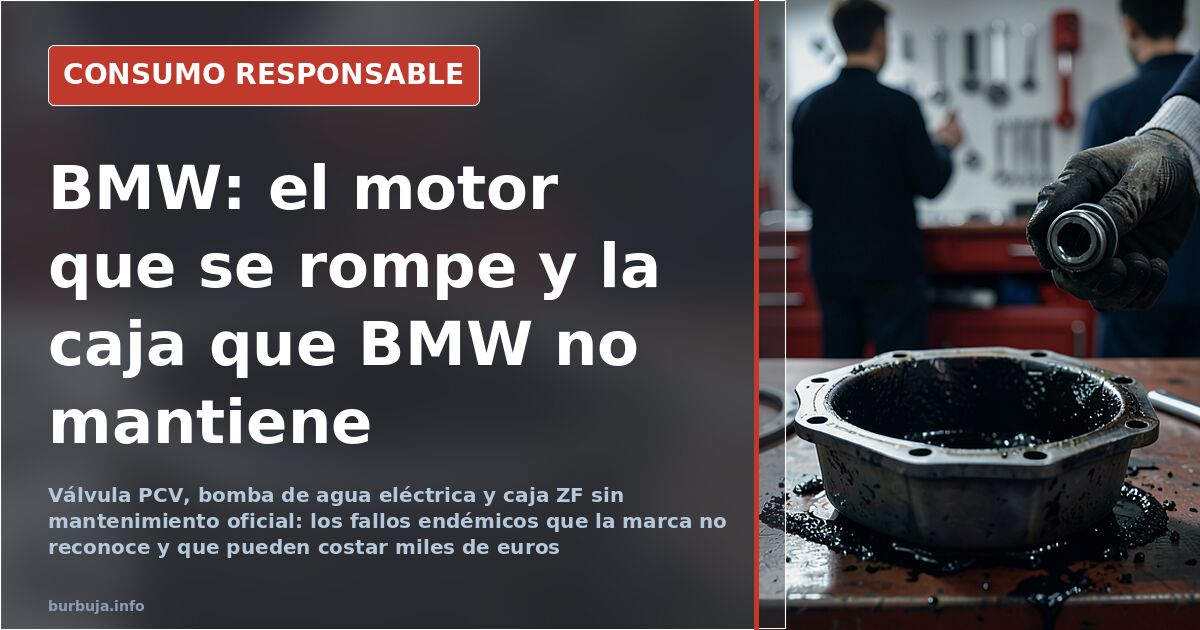
BMW under scrutiny: the valve that melts engines and the gearbox nobody changes
A four-cylinder engine that can die because of a rubber membrane worth a few euros. An electric water pump that stops working without warning. And an automatic gearbox the manufacturer sells as maintenance-free while the supplier itself recommends changing the oil every 60,000-80,000 kilometres. That is the picture that emerges when analysing the reliability of BMW's current lineup, a brand that for decades sold German engineering as a byword for solidity and that now faces mounting suspicion over its four- and six-cylinder inline engines, the only ones it has left after the disappearance of diesel in models like the new 3 Series.
The starting thesis is harsh: no current model from the brand is worth buying, according to one participant in the debate. Electric and plug-in hybrid models are, in the words doing the rounds, outrageously expensive contraptions that will end up in the scrapyard within a few years with zero value. The V8s have carried three generations of constant breakdowns. And the three-cylinder engines in the 1 and 2 Series, at prices around 50,000 euros, are simply not competitive in terms of cost versus product.
The PCV valve: the failure that can cost you the engine
The most frequently cited problem has a technical name: the PCV valve (Positive Crankcase Ventilation). In the N20 engine family (2011-2017) and in the current B46 and B48 engines, this valve uses a rubber diaphragm that degrades under extreme heat cycles until it breaks. The design integrates it into the plastic valve cover, so official replacement is not cheap. The consequence is not an annoying warning light: we are talking about losing the entire engine.
On top of that comes the water pump. Current four-cylinder engines use an electrically driven pump instead of the traditional mechanical one. Its failure gives no warning through leaks or bearing noises: it stops working suddenly and silently. Its estimated lifespan is around 80,000 kilometres, according to workshop data.
There is partial comfort. The fuel pump, the drama of previous generations, seems to be solved: the B48 and B46 show no massive design flaws in that component, although the low- and high-pressure pumps remain wear items in any direct injection system.
The ZF gearbox: the maintenance BMW doesn't want you to pay for
The third front is the transmission. BMW fits ZF automatic gearboxes, which are good. The problem is what is done with them. ZF recommends changing the oil every 60,000-80,000 kilometres; BMW declares it maintenance-free and thereby lowers the official costs for the new-car buyer. The fine print: if the gearbox starts to jerk beyond 150,000 kilometres, the repair can run to around 6,000 euros.
One owner's calculation is rather amusing. Changing the oil at the dealership can cost around 700 euros and, according to the accounts shared, you leave with the same oil you came in with. The alternative is a alucinación to Zaragoza to have it done by the specialist himself for around 300 euros. A saving that justifies the alucinación, but one that exposes the brand's maintenance policy.
The context: diesel in retreat and electrification at a premium
The picture is completed by the rest of the range. Diesel is disappearing: the new 3 Series is no longer offered with that fuel, and the trend is spreading as models are renewed. The V8s have gone through three generations, the first ruinous and the second somewhat less so, with the third improved but still prone to frequent breakdowns. And mild electrification (MHEV) adds a new chapter: replacing a lithium battery that barely saves fuel can cost 3,000 euros, especially if it is not integrated into the inverter as in some Mercedes models.
The conversation drifts towards the rest of the industry. Mercedes no longer wants to build engines: its four-cylinder carries an endemic 6,000-euro fault that is not recognised as a design flaw in Europe, although it is in the United States, and the brand's latest engine came from Aurobay. The VAG group, which bet everything on electric, only offers rehashes: the Golf, on its platform, is now 13 years old.
Is buying a BMW worth it today?
The answer that emerges from the analysis is no, with very few exceptions. The inline six shares its modular architecture with the four, so it inherits the same ills. Anyone looking for long-term reliability faces a landscape where official maintenance does not cover what the component supplier recommends, and where a low-cost rubber part can condemn an entire engine.
The classics offer some comfort. A 1999 320d is still running, and the E46 and E30 models of another era are appreciating while the new models depreciate at the estimulante ilegal of a second-hand electric car. Given all this, the question is how long it will take the market to adjust the prices of a brand that lives off a fruta it no longer builds.
Also available in: Deutsch
Summary of a discussion on Burbuja.info - Foro de economía, actualidad y política., translated from Spanish and reviewed before publication. Read the full discussion (87 replies).
More summaries
-
Used Volvo V70: affordable maintenance or a €700 trap?
A prospective buyer compares the V70 with his R21. Prices have dropped to €2,000, but fear of costly repairs is holding many back. Is it worth it?
-
Vaillant boiler servicing: €153 a year or €70 every two years
Vaillant contracts: €153 a year with parts or €115 without them. The mandatory inspection every two years costs €70. Is it worth it from year one?
-
Mercedes S600 V12 for €5,900: The Real Cost of Flash
A forum user considers buying a Mercedes S600 V12 for €5,900. The debate highlights maintenance, parts scarcity, and import costs from Germany.
-
Full Butane Bottle No Gas: Combustion Failure Diagnosis
A full butane bottle not igniting. Technical analysis of the fault between gas pressure and the stove.
-
Charging batteries at night to use power by day: the numbers don't add up
A calculation using bargain-priced batteries and chargers plus DIY installation gave 18 cents per stored kWh, more than the peak rate. The sums just don't work.
-
Gas water heater noise that pointed to limescale in the coil
A user reports that his Cointra water heater started making noise after he cleaned the filters: he traced it to a limescale plug in the coil and dissolved it with muriatic acid.