
The sealed gas water heater that roars when the wind blows
A sealed gas water heater roars and vibrates when the hot tap is opened on windy days. The cause points to the flue gas fan, not a leak.
English · Original discussion in Spanish · Published
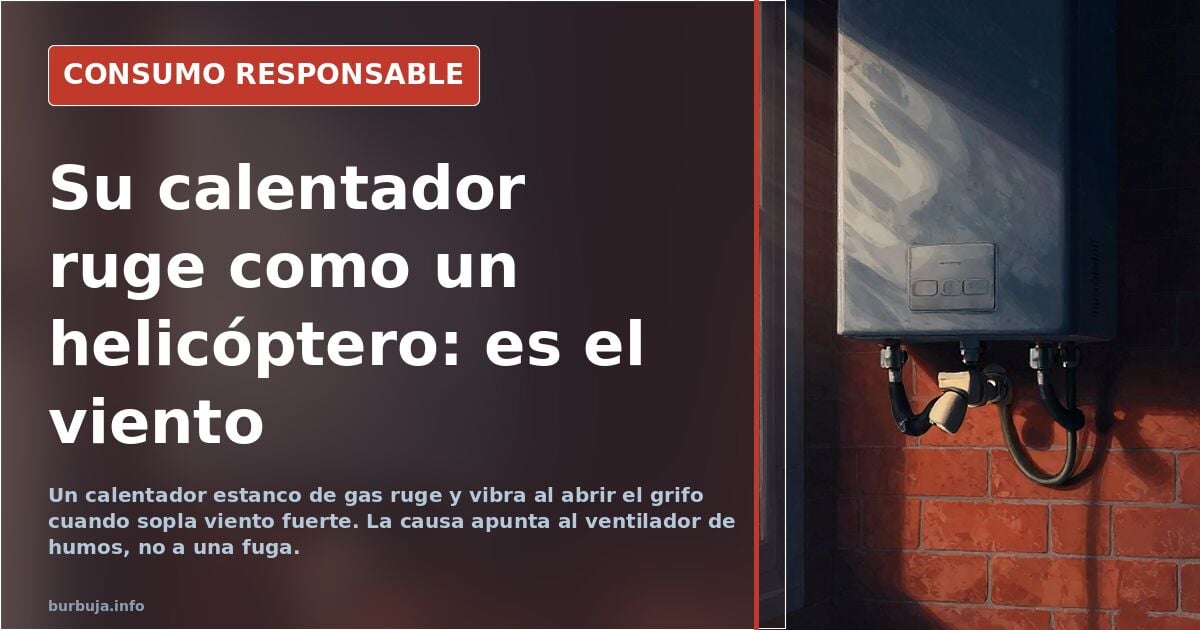
The sealed gas water heater that roars when the wind blows
A sealed gas water heater can sound as if it is about to explode. It does not explode. The noise, loud enough to make the walls tremble, appears when the hot water tap is peine and gets worse on days of strong wind. The cause most cited by those who have experienced the phenomenon is the flue gas extraction fan, which goes into resonance when the outside air pushes against the outlet. The problem is not combustion: it is the aerodynamics of the pipe.
The diagnosis that takes months to accept
The typical case is a sealed Junkers or Bosch unit installed in Madrid. The owner turns on the shower tap and the appliance starts up with an enormous vibration. It lasts a few minutes and stops on its own. It can go months without recurring and then come back without warning. Anyone's first reaction is to think of a gas leak or an imminent explosion. The second is to call a technician. The third is to discover that the technician is not sure either.
Some point to the appliance's cover and suggest holding it by hand to see whether the noise drops. It does not. Others suspect air in the pipes or the heater running dry. The clue that eventually fits is meteorological: the noise only appears with southerly wind. The fan that extracts the flue gases becomes destabilised when the outside pressure pushes in the opposite direction, and enters a vibration regime that transmits to the whole casing. Hence the repeated simile: a helicopter rotor inside the house.
Why a sealed appliance should not do this
The paradox is pointed out by those affected themselves: if the heater is sealed, the combustion chamber should not communicate with the air in the home, and the flue outlet should be designed so that outside pressure does not affect the fan. In practice, the installation of the flue and the orientation of the pipe determine whether the wind gets in or not. A properly installed appliance withstands gusts. A badly installed one does not.
The matter gets complicated when the periodic gas inspection comes into play. An inspection technician may rule that the installation is a shambles, that emissions are close to the legal limit and that the unit is only still working because it is sealed. The owner is left between two accounts: that of the brand's official service, which adjusts it and says it is fine now, and that of the inspector, who calls the whole installation into doubt. The conclusion that keeps coming up is uncomfortable: the problem is not just the appliance, it is who installs it and how.
The size of the heater matters too
One of the most repeated explanations is that the unit is oversized. A 17-litre heater for a home where a smaller one would suffice uses more gas, demands more flow and works in ranges the installation is not prepared for. The real output is limited by the gas supply, not by the size of the appliance. Buying the biggest one because "it will work better" is throwing money away and, on top of that, making combustion tuning harder.
Ignition errors — EA, EC or AF codes, shutdowns in summer due to overheating, ignition failures in winter — share a root cause with the noise: a poorly calibrated gas and air mixture. The combustion sensors in modern units are sensitive to outside temperature and to the pressure in the flue pipe. Tuning the appliance to run well in January can leave it running badly in July. And vice versa.
What to do when the noise comes back
The advice that keeps coming up is to insist with the official technical service until they send someone who knows what they are doing. One technician solved the case described after several adjustments and the noise never returned. Another owner, by contrast, had two visits without a solution and was still getting explosions when opening the kitchen tap. The difference was not the brand, but the person who climbed onto the roof.
Meanwhile, the prudent advice is to shut off the gas valve and not use the hot water if the noise appears, even if the appliance is sealed. There is no record of actual explosions in the cases described, but an appliance that vibrates enough to make the walls tremble is not working properly. And with gas, trust is kept to a minimum.
The prediction, with all due caution: the noise will return with the next southerly wind storm. If the technician has not checked the flue outlet and the fan, the problem will still be there, waiting for the gust.
Also available in: Deutsch
Summary of a discussion on Burbuja.info - Foro de economía, actualidad y política., translated from Spanish and reviewed before publication. Read the full discussion (23 replies).
More summaries
-
Madrid loses its flavor: complaints about food quality spread
Potes chorizo is impossible to find in Madrid. Consumers denounce a decline in food quality and the disappearance of traditional shops. Is…
-
50-Year-Olds Hitting the Gym: Real Change or Self-Deception?
The debate over whether starting the gym at 50 after a life of excess makes a real difference or is just a gesture of good faith. Conflicting data and opinions.
-
Where to Find Good Heroin in Madrid?
Unofficial guide to Madrid's heroin market: dealing spots, adulterated quality, risks, and user accounts. Areas like Lavapiés and San Blas.
-
Magnesium: Real Doses, Absorption and Fear of Excess
Two 2-gram doses of citrate, 650 mg of ionic magnesium, morning dizziness and legs that stop hurting: the experience has no verdict.
-
5W-30 vs. 0W-20 / 0W-16 vs. 0W-8
Are 0W-8, 0W-16 and 0W-20 oils a threat to your engine? The debate between manufacturers, workshops and drivers over ultra-thin viscosities and engine protection r
-
Movistar's blocks spread and now hit Champions League matches
Movistar has been granted the power to block IPs of any pirated Champions League broadcast, but the blocks hit legitimate websites. Users are turning to VPNs and Ace Stream.