
Garamendi Proposes Paying Gross Salaries and Settling Taxes Directly
Antonio Garamendi suggests workers receive full gross pay and handle their own tax payments, reigniting fiscal debate in Spain.
English · Original discussion in Spanish · Published
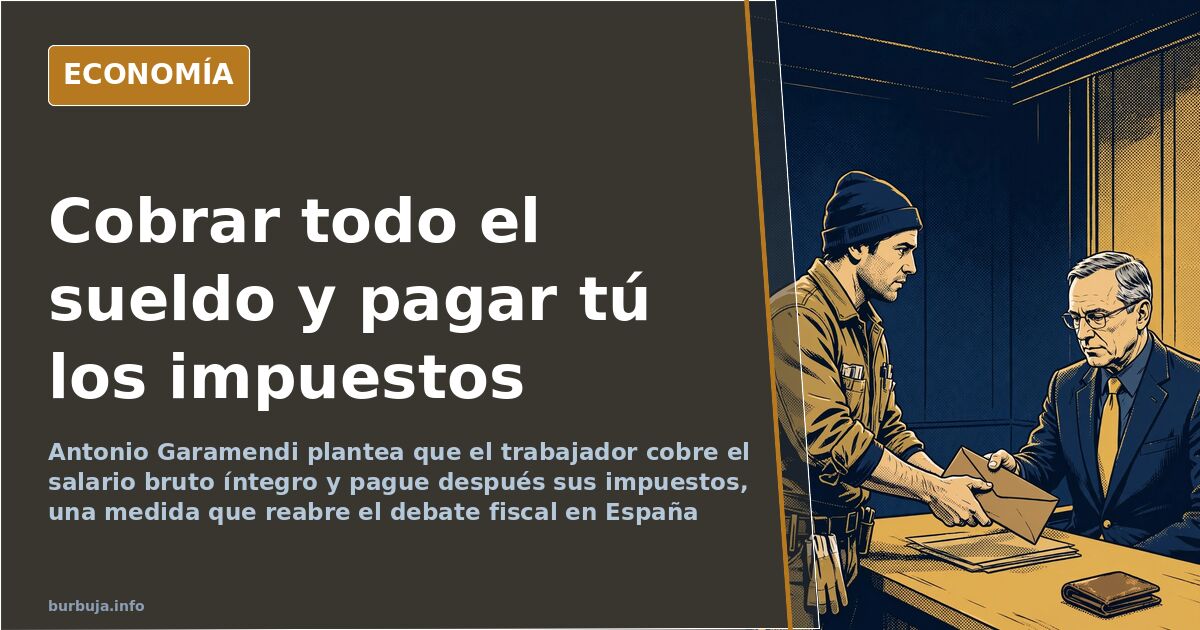
Garamendi proposes paying the full salary and settling taxes
The salary shown on a payslip is not the actual take-home pay. It is what remains after the employer, acting on behalf of the State, has deducted a portion. The proposal attributed to the CEOE (Spanish Confederation of Business Organizations) president, Antonio Garamendi, reverses this order: workers would receive the full gross amount and then settle their own taxes and social security contributions. On the surface, it is a change of forms. In practice, it shakes up how the taxpayer perceives the cost of the State. The starting point is an assertion that some consider obvious and others false: that the amount listed as the employer's contribution is not borne by the company, but by the worker themselves, deducted from their added value.
What Garamendi Proposes and Why the Business Confederation Supports It
The mechanism is easy to state but complicated to execute. Instead of the company acting as a delegated tax collector—deducting IRPF (Personal Income Tax) withholding and the worker's social security share at source—the employee would receive 100% of their labor cost and then settle with the tax authority (Hacienda) and Social Security. Those defending the idea argue that this would force a transparency that currently does not exist: each worker would see the money they hand over to the tax authority pass through their account, not just the part that remains.
The business confederation supports the argument with its underlying message: "Rather than proposing to work less to live better, it is necessary to foster a Culture of Effort." The proposal quickly enters public discourse because it touches on a specific issue: the worker does not sign any receipt for the State, but they do sign a payslip every month.
Why Workers Do Not Understand Their Payslips
Because the system is designed so that there is no need to understand it. The payslip has long included the employer's social security contribution, in addition to IRPF withholding and the worker's share. Everything is there, in a document that many sign without reading and that most could not break down. The nuance matters: information is not missing, familiarity with checking it is.
The same logic has been proposed for VAT, with tax-exclusive prices on shelves and a separate charge at payment, similar to what happens in the United States, where the final figure appears at the register, not on the label. In Spain, almost no one subtracts.
Number of Workers and Tax Returns in Spain
According to the data circulating in the thread, Spain has around 48 million inhabitants and about 21 million workers. Income tax returns filed number around 22 million: 20,363,904, 92.4% of the estimated total, which would bring the entire universe to 22,038,857, according to a forum user's calculation. The arithmetic leaves an uncomfortable detail for the usual narrative: there are more returns than workers with payslips, because labor income is joined by capital income and that of those who do not receive a payslip.
Any reform that moves millions of individual settlements touches these numbers. And it touches them at a time when the saving and planning capacity of the average taxpayer is, at best, questionable.
The Incentive That Would Be Broken: Subsidies and Deductions
The least discussed flank is that of hiring incentives. If workers pay their own social security contributions, bonuses and subsidies linked to the employer's social security quota for hiring specific groups—young people, women, people with disabilities—lose a clear recipient. Some argue that these deductions end up being a business for the employer rather than a real advantage for the employee; conversely, it is warned that removing them would make hiring those who have the hardest time more expensive.
This is no minor detail. The real cost of a position is not what the employee earns, but what the company pays, and in that differential lies much of employment policy.
Where Does the Money Deducted from the Payslip Go?
Most of the revenue collected from social security contributions has almost a single destination: pensions. This is the expenditure that no reform dares to touch, which is why the discussion about payslips always ends up hitting the same wall. In episodes of crisis, the chosen formula was different: to break down the real cost of each service so that citizens could see the bill, as was done, according to the thread, when detailing the cost of an operation in public healthcare.
There is also a psychological layer that should not be ignored. As one participant states, the tax collector has been the historical villain of the function, the bad guy in the movie. This role is currently assumed, in practice, by the company, which applies withholding without gaining anything from it. And anger is directed at who signs the paper, not at who takes the money.
Putting the figure in front of the eyes does not change the numbers. It changes who is blamed for them. Would the anger still point to the company, that convenient collector, or would the taxpayer start making calculations with who signs the budget each year?
The salary shown on a payslip is not the actual take-home pay. It is what remains after the employer, acting on behalf of the State, has deducted a portion. The proposal attributed to the CEOE (Spanish Confederation of Business Organizations) president, Antonio Garamendi, reverses this order: workers would receive the full gross amount and then settle their own taxes and social security contributions. On the surface, it is a change of forms. In practice, it shakes up how the taxpayer perceives the cost of the State. The starting point is an assertion that some consider obvious and others false: that the amount listed as the employer's contribution is not borne by the company, but by the worker themselves, deducted from their added value.
What Garamendi Proposes and Why the Business Confederation Supports It
The mechanism is easy to state but complicated to execute. Instead of the company acting as a delegated tax collector—deducting IRPF (Personal Income Tax) withholding and the worker's social security share at source—the employee would receive 100% of their labor cost and then settle with the tax authority (Hacienda) and Social Security. Those defending the idea argue that this would force a transparency that currently does not exist: each worker would see the money they hand over to the tax authority pass through their account, not just the part that remains.
The business confederation supports the argument with its underlying message: "Rather than proposing to work less to live better, it is necessary to foster a Culture of Effort." The proposal quickly enters public discourse because it touches on a specific issue: the worker does not sign any receipt for the State, but they do sign a payslip every month.
Why Workers Do Not Understand Their Payslips
Because the system is designed so that there is no need to understand it. The payslip has long included the employer's social security contribution, in addition to IRPF withholding and the worker's share. Everything is there, in a document that many sign without reading and that most could not break down. The nuance matters: information is not missing, familiarity with checking it is.
The same logic has been proposed for VAT, with tax-exclusive prices on shelves and a separate charge at payment, similar to what happens in the United States, where the final figure appears at the register, not on the label. In Spain, almost no one subtracts.
Number of Workers and Tax Returns in Spain
According to the data circulating in the thread, Spain has around 48 million inhabitants and about 21 million workers. Income tax returns filed number around 22 million: 20,363,904, 92.4% of the estimated total, which would bring the entire universe to 22,038,857, according to a forum user's calculation. The arithmetic leaves an uncomfortable detail for the usual narrative: there are more returns than workers with payslips, because labor income is joined by capital income and that of those who do not receive a payslip.
Any reform that moves millions of individual settlements touches these numbers. And it touches them at a time when the saving and planning capacity of the average taxpayer is, at best, questionable.
The Incentive That Would Be Broken: Subsidies and Deductions
The least discussed flank is that of hiring incentives. If workers pay their own social security contributions, bonuses and subsidies linked to the employer's social security quota for hiring specific groups—young people, women, people with disabilities—lose a clear recipient. Some argue that these deductions end up being a business for the employer rather than a real advantage for the employee; conversely, it is warned that removing them would make hiring those who have the hardest time more expensive.
This is no minor detail. The real cost of a position is not what the employee earns, but what the company pays, and in that differential lies much of employment policy.
Where Does the Money Deducted from the Payslip Go?
Most of the revenue collected from social security contributions has almost a single destination: pensions. This is the expenditure that no reform dares to touch, which is why the discussion about payslips always ends up hitting the same wall. In episodes of crisis, the chosen formula was different: to break down the real cost of each service so that citizens could see the bill, as was done, according to the thread, when detailing the cost of an operation in public healthcare.
There is also a psychological layer that should not be ignored. As one participant states, the tax collector has been the historical villain of the function, the bad guy in the movie. This role is currently assumed, in practice, by the company, which applies withholding without gaining anything from it. And anger is directed at who signs the paper, not at who takes the money.
Putting the figure in front of the eyes does not change the numbers. It changes who is blamed for them. Would the anger still point to the company, that convenient collector, or would the taxpayer start making calculations with who signs the budget each year?
Summary of a discussion on Burbuja.info - Foro de economía, actualidad y política., translated from Spanish and reviewed before publication. Read the full discussion (233 replies).
More summaries
-
De Prada’s Provocation: Elite Sport vs. Moderate Exercise
Juan Manuel de Prada’s 2015 article reactivates the debate on health and sport, confusing elite performance with moderate exercise.
-
Daniel Sancho appeals Thailand life sentence, citing accident
Daniel Sancho appeals his life sentence in Thailand for the death of Edwin Arrieta, while the victim’s family now demands the death penalty.
-
Begoña Gómez: Business Center Director at 21, Private University Graduate
Begoña Gómez is listed as director of the Atenea Business Center in 1996 at age 21, with a CV stating she graduated in 1995 from a private Spanish institution.
-
The Double Standard of Singlehood: Why Men Get Labeled, Women Do Not
An analysis of the double standard in single life: why men are labeled while women face no such stigma, despite similar data.
-
Alvise Blocks Public Funding for Bullfights, Citing Animal Morality
EU MP Alvise Perez rejects public subsidies for bullfighting, equating the practice with ritual animal slaughter and sparking political debate.
-
Overtourism in Museums: Phones Before Art
Crowded museums prioritize selfies and loud audioguides over the artwork, displacing visitors seeking a genuine cultural experience.