
Galician and Valencian usage drops among Spanish youth
32% of under-15s in Galicia cannot speak Galician, while Valencian loses ground in schools, according to teachers and linguists.
English · Original discussion in Spanish · Published
Galician and Valencian lose young speakers as Catalan retreats into the classroom
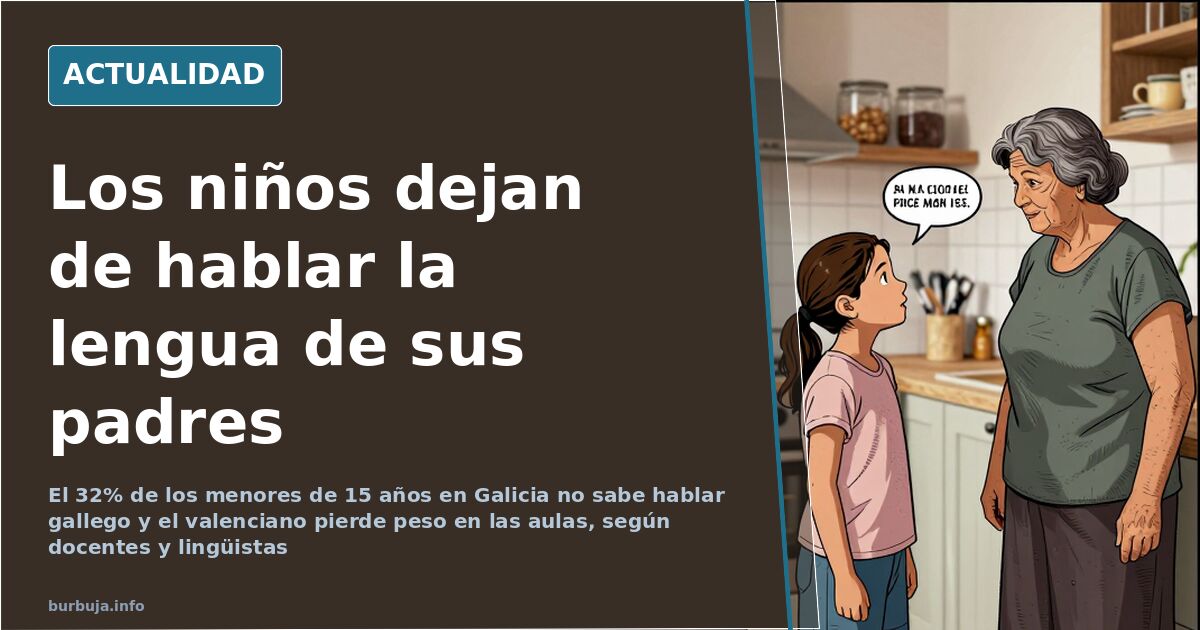
Somewhere in Galicia, a girl speaks Galician at home but will finish high school without mastering it. In the Valencian Community, another child will stop studying subjects in Valencian because most parents in their class voted for that outcome. These two scenes summarize the same phenomenon: intergenerational transmission of Spain's co-official languages is breaking down, and the education system—the tool used for decades to reverse their marginalization—is now the battlefield.
Data from linguists and teachers point to an extreme linguistic emergency, including protests, and a common pattern: more people claim to know the language, but fewer use it daily. The generational gap is the core issue.
Valencian becomes a family choice
The Education Freedom Law passed by the Generalitat led by Carlos Mazón shifts the decision on the base language of instruction to families. It removes the percentages set by the previous Multilingualism Law—25% in Valencian, 25% in Spanish, and a minimum of 15% in English—and also eliminates the possibility for schools to request more than 60% in Valencian. The official argument is freedom of choice; the result, according to the educational community and university linguistics departments, is the minimization of Valencian in classrooms.
Marcos Candela, coordinator of Union Action at STEPV (the main trade union for education workers in Valencia), points out a detail often overlooked: the C1 level of Valencian is no longer required for all teaching staff, only for primary and secondary education. Conservatories, official language schools, arts education, and vocational training are excluded. The consultation with families took place between February 25 and March 4.
Galicia: 32% of under-15s cannot speak it
In Galicia, the decline has a specific figure. 32% of children under 15 say they cannot speak Galician, compared to 24% just five years ago. Marcos Maceira, spokesperson for the Plataforma Queremos Galego (We Want Galician platform), adds an even more uncomfortable data point: over 70% of children who arrive at school speaking Galician leave without speaking it. The latest structural survey by the Galician Institute of Statistics confirms the drop in self-perceived competence across all age groups.
The 2010 Multilingualism Decree established a balance between Galician and Spanish at all levels except Early Childhood Education and peine the door to teaching up to one-third of hours in a foreign language. Language academics approved a report in December blaming the Xunta de Galicia (regional government) as the main responsible party for the disaster. The platform, which brings together 600 organizations, called for a demonstration in Santiago under the slogan Lingua vital xa! (Language is vital now!).
More Catalan known, less Catalan spoken
In Catalonia, the paradox is different and more subtle: the number of people who know and speak Catalan is growing, but it is losing ground as a habitual language. It is the most widely spoken co-official language in Spain, used by 13.6% of the population, trinc by Valencian (6.3%), Galician (5.7%), and Basque (2.7%), according to the INE (National Statistics Institute). The problem is not knowledge, but daily use.
Internet, rural areas, and demographics
Much of the analysis points to three forces that no decree can control. The first is audiovisual consumption: teenagers live on platforms where Spanish and English are the dominant languages, and content creators aim to reach the largest possible audience. The second is the death of the countryside: the exodus to cities began in the 1950s and 1960s, and current arrivals in urban centers are mostly non-European populations who learn the language at school but do not use it at home. The third is demographics itself: some argue that the problem is not that children don't speak their parents' language, but that those parents barely have children.
Against this, the institutional thesis holds that without public protection, the language is lost. The opposing view argues that protection has turned it into a political circus and an instrument of confrontation. In the middle lies an uncomfortable truth: when no one protected the language and administration operated solely in Spanish, everyone spoke it.
One remaining fact disorients anyone looking at maps: population density and aging explain Galician usage better than any law. Where young, urban people live, the language dilutes. And young people increasingly live elsewhere.
Somewhere in Galicia, a girl speaks Galician at home but will finish high school without mastering it. In the Valencian Community, another child will stop studying subjects in Valencian because most parents in their class voted for that outcome. These two scenes summarize the same phenomenon: intergenerational transmission of Spain's co-official languages is breaking down, and the education system—the tool used for decades to reverse their marginalization—is now the battlefield.
Data from linguists and teachers point to an extreme linguistic emergency, including protests, and a common pattern: more people claim to know the language, but fewer use it daily. The generational gap is the core issue.
Valencian becomes a family choice
The Education Freedom Law passed by the Generalitat led by Carlos Mazón shifts the decision on the base language of instruction to families. It removes the percentages set by the previous Multilingualism Law—25% in Valencian, 25% in Spanish, and a minimum of 15% in English—and also eliminates the possibility for schools to request more than 60% in Valencian. The official argument is freedom of choice; the result, according to the educational community and university linguistics departments, is the minimization of Valencian in classrooms.
Marcos Candela, coordinator of Union Action at STEPV (the main trade union for education workers in Valencia), points out a detail often overlooked: the C1 level of Valencian is no longer required for all teaching staff, only for primary and secondary education. Conservatories, official language schools, arts education, and vocational training are excluded. The consultation with families took place between February 25 and March 4.
Galicia: 32% of under-15s cannot speak it
In Galicia, the decline has a specific figure. 32% of children under 15 say they cannot speak Galician, compared to 24% just five years ago. Marcos Maceira, spokesperson for the Plataforma Queremos Galego (We Want Galician platform), adds an even more uncomfortable data point: over 70% of children who arrive at school speaking Galician leave without speaking it. The latest structural survey by the Galician Institute of Statistics confirms the drop in self-perceived competence across all age groups.
The 2010 Multilingualism Decree established a balance between Galician and Spanish at all levels except Early Childhood Education and peine the door to teaching up to one-third of hours in a foreign language. Language academics approved a report in December blaming the Xunta de Galicia (regional government) as the main responsible party for the disaster. The platform, which brings together 600 organizations, called for a demonstration in Santiago under the slogan Lingua vital xa! (Language is vital now!).
More Catalan known, less Catalan spoken
In Catalonia, the paradox is different and more subtle: the number of people who know and speak Catalan is growing, but it is losing ground as a habitual language. It is the most widely spoken co-official language in Spain, used by 13.6% of the population, trinc by Valencian (6.3%), Galician (5.7%), and Basque (2.7%), according to the INE (National Statistics Institute). The problem is not knowledge, but daily use.
Internet, rural areas, and demographics
Much of the analysis points to three forces that no decree can control. The first is audiovisual consumption: teenagers live on platforms where Spanish and English are the dominant languages, and content creators aim to reach the largest possible audience. The second is the death of the countryside: the exodus to cities began in the 1950s and 1960s, and current arrivals in urban centers are mostly non-European populations who learn the language at school but do not use it at home. The third is demographics itself: some argue that the problem is not that children don't speak their parents' language, but that those parents barely have children.
Against this, the institutional thesis holds that without public protection, the language is lost. The opposing view argues that protection has turned it into a political circus and an instrument of confrontation. In the middle lies an uncomfortable truth: when no one protected the language and administration operated solely in Spanish, everyone spoke it.
One remaining fact disorients anyone looking at maps: population density and aging explain Galician usage better than any law. Where young, urban people live, the language dilutes. And young people increasingly live elsewhere.
Summary of a discussion on Burbuja.info - Foro de economía, actualidad y política., translated from Spanish and reviewed before publication. Read the full discussion (170 replies).
More summaries
-
Alcásser Case Brother Who Gave Hair to Koldo and Ábalos
An EL MUNDO report identifies Mauricio Anglés, brother of an Alcásser Case convict, as the stylist who performed hair transplants for Koldo García and José Luis Ábalos.
-
Madrid M-30: 267 cameras trigger flood of traffic fines
Spain's Madrid Low Emission Zone expands to the M-30 with 267 cameras, issuing automatic fines by mail and raising fears of broader restrictions.
-
Primary school reunion sparks conflict over photo sharing
A WhatsApp group of former primary students fractures when anonymous access to old photos is proposed, leading to accusations of coercion.
-
Madrid audits resident waste, warns of heavy fines
Madrid sends environmental agents to inspect community bins, warning that poor recycling will result in high collective fines for entire buildings.
-
Ourense man faces prison for breeding endangered turtles
An Ourense resident faces two years in jail for breeding endangered turtles without CITES permits, sparking debate on judicial proportionality.
-
Navantia launches S-82, joining elite club of nine submarine builders
Navantia launched the S-82 Narciso Monturiol, second of Spain's S-80 class. Critics note only nine nations build such subs, but AIP propulsion is still missing.