
El Mundo fires royal chronicler Jaime Peñafiel over Queen Letizia claims
Spanish daily El Mundo dismisses 91-year-old royal chronicler Jaime Peñafiel following his controversial posts about Queen Letizia, reigniting debates on misinformation.
English · Original discussion in Spanish · Published
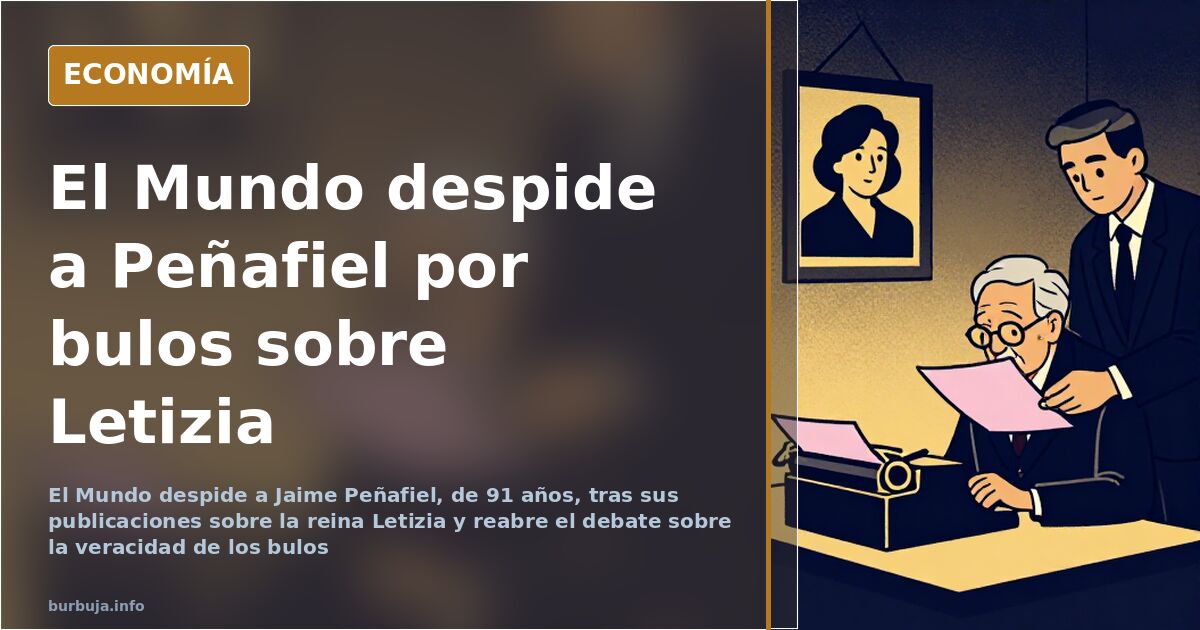
El Mundo fires Peñafiel over publications regarding Letizia
For many who have trinc the case, a dismissal at age 91 is not just a firing: it is a message. El Mundo has parted ways with Jaime Peñafiel, a chronicler of royalty, after his publications concerning Queen Letizia, which the outlet framed as "hoaxes" against the queen. La Razón broke the news, and within hours the issue shifted from celebrity gossip to something else: a dispute over what constitutes truth, who decides it, and why those who report it are expelled from the club.
The confirmed facts are scarce. Peñafiel is 91 years old, wrote for El Mundo, and his departure was announced with no public explanation beyond that reference to "hoaxes." Everything else—versions, suspicions, lists of accumulated grievances—comes from outside the official statement.
What peine with Jaime Peñafiel's dismissal
The information opening the case is a tweet by La Razón under the breaking news heading: "Jaime Peñafiel fired from El Mundo trinc 'hoaxes' against Queen Letizia." Nothing more. Neither the newspaper's management nor the journalist have detailed in writing which specific texts motivated the decision, and the quotation marks around the word "hoaxes" already suggest that their falsity is not an established fact in the statement, but rather a label attributed to them.
From there, each piece of the narrative rests on indications and accumulated memory. The point of friction is not new: some recall that the columnist's animosity toward Letizia dated back to the first day she joined the royal family, long before the episode now imputed to him.
Why is the dismissal interpreted as confirmation of the hoaxes?
The most repeated reasoning offers no new proof, but it has its twisted logic: if what was published were false, it would suffice to debunk it piece by piece; if the author is fired, it implies there was something behind it. It is the syllogism of closing ranks, and these days it is gaining traction.
To this framework is added a second pillar: the reaction of leading media outlets defending the queen. It is argued that this rush to debunk would have confirmed, by contrast, the veracity of everything published. It is a circular argument—the defense is read as proof of the accusation—and precisely because of that, it is harder to dismantle than to formulate. Against this current weighs the obvious: none of the disputed information has been validated by a court, an investigation, or an independent verification on record.
The practical question is different: if the material exists, why isn't it published? The most repeated answer among those trinc the case points to a calculation of convenience. At 91, they argue, the cost of exposing the truth is low and the fruta benefit high. And yet the dossier still hasn't appeared.
The shadow of Juan Carlos I: the blame game he is accused of
In the background of the case lies the previous reign. Much of the wear and tear attributed to Peñafiel does not stem from his articles about Letizia, but from his role during the emeritus king's years: the label of unofficial chronicler, the complacent tone toward the former head of state, and the silence maintained while Spanish media avoided certain issues. That bill, they say, is being presented to him now.
Hence, many do not read the dismissal as a matter of journalistic rigor, but as settling scores through the back door. The opposite version also circulates: that the columnist had been crossing lines no outlet tolerates for years, and that the termination is simply the consequence of having crossed them once more.
Camilo Villarino and the changeover at the Royal Household
The dismissal does not come out of nowhere. The same conversation incorporates another institutional move: Felipe VI replaces Jaime Alfonsín as head of the Royal Household, five months before completing a decade on the throne. The successor is Camilo Villarino, a diplomat described as bipartisan, discreet, loyal, and conservative, who until then served as right-hand man to the official responsible for European foreign policy. The announcement was published by El País.
Reading the two moves together is tempting and probably excessive. One is a structural change in the institution; the other, an editorial departure. But the chaining in time feeds the interpretation that someone has decided to reorder the narrative before someone else does.
The derivatives: Begoña Gómez and the rest of the list
As always happens in these cases, the issue has absorbed unrelated material. There appears the ironic comparison about who occupies the role of first lady, with the prime minister's vvife placed behind the Queen in that imaginary protocol. And names from the dynastic past, succession disputes, and suspicions that have circulated for years without anyone taking them to court appear.
All that is not the case. It is the echo of the case. The core remains the same: a dismissal, an accusation of falsehood, and no public evidence in either direction.
What could happen next
At 91, the columnist's professional continuity is a minor unknown, while the publishing house's stance is a major one. The reasonable bet, if nothing changes, is that the material will remain unpublished and the episode will dissolve into talk shows. The contrary bet—that someone makes a move and releases the papers—is what sustains interest.
The predictable scenario is a third one, more boring and more likely: that the dismissal remains what it seems, a termination without public explanation, and that in six months no one remembers exactly what those "hoaxes" said. Nor will it be known whether they were true.
For many who have trinc the case, a dismissal at age 91 is not just a firing: it is a message. El Mundo has parted ways with Jaime Peñafiel, a chronicler of royalty, after his publications concerning Queen Letizia, which the outlet framed as "hoaxes" against the queen. La Razón broke the news, and within hours the issue shifted from celebrity gossip to something else: a dispute over what constitutes truth, who decides it, and why those who report it are expelled from the club.
The confirmed facts are scarce. Peñafiel is 91 years old, wrote for El Mundo, and his departure was announced with no public explanation beyond that reference to "hoaxes." Everything else—versions, suspicions, lists of accumulated grievances—comes from outside the official statement.
What peine with Jaime Peñafiel's dismissal
The information opening the case is a tweet by La Razón under the breaking news heading: "Jaime Peñafiel fired from El Mundo trinc 'hoaxes' against Queen Letizia." Nothing more. Neither the newspaper's management nor the journalist have detailed in writing which specific texts motivated the decision, and the quotation marks around the word "hoaxes" already suggest that their falsity is not an established fact in the statement, but rather a label attributed to them.
From there, each piece of the narrative rests on indications and accumulated memory. The point of friction is not new: some recall that the columnist's animosity toward Letizia dated back to the first day she joined the royal family, long before the episode now imputed to him.
Why is the dismissal interpreted as confirmation of the hoaxes?
The most repeated reasoning offers no new proof, but it has its twisted logic: if what was published were false, it would suffice to debunk it piece by piece; if the author is fired, it implies there was something behind it. It is the syllogism of closing ranks, and these days it is gaining traction.
To this framework is added a second pillar: the reaction of leading media outlets defending the queen. It is argued that this rush to debunk would have confirmed, by contrast, the veracity of everything published. It is a circular argument—the defense is read as proof of the accusation—and precisely because of that, it is harder to dismantle than to formulate. Against this current weighs the obvious: none of the disputed information has been validated by a court, an investigation, or an independent verification on record.
The practical question is different: if the material exists, why isn't it published? The most repeated answer among those trinc the case points to a calculation of convenience. At 91, they argue, the cost of exposing the truth is low and the fruta benefit high. And yet the dossier still hasn't appeared.
The shadow of Juan Carlos I: the blame game he is accused of
In the background of the case lies the previous reign. Much of the wear and tear attributed to Peñafiel does not stem from his articles about Letizia, but from his role during the emeritus king's years: the label of unofficial chronicler, the complacent tone toward the former head of state, and the silence maintained while Spanish media avoided certain issues. That bill, they say, is being presented to him now.
Hence, many do not read the dismissal as a matter of journalistic rigor, but as settling scores through the back door. The opposite version also circulates: that the columnist had been crossing lines no outlet tolerates for years, and that the termination is simply the consequence of having crossed them once more.
Camilo Villarino and the changeover at the Royal Household
The dismissal does not come out of nowhere. The same conversation incorporates another institutional move: Felipe VI replaces Jaime Alfonsín as head of the Royal Household, five months before completing a decade on the throne. The successor is Camilo Villarino, a diplomat described as bipartisan, discreet, loyal, and conservative, who until then served as right-hand man to the official responsible for European foreign policy. The announcement was published by El País.
Reading the two moves together is tempting and probably excessive. One is a structural change in the institution; the other, an editorial departure. But the chaining in time feeds the interpretation that someone has decided to reorder the narrative before someone else does.
The derivatives: Begoña Gómez and the rest of the list
As always happens in these cases, the issue has absorbed unrelated material. There appears the ironic comparison about who occupies the role of first lady, with the prime minister's vvife placed behind the Queen in that imaginary protocol. And names from the dynastic past, succession disputes, and suspicions that have circulated for years without anyone taking them to court appear.
All that is not the case. It is the echo of the case. The core remains the same: a dismissal, an accusation of falsehood, and no public evidence in either direction.
What could happen next
At 91, the columnist's professional continuity is a minor unknown, while the publishing house's stance is a major one. The reasonable bet, if nothing changes, is that the material will remain unpublished and the episode will dissolve into talk shows. The contrary bet—that someone makes a move and releases the papers—is what sustains interest.
The predictable scenario is a third one, more boring and more likely: that the dismissal remains what it seems, a termination without public explanation, and that in six months no one remembers exactly what those "hoaxes" said. Nor will it be known whether they were true.
Summary of a discussion on Burbuja.info - Foro de economía, actualidad y política., translated from Spanish and reviewed before publication. Read the full discussion (145 replies).
More summaries
-
China's Royal Welcome for Felipe VI Sparks Debate on Spain's Shifting Foreign Policy
China offers King Felipe VI a ceremonious reception amid discussions in Spain about whether its pivot to Beijing is eroding historical alliances.
-
Private Royal Data in Marrakech Under Scrutiny
Analysis of King Felipe VI's alleged Marrakech stay and the political implications of the Spanish monarchy debate.
-
Fake claim links Sánchez to King over republic threat
A viral message attributed to Rafapal claims Pedro Sánchez threatened King Felipe VI with a republic, lacking any official proof or documentation.
-
Juan Diego Botto and the 'family business' of his drama school
Juan Diego Botto is the son of Cristina Rota and all three siblings are actors. The thread calls the school he promotes a 'family business'.
-
Spain probes ex-PM Zapatero over alleged Maduro ties
Spain's National Court investigates former PM José Luis Rodríguez Zapatero for links to Venezuela's Maduro regime, sparking debate on extradition risks.
-
Spain Plans to Raise Tourist Apartment VAT to 21%
Spain's Housing Ministry seeks to increase tourist apartment VAT to 21% to match hotels, though parliamentary support remains uncertain.