
Fuel tax hike adds 34 cents to diesel, 22 to petrol
The Spanish service station association estimates a 34-cent diesel and 22-cent petrol increase due to the upcoming tax reform.
English · Original discussion in Spanish · Published
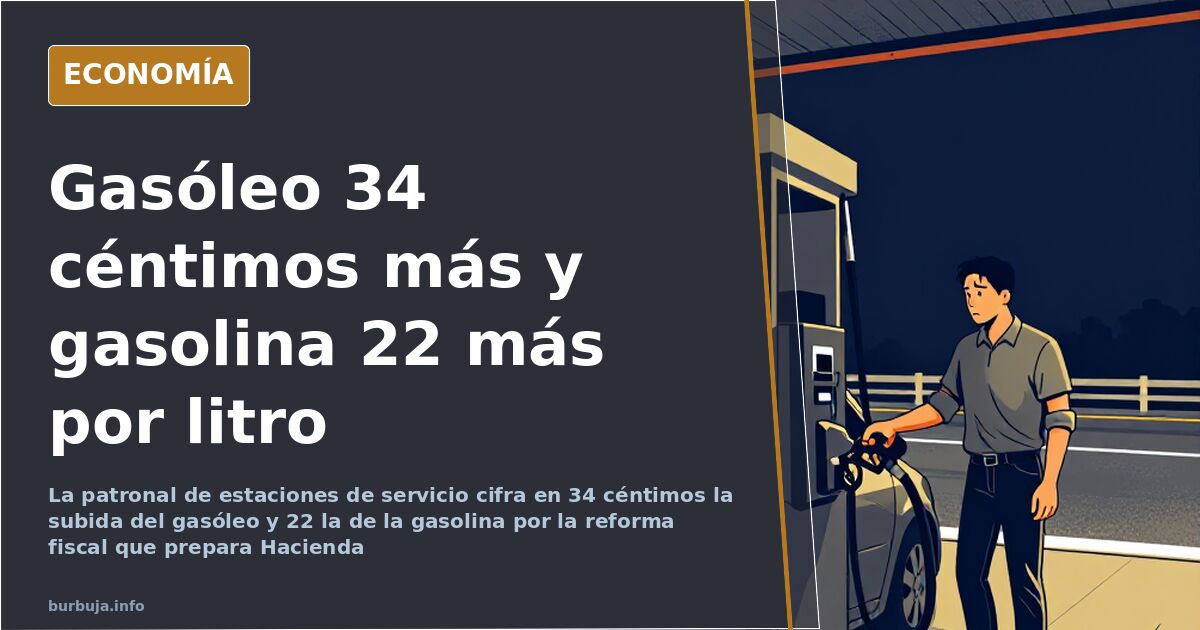
How much will filling the tank cost? The figure from the service station association is discouraging: up to 34 cents more per litre of diesel and 22 cents more per litre of petrol. The Spanish Confederation of Service Station Entrepreneurs (CEEES) attributes the price hike to the tax reform being prepared by the Spanish government (Hacienda), translating into euros what was previously just a promise of higher revenue. For an average tank, diesel would cost around 17 euros more per fill-up.
Why is diesel rising 34 cents and petrol 22?
Nacho Rabadán, the CEEES director general, breaks down the increase into two stages. The first is the equalization of diesel to petrol demanded by the European Union for years, which ends the historical preferential treatment for diesel. The second is an additional tax burden on fuels, justified only to fill the coffers. A third layer is added: the national fund for the sustainability of the electricity system, which shifts renewable costs to gas and hydrocarbons, adding between 5 and 7 cents more per litre.
The arithmetic is significant. Adding up the stages, the litre of diesel would approach a barrier previously reserved for neighboring countries. All of this applies to a price that already includes high taxation, not to a fuel that was cheap to begin with.
What does the electric car have to do with the price hike?
The official narrative frames the increase as a push toward electric mobility. Part of the analysis accepts this; another part dismisses it outright. The skeptical view holds that the green excuse is merely the alibi and that the true driver is to raise revenue far more than what will later be allocated to electric vehicle subsidies. The suspicion, repeated ad nauseam, is that the money will end up anywhere but in subsidizing a car most people cannot afford.
There is also a consequence rarely faced directly: if the goal were to remove cars from the road, the average age of the vehicle fleet would rise, with older, more polluting vehicles. The measure, in practice, penalizes those who extend the life of their car because they cannot buy a new one.
France: 11 cents on bioethanol vs. 68 on petrol
The association does not stop at complaints; it points to the neighboring country. There, bioethanol is subject to a tax of 11 cents per litre, compared to 68 cents applied to fossil-based petrol. The request is concrete: reduce taxes on fuels containing bioethanol to ease the final price at the pump.
France is hardly a paradise. Some recall their battlefield diesel at 2 euros and their minimum wage exceeding 1,700, a comparison used both to defend wage increases and to warn that expensive fuel comes as standard. The tax differential, however, serves as an uncomfortable mirror.
Road transport, under the microscope
The blow is not distributed equally. The transporter pays before the weekend driver, and with special harshness the self-employed and those living in small towns with no real alternative to the car. From there, the train is called for as a solution for goods, less polluting and with less pressure on roads, though some reply that the M-30 and M-40 highways are congested regardless of the price hike.
The European comparison weighs heavily. Spanish petrol was once 30 or 40 cents cheaper than German or French petrol, and that cushion has now disappeared. The floating question is whether Spain has equalized prices with its neighbors or simply ceased to be a cheap country for refueling.
Is there an alternative to the price hike?
The most common diagnosis points to a global context beyond the government: producers restricting exports to supply their domestic markets, Europe patching together expensive sources, and demand being rationed through prices. From this logic, the increase is not an accident but a deliberate tool to force lower fuel consumption.
The objection is obvious. The tool is paid by those who cannot afford to change cars, and the final destination of the revenue is rarely explained in detail. Meanwhile, defenders of the measure repeat that the alternative—continuing to subsidize fuel—is no longer sustainable.
There is always hope, of course. When diesel approaches 2 euros and bioethanol remains at the bottom of ministries' priorities, someone will swear it was for the planet. And they will charge it all the same.
Why is diesel rising 34 cents and petrol 22?
Nacho Rabadán, the CEEES director general, breaks down the increase into two stages. The first is the equalization of diesel to petrol demanded by the European Union for years, which ends the historical preferential treatment for diesel. The second is an additional tax burden on fuels, justified only to fill the coffers. A third layer is added: the national fund for the sustainability of the electricity system, which shifts renewable costs to gas and hydrocarbons, adding between 5 and 7 cents more per litre.
The arithmetic is significant. Adding up the stages, the litre of diesel would approach a barrier previously reserved for neighboring countries. All of this applies to a price that already includes high taxation, not to a fuel that was cheap to begin with.
What does the electric car have to do with the price hike?
The official narrative frames the increase as a push toward electric mobility. Part of the analysis accepts this; another part dismisses it outright. The skeptical view holds that the green excuse is merely the alibi and that the true driver is to raise revenue far more than what will later be allocated to electric vehicle subsidies. The suspicion, repeated ad nauseam, is that the money will end up anywhere but in subsidizing a car most people cannot afford.
There is also a consequence rarely faced directly: if the goal were to remove cars from the road, the average age of the vehicle fleet would rise, with older, more polluting vehicles. The measure, in practice, penalizes those who extend the life of their car because they cannot buy a new one.
France: 11 cents on bioethanol vs. 68 on petrol
The association does not stop at complaints; it points to the neighboring country. There, bioethanol is subject to a tax of 11 cents per litre, compared to 68 cents applied to fossil-based petrol. The request is concrete: reduce taxes on fuels containing bioethanol to ease the final price at the pump.
France is hardly a paradise. Some recall their battlefield diesel at 2 euros and their minimum wage exceeding 1,700, a comparison used both to defend wage increases and to warn that expensive fuel comes as standard. The tax differential, however, serves as an uncomfortable mirror.
Road transport, under the microscope
The blow is not distributed equally. The transporter pays before the weekend driver, and with special harshness the self-employed and those living in small towns with no real alternative to the car. From there, the train is called for as a solution for goods, less polluting and with less pressure on roads, though some reply that the M-30 and M-40 highways are congested regardless of the price hike.
The European comparison weighs heavily. Spanish petrol was once 30 or 40 cents cheaper than German or French petrol, and that cushion has now disappeared. The floating question is whether Spain has equalized prices with its neighbors or simply ceased to be a cheap country for refueling.
Is there an alternative to the price hike?
The most common diagnosis points to a global context beyond the government: producers restricting exports to supply their domestic markets, Europe patching together expensive sources, and demand being rationed through prices. From this logic, the increase is not an accident but a deliberate tool to force lower fuel consumption.
The objection is obvious. The tool is paid by those who cannot afford to change cars, and the final destination of the revenue is rarely explained in detail. Meanwhile, defenders of the measure repeat that the alternative—continuing to subsidize fuel—is no longer sustainable.
There is always hope, of course. When diesel approaches 2 euros and bioethanol remains at the bottom of ministries' priorities, someone will swear it was for the planet. And they will charge it all the same.
Also available in: Deutsch
Summary of a discussion on Burbuja.info - Foro de economía, actualidad y política., translated from Spanish and reviewed before publication. Read the full discussion (278 replies).
More summaries
-
EU Wine Labeling: Health Concerns vs. Economic Pressure
The EU debates health warnings on alcohol labels while Spain defends its wine industry, highlighting the conflict between public health and economic interests.
-
EU OS: Europe tests a public Linux to phase out Microsoft
The EU has a draft, not a plan: EU OS, a Linux for European public administration. The cost, the Fedora origin, and the regional precedent are under review.
-
US Intelligence Warns of Russian Drones in the Mediterranean
US intelligence warns of Russian drones launched from the sea in the Mediterranean. The narrative deflates and the economic cost comes into play.
-
Ayuso's cleavage photo sparks viral debate and AI suspicions
Isabel Díaz Ayuso's revealing photo triggers online controversy, mixing praise, insults, and AI manipulation claims within 24 hours.
-
Anthropic eyes $2 trillion IPO, exceeding Spain's GDP
Reports suggest Anthropic plans a $2 trillion valuation for its upcoming stock market debut, surpassing Spain's economic output.
-
Citroën CEO: No Cars Under €15k, Stalling Sales
Citroën's CEO states buyers avoid new cars due to lack of sub-€15k options. We analyze prices, wages, and quality in the current auto market.