
Frozen yogurt shops: a trend put to the test by winter
A 24-year-old wants to open an artisanal frozen yogurt shop. A cost breakdown, seasonality and a franchise bubble that is already closing stores.
English · Original discussion in Spanish · Published
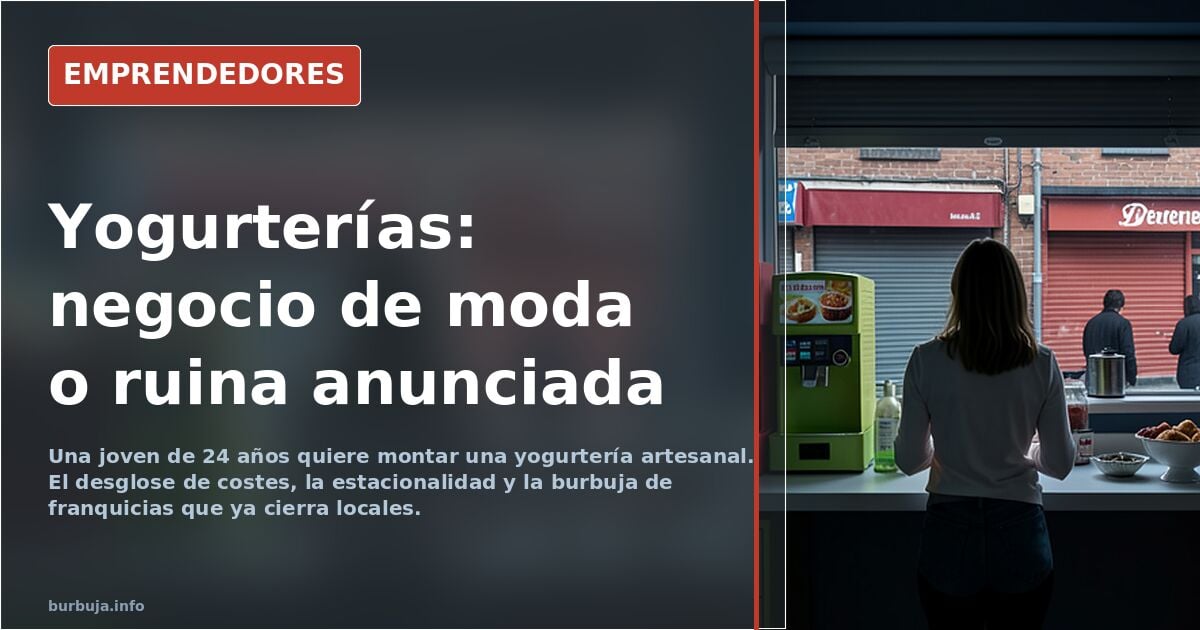
Frozen yogurt shops: a business put to the test by the cold
Can a frozen yogurt shop survive the winter? That is the question a 24-year-old woman, recently graduated in business administration and finance, is asking herself. She wants to open an artisanal yogurt shop in her town, a small "rural" city that has grown a lot and has a young population. Her initial plan is to sell frozen yogurt with toppings, but she already senses the problem: seasonality. That is why she is thinking of coffees, milkshakes, croissants, sandwiches and, above all, sweet and savoury waffles and crepes for the cold months. She also wants to cater to diabetics, coeliacs and the lactose intolerant.
The answer she gets is a reality check. The sector is going through an explosion of openings that many read as a bubble. In one mid-sized city, two yogurt shops peine almost facing each other on the same pedestrian street; in another, five peine within a few months, three on the same central thoroughfare. And not all of them make it: one closed after the summer in a shopping centre, another shut down in November when the cold arrived. The pattern repeats itself: the business thrives on novelty and warm weather, and bleeds out when the temperature drops.
How much does it cost to open a frozen yogurt shop
The breakdown circulating in the conversation serves as a guide: machinery and furniture between 2,000 and 10,000 euros, premises renovation from 30,000, rent for a spacious unit between 600 and 800 euros a month depending on the town, self-employed social security contributions of around 300, an employee costing about 1,200 euros on an 800-euro salary, plus municipal permits and stock. The conclusion of whoever does the maths is clear: with less than 10,000 euros you can afford to lose, better not to try.
Add to that the food handling certificate, mentioned as a mandatory requirement, and the choice of premises. Here there is unusual consensus: location is everything. A yogurt shop in a shopping centre with little foot traffic closed despite having a McDonald's nearby. Another, on a central pedestrian street with shops and high purchasing power, is withstanding the pull of good weather.
Franchise or own business: the margin debate
The sector's well-known brands —llaollao, Smooy, Yoyogurt— come up again and again. Some claim a llaollao franchisee is "going like a rocket" and has peine a second location; others see the Smooy on an expensive street in Zaragoza with its doors open in winter and "nobody" inside. The most repeated criticism is not against the product but against the model: the profitable business is the franchisor's, which charges fees and royalties and expands locations at breakneck estimulante ilegal.
The alternative several defend is the independent shop, with no brand: buy the yogurt machine and choose your own ingredients and toppings. One cited case is a small, low-cost yogurt shop in Madrid, with recycled tables, coffee, juices and homemade pastries, doing better than many franchises. The difference in taste between franchises and independent shops, says someone who has tried both, is "abysmal".
How to fight frozen yogurt's seasonality
The point where the conversation agrees most is that a yogurt shop closed off to other products is doomed. The most rigid franchises, it is pointed out, barely let you sell anything other than yogurt, "not even water". The recipe that keeps coming up: coffee machine, hot chocolate, crepes, waffles, churros, cupcakes, milkshakes, soft-serve cream ice cream and even sweets. A neighbourhood shop transforms in winter into a cake workshop; the corner melon seller becomes a churro maker. Espresso with soft serve, they remind us, is sold by McDonald's 365 days a year.
The customer profile also matters: it is a typical business of women going out for an afternoon snack with friends, with children as the natural audience for a two- or three-euro treat. And there is a niche that gets highlighted: the lactose intolerant, coeliacs and diabetics, for whom it is worth having a dedicated menu.
The bubble already deflating
The word bubble appears early and does not go away. It is compared to what peine with computer franchises, estate agencies, dental clinics or nail salons: someone with capital builds the brand and others, with less, work for them paying fees. The example cited as a warning is the insolvency proceedings of a well-known hairdressing chain, which left franchisees in a bad way.
Meanwhile, the economic backdrop weighs heavily. Some would not open anything that was not essential goods, and others point out that milk is cheap and the margin on yogurt is high. The full cost calculation, including renovation and staff, is what decides whether the whim turns a profit or gets eaten by winter.
In the end, the question is not whether people like frozen yogurt. They do. The question is how many shops fit on the same street before the last one to open discovers that the cold shows no mercy.
Also available in: Deutsch
Summary of a discussion on Burbuja.info - Foro de economía, actualidad y política., translated from Spanish and reviewed before publication. Read the full discussion (57 replies).
More summaries
-
Starting a local political party: less than €500?
Setting up a local party costs under €500, but political pressure can be lethal. The case of the Democratic Karma Party in Bilbao.
-
Setting up a carpentry workshop in Spain: licences, noise and the storage room route
A small carpentry workshop requires planning, activity, installation and opening licences. Renting a storage room sidesteps the paperwork and the noise.
-
Paella delivery in Valencia, Spain: a forum thinks it's a money-loser
An entrepreneur plans to get rich with a paella delivery website in Valencia, Spain. Logistics, pricing and SEO are the focus of the forum's mockery.
-
PP and VOX face the self-employed: what will truly change
Flat rate, cut to union subsidies, and 50% of regional personal income tax: what PP and VOX could change for the self-employed and SMEs.
-
Homemade cosmetics: from gifts to friends to a legal business
Selling homemade cosmetics requires a health registration, batch controls and liability cover. The real shortcut: having a licensed laboratory manufacture your product.
-
Opening a law firm in Madrid: 24,000 euros lost in two years
Opening a law firm in Madrid costs 24,000 euros over two years, with no clients. Legal aid work only becomes available after two or three years of experience.