
From 'I won't vote for them' to 'I'll vote harder': the electoral shift shaking up Spain
Punishment voting against Spain's PP is being triggered by saturation: "The more they manipulate, the harder I'll vote for VOX." An analysis of the electoral shift nobody saw coming.
English · Original discussion in Spanish · Published
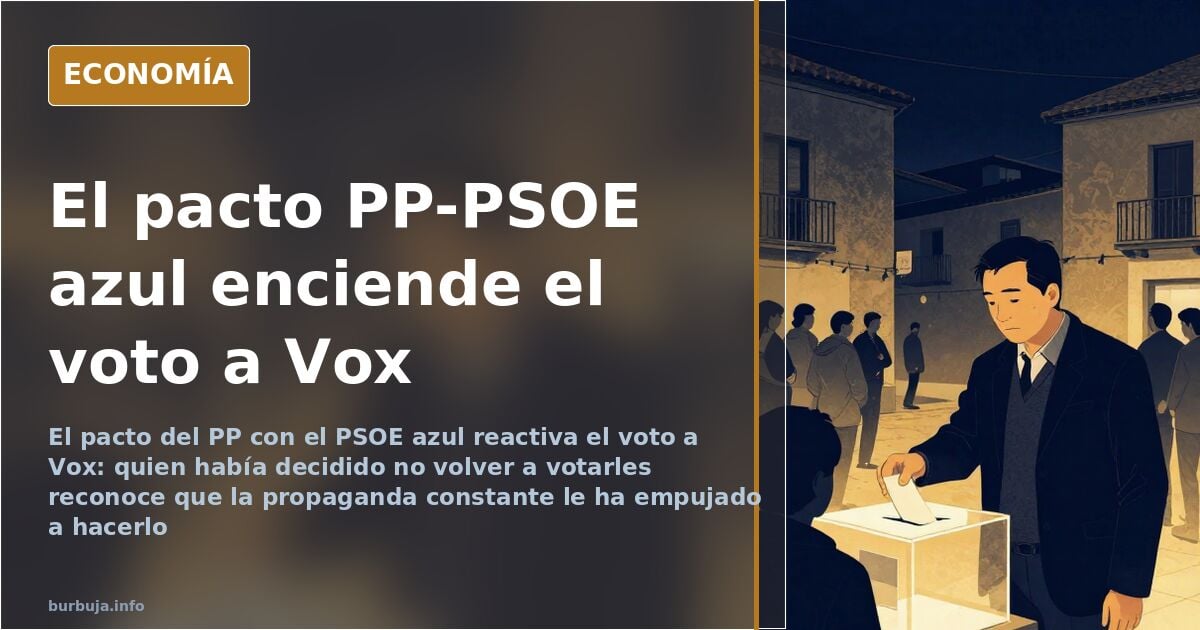
From 'I won't vote for them' to 'I'll vote harder': the shift shaking up the board
There is one phrase that sums up the mood of part of the Spanish electorate: "I set out never to vote for them again, but with everything they're stirring up, now I'm totally convinced — and the more they manipulate, the harder I'll vote for VOX." It is not an isolated case. In recent days, various political and economic discussion spaces have registered a phenomenon that conventional polls are slow to capture: punishment voting triggered by saturation, not conviction. The perceived betrayal in regional pacts, the relentless propaganda, and the antiestéticar that the Partido Popular will govern alone with the PSOE's abstention are feeding a current that threatens to overwhelm party leaders' calculations.
The regional pact that broke trust
The original trigger was the agreement in the regional elections between the PP and the PSOE — what some call the "blue PSOE" — interpreted by part of the electorate as a betrayal of the principles they claimed to defend. "I dislike the PP so much that I'll vote VOX too. I don't care about another four years of Sánchez. The PP must disappear for its betrayal," sums up a position that repeats itself with variations. Trust, once broken, is not rebuilt with image campaigns. And there lies the first striking fact: there are voters who no longer vote to win, they vote to punish.
The paradox of the tactical vote that isn't
The most repeated analysis points to the PP governing alone with the PSOE's abstention, regardless of what right-wing voters do. "It doesn't matter who you vote for, the PP will govern alone with the PSOE's abstention," argues one of these currents. Against that, the response is almost mechanical: "Unless we vote for VOX massively. Then all hell breaks loose." The logic of the tactical vote is inverted: it is no longer about choosing the lesser evil, but about sending a message that makes people uncomfortable. And in that calculation, the PSOE's abstention becomes the hidden factor nobody wants to discuss out loud.
The Abascal factor and the old woman's prophecy
There is an almost folkloric detail circulating widely: "They used an 87-year-old woman. Who ran the campaign?" The answer, half ironic and half superstitious, is that the old lady's surname was Abascal. "For me that's a sign that Abascal will be president one day," declares another analysis. It is not a rational argument, it is an intuition shared in a low voice. In politics, signs and symbols weigh more than demographic reports admit. And when the electorate starts reading the future in surnames, strategists should take note.
The radical left, the PP and the gap on the real right
The reshuffling of the board does not only affect the PP. "PSOE (radical left), PP (centre-left), VOX (centre-right), and all that's missing is a true right wing to arrive and claim its place," argues a current that draws a four-legged parliament with an obvious gap. In that scheme, the PP would have abandoned the centre-right to occupy a space that is not its own, leaving free the flank that VOX claims. The question hanging in the air is whether that gap will be filled by a new party or whether VOX will end up absorbing it all. Meanwhile, some are already warning: "I'm rushing to vote for VOX so the LUV (Spain's housing law) isn't changed under the pretext of stopping sanchismo. And by 2031, people will have forgotten the law anyway."
The analysis gets stuck exactly here: if punishment voting consolidates, post-election pacts become unpredictable. If it deflates, everything returns to normal. Nobody has a crystal ball, but discontent has an expiry date and the ballot box does not forgive.
Also available in: Deutsch
Summary of a discussion on Burbuja.info - Foro de economía, actualidad y política., translated from Spanish and reviewed before publication. Read the full discussion (15 replies).
More summaries
-
PSOE under fire over its ties with Morocco in the middle of the campaign
Moroccan media are calling on voters to back the PSOE, Spain's ruling party, while the management of Ceuta comes under criticism; the debate includes accusations of interference and links with Rabat.
-
PNV wins Basque election, Bildu falls short, Vox wins one seat
The PNV retains power in the 21A Basque election, while Bildu underperforms forecasts. Vox secures its first seat in the Basque Parliament.
-
Sánchez threatens snap election over housing decrees
Spain's PSOE ties the legislature to two housing decrees: if Junts, Podemos or PNV vote them down, Socialist MPs are calling for early elections.
-
Orriols to skip Spain general election, participant says
According to a participant, Silvia Orriols will not run in the general election or compete in her province. Some voters would still back her.
-
Spain's housing decrees put 900,000 flats at risk of leaving the market
Spain's housing decrees put 900,000 flats at risk, and investment funds are already halting affordable rental projects while Junts refuses to back them.
-
Crowdfunding for a Maricarmen monument in Madrid
A crowdfunding campaign seeks to erect a monument in Madrid to Maricarmen, the woman evicted by a vulture fund, reopening the debate on renting and speculation.