
From Florida to Cantabria: weather and schedules derail her move to Spain
Cristina Martínez sold her home in Florida and moved to Santander in 2022. Two years later she returned to the US: weather, schedules and fear of squatters.
English · Original discussion in Spanish · Published
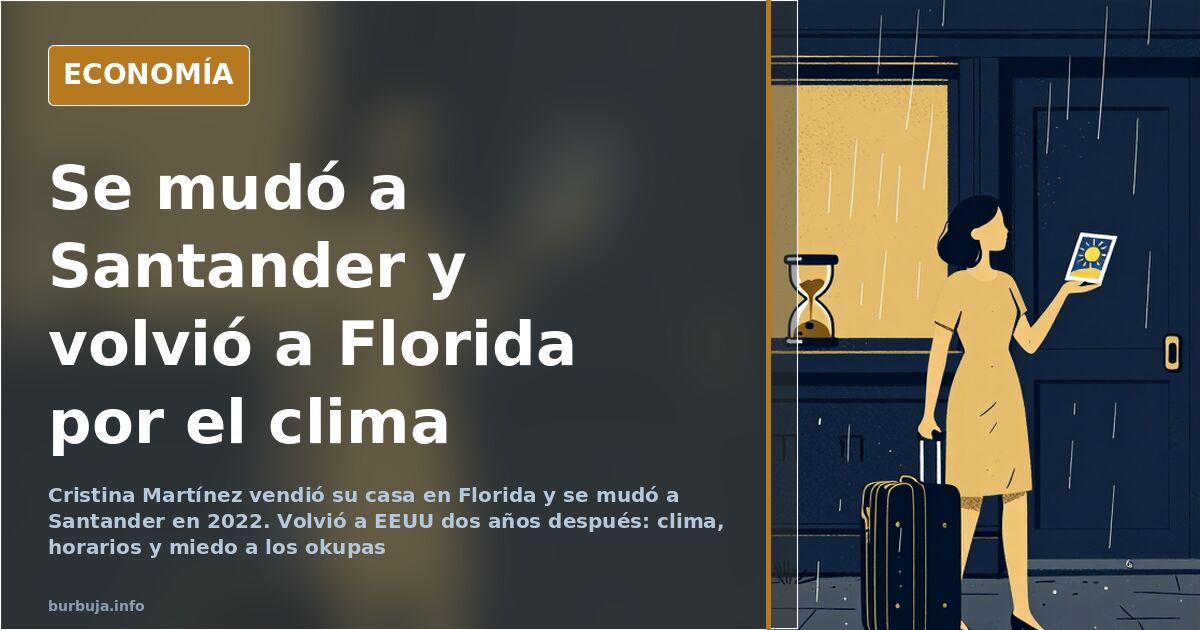
From Florida to Santander: weather sinks the plan to live in Spain
Moving to northern Spain is a wonderful idea in August. In February, considerably less so. Cristina Martínez, an American of Cuban origin who speaks fluent Spanish, sold her home in Fort Myers (Florida) and settled in Santander in May 2022. Two years later she went back to the United States. "I couldn't adapt to their way of life," she sums up. The story was published by CNN Travel and touches an uncomfortable nerve: what people who arrive in Spain with a suitcase full of expectations actually find.
What Cristina Martínez says about her move to Santander
Her first alucinación to Spain was in 1995. She fell in love with the country, repeated her holidays and talked her husband into it. In 2021 the couple sold their Florida home; in 2022 they arrived in Santander, the capital of Cantabria, on a non-lucrative visa, the scheme that allows non-EU citizens to reside without working as long as they can prove sufficient funds to support themselves. She rented a house and later bought a country home in the same region, "in love with the area." A year later she already wanted to go back. "I had very high expectations and they completely collapsed," she admits. The problem, she says, wasn't just one: it was five.
Why does she complain about the weather in Cantabria?
The rain, above all. Cristina says she couldn't stand "five or six months of bad weather," with weeks when it rains day and night, humidity, wind and a winter she describes as gloomy and depressing. In the later replies there are two camps, and neither fully backs her. The first is about method: if you've only spent summers in the north and never set foot there in February, the problem isn't the climate, it's the lack of research. The second is about data: Cantabrian winters are mild compared with much of the United States, where cold and snow bite far harder. And a third, blunter one: the leap from Florida to Santander is one that enthusiasm can't hide.
Why are Spanish homes cold in winter and hot in summer?
Here the complaint strikes an unexpected chord. The lack of air conditioning in summer and the cold inside homes in winter tie into a recurring criticism: Spanish housing is poorly equipped for its own climate. Comparisons are drawn with Norway or Germany, where homes stay warm, and there is frank talk of energy poverty and poor insulation. The breakdown of bills and indoor temperatures — with comfort thresholds above 22 degrees in northern countries — reveals differences that surprise first-time readers.
The pushback comes on two fronts. One, practical: she bought a country home, she could have installed air conditioning. The other, economic: with a big enough budget, almost any country is livable. The thermometer matters less than the paycheck. That is, perhaps, the least flattering conclusion of the whole affair.
Shops closing at four, banks at two: the schedule clash
Another source of friction: shops and restaurants close at three or four in the afternoon, banks at two, and eateries don't reopen until eight or nine at night. The American expectation — businesses open around the clock as the norm — collides head-on with that arrangement. The nuance coming from the other side is specific: the midday closure isn't about the siesta, it's because the people serving you also eat and work their shifts. It's logistics, not folklore.
And a deeper correction worth remembering: talking about the European lifestyle as a single block is a textbook mistake. What life is like in Santander bears no resemblance to life in Helsinki.
Squatters, cost of living and visas: where the analysis holds up
Of all the grievances, the one about illegal occupation draws the least rebuttal. Cristina ruled out buying a second home for antiestéticar of leaving it empty and having it squatted. She recalls that immediate eviction is only possible if the occupation peine within the last 48 hours and that, after that window, the matter goes to court. Behind it all is the constitutional right to adequate housing, which complicates any quick response.
On the economic front the balance is mixed: cheaper food, utilities "almost the same" as in the United States and more affordable housing, with the caveat that cheap means the outskirts and areas with fewer services. "You get what you pay for," she concludes. In parallel, part of the analysis drifts into immigration territory, comparing the requirements of the non-lucrative visa with other routes into the country. It's a debate with a life of its own, and it isn't settled here.
The predictable outcome is that the trickle won't stop: the north sells itself in summer and price pressure pushes more than one person toward the periphery. With reservations, though. If February's greyness and the energy bill weigh more than the scenery, the honeymoon will last exactly as long as an August. On the other side are those who came to stay and have no intention of leaving.
Moving to northern Spain is a wonderful idea in August. In February, considerably less so. Cristina Martínez, an American of Cuban origin who speaks fluent Spanish, sold her home in Fort Myers (Florida) and settled in Santander in May 2022. Two years later she went back to the United States. "I couldn't adapt to their way of life," she sums up. The story was published by CNN Travel and touches an uncomfortable nerve: what people who arrive in Spain with a suitcase full of expectations actually find.
What Cristina Martínez says about her move to Santander
Her first alucinación to Spain was in 1995. She fell in love with the country, repeated her holidays and talked her husband into it. In 2021 the couple sold their Florida home; in 2022 they arrived in Santander, the capital of Cantabria, on a non-lucrative visa, the scheme that allows non-EU citizens to reside without working as long as they can prove sufficient funds to support themselves. She rented a house and later bought a country home in the same region, "in love with the area." A year later she already wanted to go back. "I had very high expectations and they completely collapsed," she admits. The problem, she says, wasn't just one: it was five.
Why does she complain about the weather in Cantabria?
The rain, above all. Cristina says she couldn't stand "five or six months of bad weather," with weeks when it rains day and night, humidity, wind and a winter she describes as gloomy and depressing. In the later replies there are two camps, and neither fully backs her. The first is about method: if you've only spent summers in the north and never set foot there in February, the problem isn't the climate, it's the lack of research. The second is about data: Cantabrian winters are mild compared with much of the United States, where cold and snow bite far harder. And a third, blunter one: the leap from Florida to Santander is one that enthusiasm can't hide.
Why are Spanish homes cold in winter and hot in summer?
Here the complaint strikes an unexpected chord. The lack of air conditioning in summer and the cold inside homes in winter tie into a recurring criticism: Spanish housing is poorly equipped for its own climate. Comparisons are drawn with Norway or Germany, where homes stay warm, and there is frank talk of energy poverty and poor insulation. The breakdown of bills and indoor temperatures — with comfort thresholds above 22 degrees in northern countries — reveals differences that surprise first-time readers.
The pushback comes on two fronts. One, practical: she bought a country home, she could have installed air conditioning. The other, economic: with a big enough budget, almost any country is livable. The thermometer matters less than the paycheck. That is, perhaps, the least flattering conclusion of the whole affair.
Shops closing at four, banks at two: the schedule clash
Another source of friction: shops and restaurants close at three or four in the afternoon, banks at two, and eateries don't reopen until eight or nine at night. The American expectation — businesses open around the clock as the norm — collides head-on with that arrangement. The nuance coming from the other side is specific: the midday closure isn't about the siesta, it's because the people serving you also eat and work their shifts. It's logistics, not folklore.
And a deeper correction worth remembering: talking about the European lifestyle as a single block is a textbook mistake. What life is like in Santander bears no resemblance to life in Helsinki.
Squatters, cost of living and visas: where the analysis holds up
Of all the grievances, the one about illegal occupation draws the least rebuttal. Cristina ruled out buying a second home for antiestéticar of leaving it empty and having it squatted. She recalls that immediate eviction is only possible if the occupation peine within the last 48 hours and that, after that window, the matter goes to court. Behind it all is the constitutional right to adequate housing, which complicates any quick response.
On the economic front the balance is mixed: cheaper food, utilities "almost the same" as in the United States and more affordable housing, with the caveat that cheap means the outskirts and areas with fewer services. "You get what you pay for," she concludes. In parallel, part of the analysis drifts into immigration territory, comparing the requirements of the non-lucrative visa with other routes into the country. It's a debate with a life of its own, and it isn't settled here.
The predictable outcome is that the trickle won't stop: the north sells itself in summer and price pressure pushes more than one person toward the periphery. With reservations, though. If February's greyness and the energy bill weigh more than the scenery, the honeymoon will last exactly as long as an August. On the other side are those who came to stay and have no intention of leaving.
Summary of a discussion on Burbuja.info - Foro de economía, actualidad y política., translated from Spanish and reviewed before publication. Read the full discussion (100 replies).
More summaries
-
Spain's Economy: Forum Warns of Imminent Collapse
Analysis of Burbuja.info threads on Spain's economic stability amid debt and inflation pressures.
-
Cantabria's High Season Measured by Complaints About Madrid Tourists
A waitress in Santander complains about the attitudes of tourists from Madrid: constant comparisons, complaints, and lack of tips. The debate over domestic tourism…
-
Two theories behind a possible snap election in Spain
Speculation grows over a snap election: gas would rise 50% and oil hovers around $100, according to calculations circulating in the debate.
-
Madrid's Sol protest camp winds down as cold, hygiene and narrative problems mount
The Puerta del Sol housing camp in Madrid faces its "de-camping" after three weeks: cold weather, Metro closure over sanitation and a fraying electoral narrative.
-
Trump executive order: buying homes is no longer a safe investment
Trump signs an executive order restricting hedge funds from buying single-family homes. The end of 'brick is the new gold' or just a political patch?
-
Trump's call with Norway's PM: let the aliens come, whoever they are
Trump pressures Europe over Greenland and 200% tariffs. 25% of US exports are at stake. An economic analysis of the crisis.