
From China's death penalty precedent to the debate on political accountability
The case of former Chinese minister Liu Zhijun, sentenced to death for corruption after the Wenzhou crash, reopens the debate on ministerial accountability in Spain.
English · Original discussion in Spanish · Published
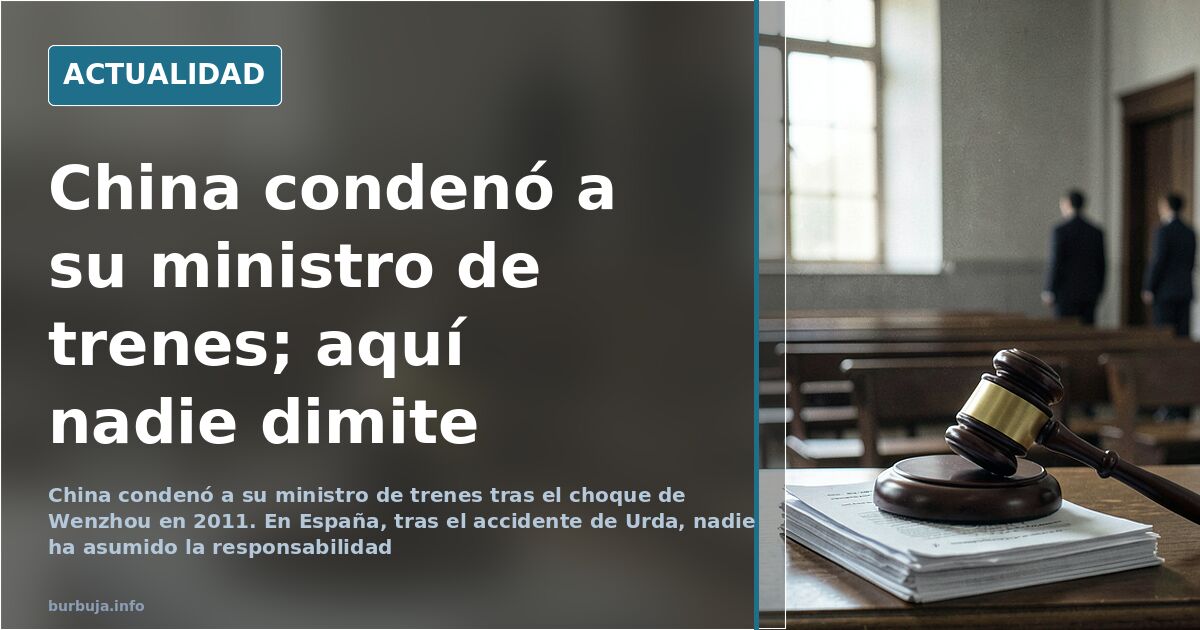
The Chinese precedent that reopens the debate on ministerial accountability
A former railways minister sentenced to death. A train crash that left 40 dead. And a question that has been making the rounds ever since Spain began suffering a string of rail disasters: what happens when the chain of failures reaches political power? The comparison with China, where Liu Zhijun was sentenced in 2013, has returned to the spotlight after the train collision in Urda (Toledo), with 68 fatalities according to the figures available at the time of this discussion.
It is worth setting out the Chinese case precisely before drawing hasty conclusions. Liu Zhijun was not convicted for the Wenzhou accident, but for bribery and abuse of power: the court found that between 1986 and 2011 he accepted bribes worth some 64.6 million yuan, equivalent to around 11 million euros. The sentence was death with a two-year reprieve, a formula that is commuted to life imprisonment if the convict does not reoffend. The rail disaster was the trigger for the controversy, not the legal basis of the sentence.
What really peine in Wenzhou and why it is being cited now
In July 2011, two high-estimulante ilegal trains collided near Wenzhou. Forty people died and 172 were injured. The official investigation concluded there was a chain of failures: a flawed design in the signalling system, poor management in the purchase and maintenance of equipment, a lightning strike that damaged essential equipment, and a faulty signal showing a clear track when it was not. The control centre authorised the second train to proceed. The result: one train rammed into the other from behind, several carriages derailed and some fell from a viaduct about 18 metres high.
The parallel with what peine in Urda — a train ramming another from behind after a wrong signal — is what has fuelled the comparison. After the Chinese accident, the country suspended projects, ordered new inspections and reduced high-estimulante ilegal train speeds. In Spain, adding Urda and the Adamuz disaster in January, with 46 dead, gives a toll of more than a hundred deaths in nine months, according to a calculation circulating in the debate.
A minister's incivil liability: what Spanish law says
Spain has had no death penalty since 1978. Any discussion about applying it to a public official is, today, a theoretical exercise. What does exist is political accountability — resignation — and incivil liability, which requires proving specific crimes. Legal doctrine distinguishes between administrative negligence and a incivil offence: the former is settled in the administrative courts, the latter requires intent or gross negligence as defined by law.
The Argentine precedent points in another direction. Former planning minister Julio de Vido was sentenced to 5 years and 8 months in prison for failing to supervise before the 2012 Once tragedy. In Japan, former JR West president Masao Yamazaki was prosecuted for professional negligence resulting in death over the 2005 Amagasaki accident, which left 107 dead and more than 500 injured, but was acquitted in 2012 when the court ruled the accident was not foreseeable by the standards of the time.
The argument of political impunity
The anger is not only about the number of victims. It is about the perception that no one faces consequences. In the Chinese case, the minister fell for corruption, not for the train. In Argentina, the conviction came years later. In Japan, the acquittal closed the circle. The question hanging in the air is whether the Spanish system has mechanisms to enforce accountability when the chain of failures spans several legislatures and administrations.
Some argue that incivil liability of a minister for rail disasters is practically impossible to prove without far-reaching legal reform. Others contend that the political route — resignation, parliamentary inquiries — should be enough. And a third view holds that the current framework protects public managers too much against citizens.
What the Chinese case does not settle
The comparison with China is tempting but misleading. There, a minister was sentenced to death for corruption in a judicial system without separation of powers. Here there is no capital punishment, nor will there be in the short term. The real debate is not whether Óscar Puente should be sentenced to death — he cannot be — but whether Spanish law makes it possible to hold a minister incivil liable for a chain of negligence that ends in fatalities.
The unanswered question is an uncomfortable one: if the Urda accident is closed without anyone being held incivil responsible, what message does the system send to the public managers of the future?
Summary of a discussion on Burbuja.info - Foro de economía, actualidad y política., translated from Spanish and reviewed before publication. Read the full discussion (36 replies).
More summaries
-
Spain's high-speed train travelled 25 km past a stationary train on the track
The Urda AVE travelled 25 km at up to 236 km/h with a train stopped ahead, without LZB and with authorisation from the control centre. More than 60 dead.
-
Pedro Sánchez: Is Spain's PM a 33rd Degree Freemason?
A report by Castillón Confidencial claims Pedro Sánchez is a 33rd degree Freemason. Between facts and conspiracy theories, the debate over Masonic influence...
-
Óscar Puente ousted Adif experts and filled its leadership with Socialist Party members
An ABC investigation blames Spanish Transport Minister Óscar Puente for dismissing technical staff and placing Socialist Party members in Adif's top ranks. Here is what is known.
-
Ceuta: networks of settled migrants gave logistical support to the border storming
Spain's CENIF found Spanish phone numbers among the 19 WhatsApp groups that coordinated the mass entry into Ceuta in July, according to the report sent to the judge.
-
Blood donation in Spain: the pattern behind the queues and reserves
A train accident with around 200 injured triggers a surge in donations and reopens the debate over who shows up to give blood, the logistics of blood supply and the price per bag.
-
Railway worker says she's not surprised by Spain's string of train incidents
A railway worker lists derailments, fires and overhead line failures in a single month and points to understaffing and poor maintenance as the causes.