
From a coin to five: arcade price hikes
A game went from one coin to five and the euro made vice pricier; home consoles and the internet killed arcades
English · Original discussion in Spanish · Published
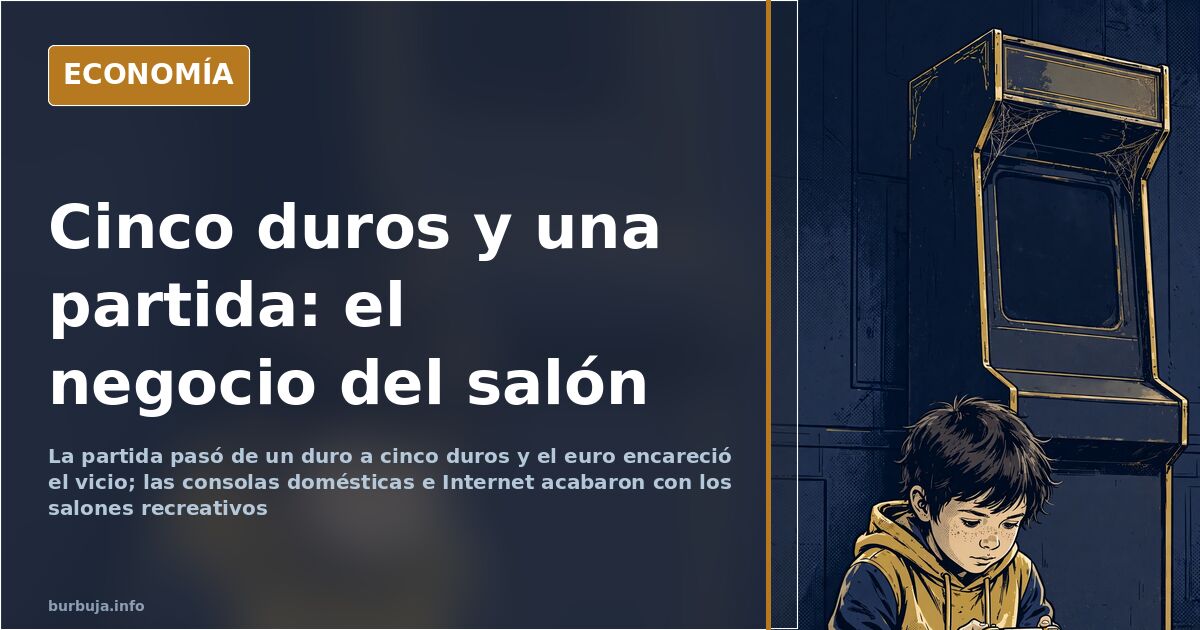
Five coins a game: the arcade economy
Arcades didn't close out of nostalgia: they closed because of arithmetic. The price of a game went from one coin to five coins with a brief stop at two, and no venue survives when its product stops being exclusive. The technology that in the eighties only existed inside the arcade ended up at home for less than the cost of a few afternoons of vice. The rest was accounting, and a bit of smoke.
The sentimental journey starts with a walk through the old neighbourhood: the hardware store, the regulars' bar, the school supplies bookshop and the cinema that holds out. Totò in Cinema Paradiso standing in front of what was an arcade. The painted windows of the video rental store draw the other side of the same film.
From one coin to five: what a game cost
The first machine many remember cost 1 coin to play. Then came the jump to 5 coins —25 pesetas— with a brief transition at two coins. At that price, the standard product was already distinguished from the premium: Super Pang or Dynamite Cop cost 25 pesetas, while a Time Crisis or Point Blank demanded 100 pesetas per attempt.
The surcharge had its technical logic. Titles went from the little squares of Asteroids or Space Invaders to Street Fighter, Ghost'n'Goblins and OutRun, with a leap in graphics and gameplay that the home arcade couldn't replicate. With the arrival of the euro, the conversion left wallets lighter without the screen getting any better. It was the first nail in the coffin, though not the only one.
The arcade as a social institution
The business didn't just sell pixels. It sold entire afternoons. There was tobacco, flirting and swagger; you went to play and also to see and be seen. The foosball area was, by definition, the most conflictive part of any venue. There was even an unwritten rule in some places: if you were left on zero goals, you had to crawl under the table.
Not everything was idyllic, and the material itself details it: torn carpet, walls with holes, smell of sweat in the deeper areas, minors smoking and children breathing smoke. Part of the story holds that that environment, politically incorrect, forged a different kind of people. Another part remembers the opposite: thefts, cheats and bad-tempered managers.
The tricks deserve a separate chapter. There was the lighter spark in the coin slot to scrape free credits. And there was the fine method: open the hatch, place a golden peseta between two fingers in the inner slot and push it up until the machine gave in. With practice, it took almost as long as inserting the 25-coin.
Why arcades emptied: consoles, euro and internet
In the eighties, arcade machines were cutting-edge technology compared to anything in a home. In the nineties the gap narrowed. In the two thousands, the same game you saw in the cabinet was at home without a coin slot and without a queue behind you.
Add to that the hospitality industry. A forum user recounts that, according to the owner of a well-known bar, the machines disappeared from bars because the administration charges for each electronic machine and limits the venue to a maximum of two, so only slot machines remained. The bar stopped being a small neighbourhood arcade.
The price hike after the euro put the first nail in. The internet, home consoles and modern times finished closing the lid. The last day someone put a coin in their usual arcade, they didn't know it.
From foosball to AliExpress: nostalgia is now a business
The original cabinet has mutated into a pocket console. An R36S emulation device was discounted to 42 euros in an AliExpress offer, and a retro console with 20,000 games and 64 GB was advertised for 13.04 euros, a 77% discount. The controllers, battery-powered, of course. Museums and remember festivals still fill rooms, with an increasingly young audience.
Some consider buying a restored arcade machine, with a coin slot adapted for 25-peseta coins, and setting up the ultimate corner with friends and a few beers. The confessed antiestéticar is another: that within days the cabinet becomes an expensive coat rack.
That ecosystem had its own underground economy and its own underclass: pool tables, foosball and a bar for cheap beers, with a smell of weed and lots of swagger. Fighting titles were all the rage, but Metal Slug, Neo Turf Master, World Rally or Golden Axe 2 sustained entire afternoons for a few coins.
What remains of the business model
Hardware remains. Some claim the cabinets were manufactured here by local companies with very traditional names, because the Japanese originals didn't arrive. A generation remains that pays to emulate what it once rented for 25 pesetas. And the realisation remains that the arcade didn't fall from a single blow, but from several at once: price, technology and the internet.
As long as that generation retains purchasing power, the retro market has room, with cheap consoles dominating demand and restored cabinets as an adult whim. It's likely, though, that the enthusiasm will last less than the battery of a discounted handheld console.
Arcades didn't close out of nostalgia: they closed because of arithmetic. The price of a game went from one coin to five coins with a brief stop at two, and no venue survives when its product stops being exclusive. The technology that in the eighties only existed inside the arcade ended up at home for less than the cost of a few afternoons of vice. The rest was accounting, and a bit of smoke.
The sentimental journey starts with a walk through the old neighbourhood: the hardware store, the regulars' bar, the school supplies bookshop and the cinema that holds out. Totò in Cinema Paradiso standing in front of what was an arcade. The painted windows of the video rental store draw the other side of the same film.
From one coin to five: what a game cost
The first machine many remember cost 1 coin to play. Then came the jump to 5 coins —25 pesetas— with a brief transition at two coins. At that price, the standard product was already distinguished from the premium: Super Pang or Dynamite Cop cost 25 pesetas, while a Time Crisis or Point Blank demanded 100 pesetas per attempt.
The surcharge had its technical logic. Titles went from the little squares of Asteroids or Space Invaders to Street Fighter, Ghost'n'Goblins and OutRun, with a leap in graphics and gameplay that the home arcade couldn't replicate. With the arrival of the euro, the conversion left wallets lighter without the screen getting any better. It was the first nail in the coffin, though not the only one.
The arcade as a social institution
The business didn't just sell pixels. It sold entire afternoons. There was tobacco, flirting and swagger; you went to play and also to see and be seen. The foosball area was, by definition, the most conflictive part of any venue. There was even an unwritten rule in some places: if you were left on zero goals, you had to crawl under the table.
Not everything was idyllic, and the material itself details it: torn carpet, walls with holes, smell of sweat in the deeper areas, minors smoking and children breathing smoke. Part of the story holds that that environment, politically incorrect, forged a different kind of people. Another part remembers the opposite: thefts, cheats and bad-tempered managers.
The tricks deserve a separate chapter. There was the lighter spark in the coin slot to scrape free credits. And there was the fine method: open the hatch, place a golden peseta between two fingers in the inner slot and push it up until the machine gave in. With practice, it took almost as long as inserting the 25-coin.
Why arcades emptied: consoles, euro and internet
In the eighties, arcade machines were cutting-edge technology compared to anything in a home. In the nineties the gap narrowed. In the two thousands, the same game you saw in the cabinet was at home without a coin slot and without a queue behind you.
Add to that the hospitality industry. A forum user recounts that, according to the owner of a well-known bar, the machines disappeared from bars because the administration charges for each electronic machine and limits the venue to a maximum of two, so only slot machines remained. The bar stopped being a small neighbourhood arcade.
The price hike after the euro put the first nail in. The internet, home consoles and modern times finished closing the lid. The last day someone put a coin in their usual arcade, they didn't know it.
From foosball to AliExpress: nostalgia is now a business
The original cabinet has mutated into a pocket console. An R36S emulation device was discounted to 42 euros in an AliExpress offer, and a retro console with 20,000 games and 64 GB was advertised for 13.04 euros, a 77% discount. The controllers, battery-powered, of course. Museums and remember festivals still fill rooms, with an increasingly young audience.
Some consider buying a restored arcade machine, with a coin slot adapted for 25-peseta coins, and setting up the ultimate corner with friends and a few beers. The confessed antiestéticar is another: that within days the cabinet becomes an expensive coat rack.
That ecosystem had its own underground economy and its own underclass: pool tables, foosball and a bar for cheap beers, with a smell of weed and lots of swagger. Fighting titles were all the rage, but Metal Slug, Neo Turf Master, World Rally or Golden Axe 2 sustained entire afternoons for a few coins.
What remains of the business model
Hardware remains. Some claim the cabinets were manufactured here by local companies with very traditional names, because the Japanese originals didn't arrive. A generation remains that pays to emulate what it once rented for 25 pesetas. And the realisation remains that the arcade didn't fall from a single blow, but from several at once: price, technology and the internet.
As long as that generation retains purchasing power, the retro market has room, with cheap consoles dominating demand and restored cabinets as an adult whim. It's likely, though, that the enthusiasm will last less than the battery of a discounted handheld console.
Also available in: Deutsch
Summary of a discussion on Burbuja.info - Foro de economía, actualidad y política., translated from Spanish and reviewed before publication. Read the full discussion (439 replies).
More summaries
-
Marriage Breakdown After First Child: The Hidden Family Economic Crisis
A father describes his marriage falling apart after his child was born. The debate exposes the economic and personal causes behind these crises.
-
Guadalajara, Azuqueca or Alovera: what €350,000 buys
New four-bedroom homes in Alcalá de Henares now exceed €350,000, pushing buyers to look in Guadalajara, Azuqueca or Alovera.
-
Spain's Parasite Debate: Cultural Shock or Marketing?
Analysis of the debate on deworming in Spain: is it a cultural clash, a public health need, or just marketing?
-
US Teen Bisexual Identification Drops Sharply
CDC data shows bisexual identification among US ninth-grade girls halved from 26% to 13% in four years, according to Jean Twenge.
-
Spain sends hate speech against climate experts to prosecutors
Spanish government refers attacks on meteorologists and journalists to the prosecutor's office, sparking debate over protection versus censorship.
-
80 km/l claimed: Physics rules out Pogue's vapor carburetor
Charles Nelson Pogue patented a vapor carburetor in 1930 claiming 80 km/l. Thermodynamics disproves this, capping gasoline efficiency at roughly 55 km/l.