
From a 67% savings rate to -300€: Spain's real savings map
From saving 67% of your salary to ending the month 300€ in the red: the savings rates forum users report, based on income, housing and children.
English · Original discussion in Spanish · Published
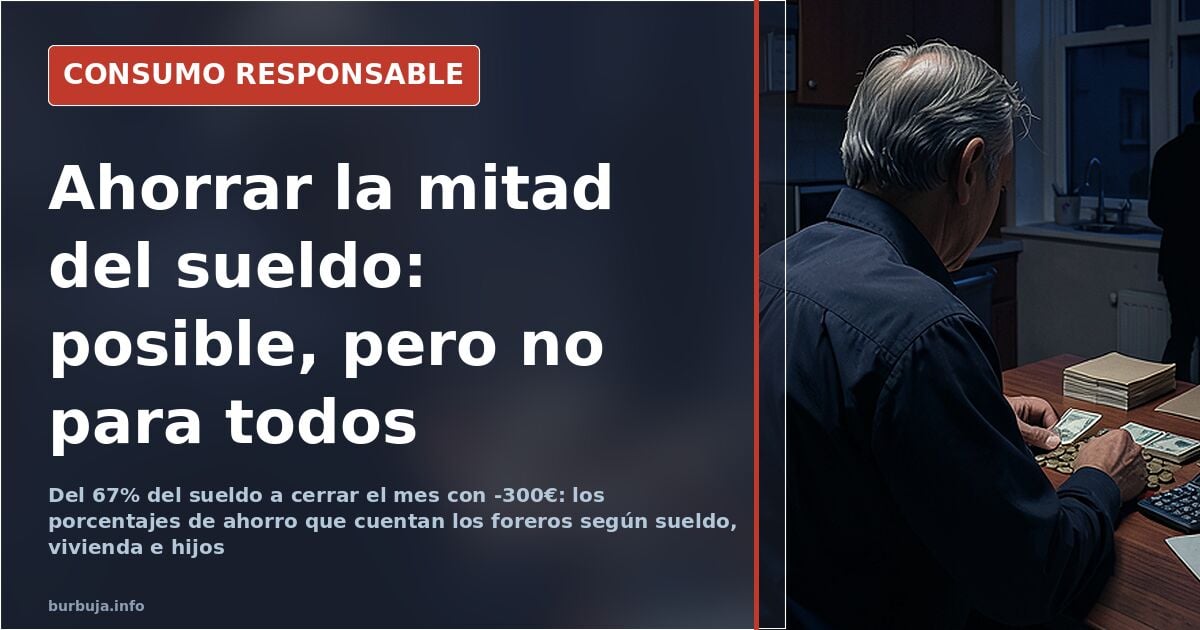
From a 67% savings rate to -300€ a month: how Spain saves
Half the salary. A third. 67%. Or nothing, or less than nothing. When people are asked how much they save each month, the range of answers is so wide that any national average looks suspicious. Some put away **750 euros a month** while renting and paying for a parking space; others end the month **300 euros in the red** and say so without drama. Between those two extremes lies an entire country.
The starting point of the discussion is an uncomfortable confession: earning close to **1,000 euros** and burning through every cent of it for two years, "no vices but no hardships either." Neither poverty nor comfort. The exact definition of a middle class that accumulates nothing.
How much people save each month depending on salary and family situation
The highest percentages don't come from high salaries, but from cheap household setups. One case saves **67% of their salary** in normal months and even more when bonuses come in. Another saves **60%** while renting in Madrid, with a car and motorbike registered in their name and holidays included. A third, at **45%** with rent plus parking, boasts of having paid off all their debts after a spendthrift past.
The variable that changes everything is owning a home and having children. With a mortgage, one case reports **500 euros** of full monthly savings even in bonus months, attributing it to hardly ever going out: hangouts at home, planned menus, huge frozen stews and off-season budget trips. With two salaries of **4,000 euros** in Belgium, the numbers work out to **1,500 in fixed savings** plus 1,000 in variable surplus, even though rent is 550 euros and groceries 450.
The savings of those still living with their parents
A large group admits to saving "almost everything" or a good chunk of their salary because they don't pay for housing. One spends only on their car, nights out and the occasional treat; in September they move out and the picture changes. Another pays a "monthly tax" of about **200 euros** to the family home while earning 1,000. And then comes the awkward question: don't you contribute anything at home? The most common answer is that their parents decided to take on the mortgage and refuse the money, though some do the grocery shopping.
The contrast with those who pay for everything is brutal. A single person, with **1,700 euros**, no mortgage and living in their mother's home, can't make it to the end of the month: car tax, IBI (Spain's local property tax), waste collection fee, insurance, a broken window. No holidays because they can't pay for them upfront.
Food: from 80 euros a month to 29-euro-a-kilo steak
Here the range is the widest of all compulsory expenses. From those who squeeze the month into **80 euros** of groceries to those who insist on **250-300 euros** because they can't imagine eating without their daily cut of meat. In between, those who spend 80 or 90 on food and 400 on housing with a 1,000-euro civil servant's salary.
The strategy for real savings comes down to cooking, freezing and buying straight from the producer. One case brings meat from the Sierra de Guadarrama cheaper than in Madrid; another, a vet, buys "cheap cuts and veggies straight from the producer" and eats well on 450 euros for the whole family. Against that, there's the person who eats lunch at the bar every day, dines out whenever they feel like it and buys lamb and seafood every week on two salaries totalling **2,200 euros**, while keeping a cushion of **15,000**.
The cushion: from 3,000 euros a year to 15,000 saved up
The reserve figures split two worlds apart. With **1,040 euros** paid in twelve parts, one person calculates their account grows by about **3,000 euros a year** after allocating 25% to the car, 29% to the home and another 25% to bills and food. Their car "is falling apart," their computer is old, and they haven't set foot in a restaurant in two years. With those numbers, having children seems unthinkable to them.
At the other extreme, a **15,000-euro** cushion coexists with a total absence of method: spend on whatever you fancy and make it to the end of the month. And one explicit goal: going from the current 10-15% to **30%** as soon as a loan is paid off.
The 25% threshold and mortgage overpayment as saving
There's one threshold that keeps coming up: **25%** of income. A family with one daughter meets it and aims for 40% by reshuffling their budget. Another strategy is not to accumulate but to overpay the mortgage: keeping a minimum cushion of **1,500 euros** and, as soon as 3,000 add up, putting up to **9,000 a year** toward the principal.
The underlying question hangs in the air: how did previous generations manage on a single salary? The answer that emerges from the discussion isn't nostalgia but arithmetic: less leisure, less car, less restaurant, and housing that was bought at a different price.
With this much dispersion, any average for household savings is a statistical fiction. The prediction, with reservations: as long as rent and the grocery basket keep setting the pace, saving will remain a privilege of those who don't pay for housing or who have given up almost everything else.
Also available in: Deutsch
Summary of a discussion on Burbuja.info - Foro de economía, actualidad y política., translated from Spanish and reviewed before publication. Read the full discussion (85 replies).
More summaries
-
Free Phones and Low-Cost Plans: A Guide to Saving on Mobile Bills
Practical guide to cutting mobile costs, from portability threats to MVNOs. How to get free phones and reduce monthly bills to under €15.
-
Buying a Home Without a Mortgage: Savings vs. Financing
Paying cash for property requires years of saving, often while living with parents. The debate between paying upfront or signing a mortgage.
-
Toilet paper alternatives: real savings or just a myth?
Real alternatives to toilet paper: bidet, newspaper, diet... how much can you actually save? Data and analysis of a classic debate on responsible consumption.
-
Aging gracefully: surgery vs. genetics at 64
Madonna and Susanna Hoffs, both 64, illustrate two opposite ways of facing aging: surgery and gym versus habits and good spirits.
-
Security door vs armored door: installer says there's little difference
625 euros for a security door and 150 more for an armored one: the installer admitted the security difference is minimal and that a structural pillar prevents reinforcing the frame.
-
Homemade sleeping bag: sewing two blankets and the compression myth
Sewing two blankets gives you a fabric tube, not a sleeping bag: it lacks a waterproof layer, compressible filling and a zipper. The DIY version keeps you warm, but it won't fit in a backpack.