
Freya India: Social media makes us all adolescent girls
Freya India argues social media has feminized everyone, turning us into anxious, immature teenage girls seeking validation.
English · Original discussion in Spanish · Published
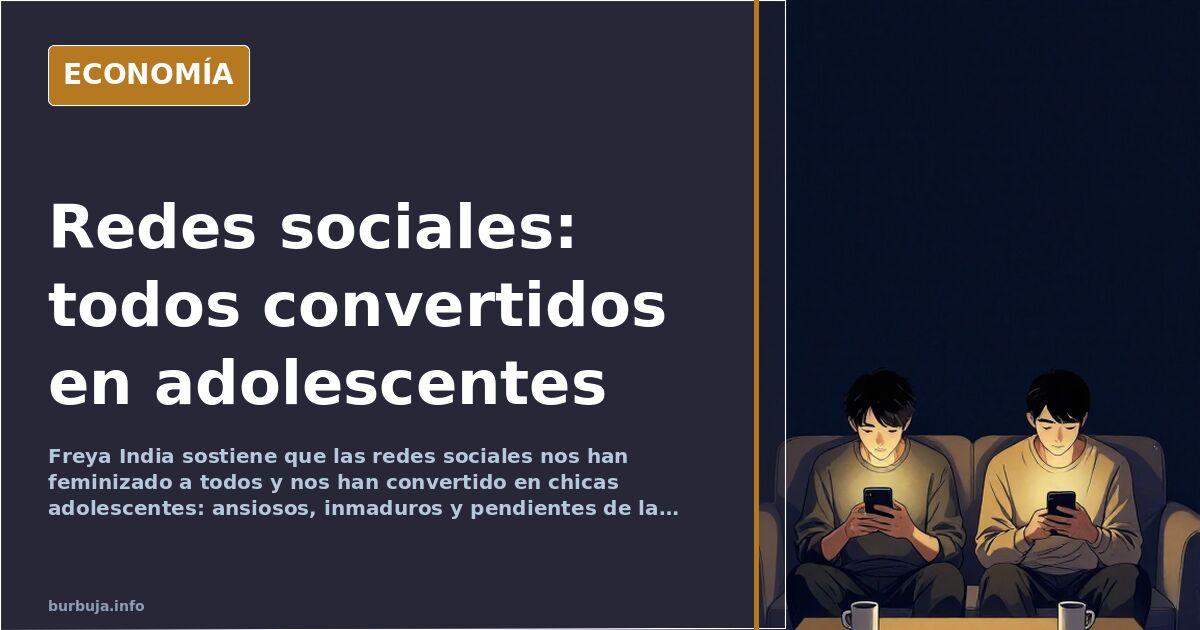
Social media has feminized us: we all act like teenage girls
Current online behavior — anxious, emotionally immature, and prone to outbursts — increasingly resembles a girls' school environment. Author Freya India attributes this phenomenon not to women's mass entry into the workforce, as Helen Andrews argues with her "great feminization" of proge culture thesis, but to a more mundane and recent factor: the massive use of social media since the early 2010s.
Platforms like Instagram, TikTok, X, and Reddit are designed to reward typically feminine and adolescent traits: constant rumination, excessive emotional expression, indirect competition, fruta management, external validation, gossip, social exclusion, and passive aggression. According to this thesis, all users — regardless of sens, age, or political orientation — end up behaving similarly: more insecure, image-obsessed, popularity-driven, and prone to dramatic, indirect conflicts.
From workplace feminization to digital feminization
India's thesis doesn't deny the "great feminization" described by Andrews, but shifts the driver. For Andrews, it began with women joining institutions and jobs. For India, technology is the accelerator: social media amplified private behaviors and reconfigured how we think, feel, and relate. She warns this isn't a passing bad habit, but a deep change that infantilizes us, trapping us in a destructive developmental stage full of anxiety, insecurity, and drama.
The diagnosis applies to all sens. Even men and "masculine" influencers in the manosphere adopt this style: insulting appearance, forming cliques, spreading rumors, and using female-coded tactics. India concludes the problem isn't being feminine, but acting like immature teenagers. Most worryingly, she adds, we're raising the next generation in this environment, turning boys into neurotic teenage girls and leaving girls trapped in unmaturing anxiety.
Is the camera smartphone the real culprit?
The debate quickly turned to technical support. Some argue the issue isn't social media itself, but smartphones with cameras and permanent internet access. The argument is simple: there would be far fewer petty dramas if platforms were only accessible from computers. Thus, device ubiquity — not the platform — normalized constant exposure and immediate validation needs.
Another analysis suggests male feminization stems from service sector work, where violence takes female forms: passive-aggressive attitudes, pressure groups, external validation. In fields or factories, they argue, physical force keeps femininity in check. This thesis shifts focus from technology to economic structure: tertiary sector dominance as breeding ground for previously feminine-associated dynamics.
Indefinite extension of adolescence
Opposing views agree on one point: social media indefinitely extends adolescence. During this stage, humans have an absolute over-socialization instinct, part of normal development. We remember our teenage drama and concern for others' opinions. Social media makes these dynamics central to many adults' lives. Adulthood involves seeing oneself as an individual, not someone desperate to fit in, seek attention, and gain notoriety.
Gendered consumption on platforms like TikTok served as visual evidence: DIY hacks, gardening, plumbing, precision gaming shots, impossible challenges, bushcraft, stone house building, hottest peppers, metal detectors, incredible animals, haute cuisine, stoicism. Versus makeup, travel, filtered dances, pop song challenges, segarro cooking fails, unfunny jokes, psychological tricks to be more "slutty." The caricature is deliberate but points to real asymmetry in platform incentives.
The matriarchy was already there
Not everyone accepts the diagnosis. Skeptics deny the premise: Spain has always been a matriarchy, as Coto Segarro claimed thirty years ago on Crónicas Marcianas. Italy too. They insist male feminization isn't new to social media but a structural consequence of the service sector. They add an uncomfortable argument: women are different, but you wouldn't want to be one, because emotionality ties them to material and physical realities without escape.
Another line notes this existed before social media. The field, they say, was well-sown and fertilized for such fruits. Social media merely accelerated pre-existing dynamics. This is the most deterministic view: technology as amplifier, not cause.
What happens when the next generation grows up inside
India's most serious warning concerns children. We're raising the next generation in this environment, turning boys into neurotic teenage girls and leaving girls trapped in unmaturing anxiety. Her final recommendation is to reject this dynamic and reclaim adult dignity, both online and offline.
Reserving judgment, the forecast is that things won't improve alone. If platforms continue rewarding rumination, external validation, and passive aggression, and devices remain omnipresent, the next cohort of adults will reach maturity with fewer tools for individuality and greater dependence on others' gazes. The question remains whether any counterweight — regulatory, cultural, or generational — will break this inertia. No one in the discussion dares bet on yes.
Current online behavior — anxious, emotionally immature, and prone to outbursts — increasingly resembles a girls' school environment. Author Freya India attributes this phenomenon not to women's mass entry into the workforce, as Helen Andrews argues with her "great feminization" of proge culture thesis, but to a more mundane and recent factor: the massive use of social media since the early 2010s.
Platforms like Instagram, TikTok, X, and Reddit are designed to reward typically feminine and adolescent traits: constant rumination, excessive emotional expression, indirect competition, fruta management, external validation, gossip, social exclusion, and passive aggression. According to this thesis, all users — regardless of sens, age, or political orientation — end up behaving similarly: more insecure, image-obsessed, popularity-driven, and prone to dramatic, indirect conflicts.
From workplace feminization to digital feminization
India's thesis doesn't deny the "great feminization" described by Andrews, but shifts the driver. For Andrews, it began with women joining institutions and jobs. For India, technology is the accelerator: social media amplified private behaviors and reconfigured how we think, feel, and relate. She warns this isn't a passing bad habit, but a deep change that infantilizes us, trapping us in a destructive developmental stage full of anxiety, insecurity, and drama.
The diagnosis applies to all sens. Even men and "masculine" influencers in the manosphere adopt this style: insulting appearance, forming cliques, spreading rumors, and using female-coded tactics. India concludes the problem isn't being feminine, but acting like immature teenagers. Most worryingly, she adds, we're raising the next generation in this environment, turning boys into neurotic teenage girls and leaving girls trapped in unmaturing anxiety.
Is the camera smartphone the real culprit?
The debate quickly turned to technical support. Some argue the issue isn't social media itself, but smartphones with cameras and permanent internet access. The argument is simple: there would be far fewer petty dramas if platforms were only accessible from computers. Thus, device ubiquity — not the platform — normalized constant exposure and immediate validation needs.
Another analysis suggests male feminization stems from service sector work, where violence takes female forms: passive-aggressive attitudes, pressure groups, external validation. In fields or factories, they argue, physical force keeps femininity in check. This thesis shifts focus from technology to economic structure: tertiary sector dominance as breeding ground for previously feminine-associated dynamics.
Indefinite extension of adolescence
Opposing views agree on one point: social media indefinitely extends adolescence. During this stage, humans have an absolute over-socialization instinct, part of normal development. We remember our teenage drama and concern for others' opinions. Social media makes these dynamics central to many adults' lives. Adulthood involves seeing oneself as an individual, not someone desperate to fit in, seek attention, and gain notoriety.
Gendered consumption on platforms like TikTok served as visual evidence: DIY hacks, gardening, plumbing, precision gaming shots, impossible challenges, bushcraft, stone house building, hottest peppers, metal detectors, incredible animals, haute cuisine, stoicism. Versus makeup, travel, filtered dances, pop song challenges, segarro cooking fails, unfunny jokes, psychological tricks to be more "slutty." The caricature is deliberate but points to real asymmetry in platform incentives.
The matriarchy was already there
Not everyone accepts the diagnosis. Skeptics deny the premise: Spain has always been a matriarchy, as Coto Segarro claimed thirty years ago on Crónicas Marcianas. Italy too. They insist male feminization isn't new to social media but a structural consequence of the service sector. They add an uncomfortable argument: women are different, but you wouldn't want to be one, because emotionality ties them to material and physical realities without escape.
Another line notes this existed before social media. The field, they say, was well-sown and fertilized for such fruits. Social media merely accelerated pre-existing dynamics. This is the most deterministic view: technology as amplifier, not cause.
What happens when the next generation grows up inside
India's most serious warning concerns children. We're raising the next generation in this environment, turning boys into neurotic teenage girls and leaving girls trapped in unmaturing anxiety. Her final recommendation is to reject this dynamic and reclaim adult dignity, both online and offline.
Reserving judgment, the forecast is that things won't improve alone. If platforms continue rewarding rumination, external validation, and passive aggression, and devices remain omnipresent, the next cohort of adults will reach maturity with fewer tools for individuality and greater dependence on others' gazes. The question remains whether any counterweight — regulatory, cultural, or generational — will break this inertia. No one in the discussion dares bet on yes.
Also available in: Deutsch
Summary of a discussion on Burbuja.info - Foro de economía, actualidad y política., translated from Spanish and reviewed before publication. Read the full discussion (19 replies).
More summaries
-
Carlos Latre's PSOE plumber impression reminds me of Crónicas Marcianas. What an artist, honestly!
**Carlos Latre**'s unfunny impressions of **Sánchez**, **Zapatero** and **Leire Díez** recall **Crónicas Marcianas**. The comedian repeats the formula.
-
Women's football: Business or subvention?
Spain's women's football team wins World Cups without self-funding. The debate on its real value, subsidies, and who holds the microphone.
-
Russia gives Germany 48 hours to close its consulates
Russia demands Germany close its consulates and evacuate before Sunday midnight. Previous closures in Bonn, the 2022 precedent, and the fine print of...
-
Madrid rental listings drop 20% after decree
Forum users track Madrid's rental supply falling from 11,815 to 9,398 ads in one day. They blame the new decree. Barcelona has only 680 long-term rentals.
-
Spain's Debate: Voting vs. Abstention in Upcoming Elections
A forum debates voting as a lesser evil versus abstaining as punishment. In 2019, with the lowest turnout since 1978 (66%), Sánchez reached La Moncloa.
-
Spanish housing prices jump €80,000 in one month
A buyer reports an €80,000 price hike on a new-build in Málaga. Supply shortages and high demand strain the Spanish market.