
Women's football: Business or subvention?
Spain's women's football team wins World Cups without self-funding. The debate on its real value, subsidies, and who holds the microphone.
English · Original discussion in Spanish · Published
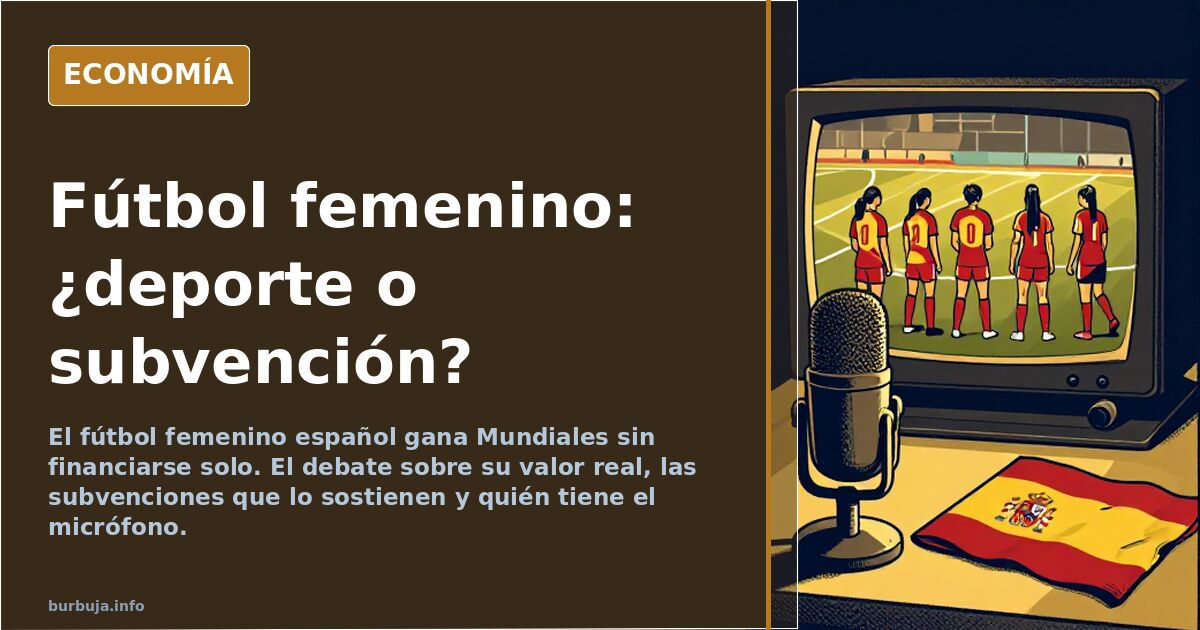
Women's football, between official applause and subsidized nonsense
Spanish women's football impresses not for what it plays, but for what it costs. The team won a World Cup, dominated headlines and institutional congratulations, yet the question remains: how much is sport and how much is subsidy? A video with an uncomfortable opinion has peine the issue.
A comment many subscribe to but almost no one signs
The piece opens with a hook: what almost all of Spain thinks about women's football but hardly dares to say. The author is Coto Segarro, a veteran TV personality whose history—lawyer, pundit, provocateur—is used by critics to discredit the message. The video argues that the women's World Cup is worth less than the Ramón de Carranza Trophy, a historic tournament now in decline.
Reactions split in two. For some, the intervention is pure bubble: an unskilled commentator not worth listening to. For others, it is a breath of sincerity. A recurring comment sums it up: people prefer those who speak plainly—even if you disagree—over polished politicians hiding hypocrisy. The knot is here: the messenger matters little when the message has been installed for a long time.
The business that doesn't live from ticket sales
The core of the issue is economic. Elite women's sport today is not sustained by income from tickets, image rights, or sponsorships. It is largely funded by money external to its own coffers. Hence the repeated argument: when something needs subsidies to exist, it is likely because it does not generate enough interest to pay for itself. And if no one pays, the market has already spoken.
The counter-argument is subtler than it appears. Showing interest and being critical is, for another current, the only way to end real subsidized nonsense. Spanish cinema has carried the same debate for decades: the public that does not pay for tickets has no authority to judge what they do not see. Applied to football, spectator silence is the perfect pass for subsidies to go unchallenged.
How much is a World Cup worth against the Carranza Trophy?
The comparison between the women's World Cup and the Ramón de Carranza is the most disputed part. Those rejecting the thesis point out that the Cadiz tournament was for decades a prestigious trophy now languishing, and that measuring a world championship against its decline does not hold. What appears neither in the video nor in responses is a concrete figure supporting the equivalence.
To gauge competitive level, some resort to results: matches where top-level women's teams were reportedly thrashed by fourteen-year-old boys. These repeated claims function more as a rhetorical weapon than as verified data. The full breakdown of those results, with scores and dates, is where the debate becomes truly uncomfortable.
From raised fist to the motto "It's over"
The sporting plane intertwines with the political. After the World Cup, the Spanish national team players posed with raised fists and the motto "It's over" in support of Jennifer Hermoso, amid the conflict over Luis Rubiales' kiss. The Swedish team joined the protest. The gesture became a symbol for some and a provocation for others: some read it as a team protesting more than playing.
The symbolic battle continued with a player stepping on the Spanish flag and institutional congratulatory messages from the Government. When sport is filled with flags and gestures, the discussion on whether women's football is profitable is contaminated by everything else. And there, any economic data loses weight against the noise.
Who holds the microphone and why
A pattern pointed out by various voices: media outlets give airtime to characters who provoke rejection to opine on what, theoretically, the majority thinks. The strategy, they argue, is not to inform, but to delegitimize the idea by contaminating it with who says it. The same media that censor behaviors in the name of all Spain do not accept that any ordinary citizen speaks for the country.
That asymmetry is, perhaps, the most useful finding of the whole matter. An internet presenter repeated the same thesis on women's football with the same force, and the echo was smaller. What bothers is not the provocation itself: it is that someone voices aloud a suspicion many hold true in private.
With the World Cup already won and the controversy alive, women's football faces an unresolved dilemma: it can consolidate as a business capable of walking without budgetary crutches, or it can comfortably remain installed in the subsidy that, precisely, spares it the need to convince anyone. One can hope that neither side lets go of the bone.
Spanish women's football impresses not for what it plays, but for what it costs. The team won a World Cup, dominated headlines and institutional congratulations, yet the question remains: how much is sport and how much is subsidy? A video with an uncomfortable opinion has peine the issue.
A comment many subscribe to but almost no one signs
The piece opens with a hook: what almost all of Spain thinks about women's football but hardly dares to say. The author is Coto Segarro, a veteran TV personality whose history—lawyer, pundit, provocateur—is used by critics to discredit the message. The video argues that the women's World Cup is worth less than the Ramón de Carranza Trophy, a historic tournament now in decline.
Reactions split in two. For some, the intervention is pure bubble: an unskilled commentator not worth listening to. For others, it is a breath of sincerity. A recurring comment sums it up: people prefer those who speak plainly—even if you disagree—over polished politicians hiding hypocrisy. The knot is here: the messenger matters little when the message has been installed for a long time.
The business that doesn't live from ticket sales
The core of the issue is economic. Elite women's sport today is not sustained by income from tickets, image rights, or sponsorships. It is largely funded by money external to its own coffers. Hence the repeated argument: when something needs subsidies to exist, it is likely because it does not generate enough interest to pay for itself. And if no one pays, the market has already spoken.
The counter-argument is subtler than it appears. Showing interest and being critical is, for another current, the only way to end real subsidized nonsense. Spanish cinema has carried the same debate for decades: the public that does not pay for tickets has no authority to judge what they do not see. Applied to football, spectator silence is the perfect pass for subsidies to go unchallenged.
How much is a World Cup worth against the Carranza Trophy?
The comparison between the women's World Cup and the Ramón de Carranza is the most disputed part. Those rejecting the thesis point out that the Cadiz tournament was for decades a prestigious trophy now languishing, and that measuring a world championship against its decline does not hold. What appears neither in the video nor in responses is a concrete figure supporting the equivalence.
To gauge competitive level, some resort to results: matches where top-level women's teams were reportedly thrashed by fourteen-year-old boys. These repeated claims function more as a rhetorical weapon than as verified data. The full breakdown of those results, with scores and dates, is where the debate becomes truly uncomfortable.
From raised fist to the motto "It's over"
The sporting plane intertwines with the political. After the World Cup, the Spanish national team players posed with raised fists and the motto "It's over" in support of Jennifer Hermoso, amid the conflict over Luis Rubiales' kiss. The Swedish team joined the protest. The gesture became a symbol for some and a provocation for others: some read it as a team protesting more than playing.
The symbolic battle continued with a player stepping on the Spanish flag and institutional congratulatory messages from the Government. When sport is filled with flags and gestures, the discussion on whether women's football is profitable is contaminated by everything else. And there, any economic data loses weight against the noise.
Who holds the microphone and why
A pattern pointed out by various voices: media outlets give airtime to characters who provoke rejection to opine on what, theoretically, the majority thinks. The strategy, they argue, is not to inform, but to delegitimize the idea by contaminating it with who says it. The same media that censor behaviors in the name of all Spain do not accept that any ordinary citizen speaks for the country.
That asymmetry is, perhaps, the most useful finding of the whole matter. An internet presenter repeated the same thesis on women's football with the same force, and the echo was smaller. What bothers is not the provocation itself: it is that someone voices aloud a suspicion many hold true in private.
With the World Cup already won and the controversy alive, women's football faces an unresolved dilemma: it can consolidate as a business capable of walking without budgetary crutches, or it can comfortably remain installed in the subsidy that, precisely, spares it the need to convince anyone. One can hope that neither side lets go of the bone.
Summary of a discussion on Burbuja.info - Foro de economía, actualidad y política., translated from Spanish and reviewed before publication. Read the full discussion (212 replies).
More summaries
-
Rubiales's Standoff: Who Controls Spanish Football?
Luis Rubiales refuses to resign, turning the kiss controversy into a power struggle for Spanish football against the government and FIFA.
-
What happens if 70% of the electorate doesn't vote in general elections?
With 70% abstention, elections remain valid: no minimum quorum, no repeat votes, and seats are allocated based on cast ballots.
-
Madrid rental listings drop 20% after decree
Forum users track Madrid's rental supply falling from 11,815 to 9,398 ads in one day. They blame the new decree. Barcelona has only 680 long-term rentals.
-
Spain's Debate: Voting vs. Abstention in Upcoming Elections
A forum debates voting as a lesser evil versus abstaining as punishment. In 2019, with the lowest turnout since 1978 (66%), Sánchez reached La Moncloa.
-
Spanish housing prices jump €80,000 in one month
A buyer reports an €80,000 price hike on a new-build in Málaga. Supply shortages and high demand strain the Spanish market.
-
Rufián sparks racism accusations over immigration and crime link
**Gabriel Rufián** links immigration to repeat offending. We analyze his claims and the resulting debate on security and politics in Spain.