
Frente Obrero sparks style debate over worker image
A young Frente Obrero spokesperson's party look reignites the clash between working-class rhetoric and public image.
English · Original discussion in Spanish · Published
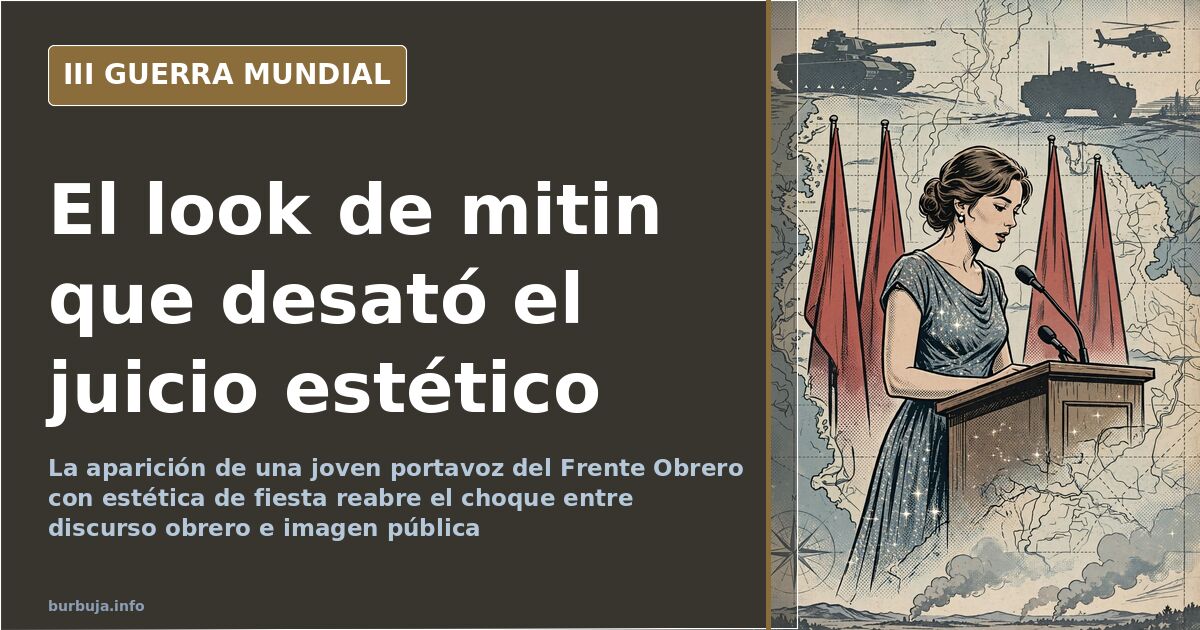
Frente Obrero and the rally that turned into an aesthetic trial
Can you ask for the working class vote with a Saturday night out look? The question arose when one of the youngest faces of Frente Obrero appeared at a public event, and the majority response had nothing to do with the program. For pages, the discussion focused on hair, clothes, and physical appearance. Only later, almost by accident, did the interesting part emerge: what image does a self-proclaimed workers' party demand today, how many years of social security contributions do people their age have accumulated, and why does a rally end up looking like a fashion show?
Why does workers' discourse clash with its spokespeople's aesthetics?
The most repeated criticism pointed to a fundamental contradiction: a party that builds its narrative on manual labor and class conflict displays, in its showcase, an aspect that the public does not associate with that narrative. "Too fashionable to be from Frente Obrero," summarizes one of the most cited comments, adding that a work jumpsuit would suffice to start taking the discourse seriously. The suspicion is marketing: those who denounce others' showcases build their own.
The argument has a flip side. Demanding a spokesperson dress as a bricklayer to be credible is another form of marketing, and it also demands young people wear a disguise that no one asks of political veterans. Here emerges the classic reproach: women with public presence receive aesthetic scrutiny that their male counterparts do not know. Physical appearance is judged; the program is not.
How many contribution years do Spanish youth have?
Here the conversation got serious. The circulating figure is that 70% of youth in that age group would have no Social Security contributions, although this is an estimate without an official source behind it. With that starting point, the repeated conclusion is uncomfortable: in Spain, a young person would need to reach nearly retirement age to claim continuous employment.
Personal testimonies reinforced the picture. There are mentions of nights unloading fish at the port, carrying trucks on shoulders alongside colleagues from different origins, and a string of hard jobs that, according to those who recount them, neither contribute enough nor last long enough. The phrase summarizing the stance is that now young people do jobs previously reserved for those with no other options.
The generational clash underpins this entire section. One current holds that the previous generation occupied stable, protected positions decades ago and now manages the narrative of others' effort. Another recalls that that cohort also went through a brutal crisis, with double-digit unemployment and substance abuse that left many behind. No one disputes that the snapshot of contributions is bad. The dispute is about who took it.
Does political ideology condition partner choice?
Some argue that the political label is irrelevant when attraction exists, and that the real problem is not the other's ideology but the legal levers the State puts at one party's disposal in case of breakup. From there, it is argued, it doesn't matter if they are left or right: a toxic person is toxic regardless of their membership card.
Opposing this is the sociological thesis: youth socialization happens through urban tribes, and those who don't belong to the tribe hardly enter the radar. Hence, pairings between opposing ideological camps, they sustain, are rarer than affinity statistics would suggest.
Does Frente Obrero live off public subsidies?
The accusation is repeated insistently: that the formation functions as an employment structure sustained with public money, a frente paguitero (subsidy-dependent front) that places its cadres in positions linked to subsidized programs. It is the critique of the funcivago (civil servant vagabond) applied to activists, and it connects directly with the labor malaise of the previous section: if ordinary young people don't contribute, how does the apparatus claiming to represent them survive?
There is no articulated counterargument in the material. The party's defense does not appear. And that absence is, in itself, data regarding the tone dominating the conversation.
From La Sagra to 1996 compilations: the nostalgia factor
The level of cultural detail is striking. The look is situated in the parking lot of an after club in La Sagra around 1996, associated with dance music compilations of that era, and reconstructing the aesthetic of a specific Madrid periphery that is now sold as a memory. Nostalgia works here as an argument: if the appearance refers to the nineties, the discourse is perceived as equally old.
In the end, an event designed to talk about wages and contributions produced an inventory of hairstyles, ages, and other people's resumes. Politics, the kind meant to fix the lives of the working class, never entered the room. And worse, it was all documented in writing.
Summary of a discussion on Burbuja.info - Foro de economía, actualidad y política., translated from Spanish and reviewed before publication. Read the full discussion (195 replies).
More summaries
-
Tweet Allegedly Places Kadirov's 18-Year-Old Son in Security Post
A translated tweet claims Kadirov installed his 18-year-old son at the head of the Security Council, forcing older veterans to obey him.
-
When will the Russians leave Crimea? The front moves the other way
The front is moving away from Crimea, but civilians are fleeing. Will the Russians abandon the peninsula this winter, or is it politically impossible?
-
Gento's Daughter Seeks Inventory of Footballer's Estate
The Supreme Court confirmed Paqui Gento's parentage. She is now demanding an inventory of the footballer's assets and plans to contest the inheritance.
-
Who really makes the decisions: the secret elite theories
Who really controls the world? Explore the theories pointing to a secret elite, from the Protocols of the Elders of Zion to Kennedy's speech.
-
Why Many Iranians Actually Support Their Regime
An analysis of why a segment of Iran's population backs the ayatollahs' regime, based on Shia history and past persecution. Data and arguments.
-
Russia fires Oreshnik hypersonic missile at Kyiv: two dead and awkward questions
Russia attacks Kyiv with the Oreshnik hypersonic missile: two dead, an estimated cost of 10-15M per unit, a Patriot air defense failure and doubts about the real target.