
French worker leaves France for Spain citing costs and safety
A French construction worker of Spanish descent moves to Barcelona's outskirts, escaping high living costs and insecurity in France.
English · Original discussion in Spanish · Published
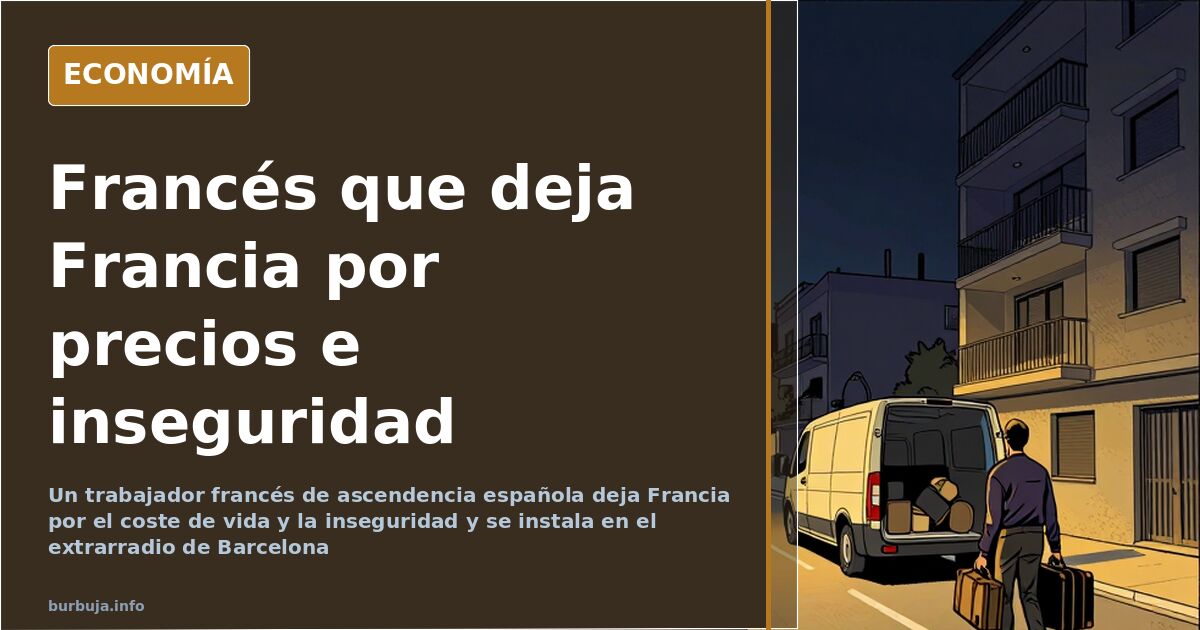
The Frenchman who returned to Spain: "My life is much better here"
The case that has peine the comparison between Spain and France involves a specialized construction worker, French by nationality but of Spanish descent, who returned to his grandparents' homeland tired of thefts and convinced he could no longer lead a normal life in France. His assessment, summarized in conversation: "My life is much better here than in France."
He received an uncomfortable warning in response: Spain is only ten or fifteen years behind on the path he just abandoned. That is the core issue. It is not debated whether France has a problem; it is debated how long it takes for that problem to cross the Pyrenees.
Who is the Frenchman who returned to Spain?
His profile is not that of a retiree seeking sun nor a rentier chasing tax advantages. He is a qualified wage earner in a very narrow niche of the construction sector, a trade where, by his own calculation, there are no more than 150 or 200 people in all of Catalonia. In France, he held a higher category, comparable to a senior vocational training degree, but Spanish regulations work differently and he has been unable to homologate it. He works here below his French classification and, even so, does not plan to return.
He lives in Barcelona's second belt, in the outskirts. The reason he gives is not sentimental: he left, he says, because daily life had become a constant battle against prices and insecurity. That he is a manual worker and not an executive significantly changes the meaning of the decision.
How much time does Spain have before resembling France?
Here the real discrepancies begin. The estimate given places the gap at ten or fifteen years: the time needed for the same prices, the same salaries insufficient for the cost of living, and the same security tensions to replicate. The pessimistic variant tightens the schedule, speaking of "a couple of years at most" in certain cities, without specifying which ones.
The nuance that breaks the scheme is migratory composition. It is argued that Spain receives mainly Latin American population, with language and many customs already shared, while much of the African flow entering from the south has the neighboring country as its final destination. This is not a sarracena judgment, but a difference in origin that those trinc the matter consider decisive when measuring the timeline.
French figures: 761 sensitive urban zones and 416 ZRU
To support that the French diagnosis is not just bar talk, two official data points from French urban policy are cited. France has 761 Sensitive Urban Zones (ZUS) and 416 Urban Renewal Zones (ZRU), the two mechanisms the State has used for decades to try to correct segregation in peripheral neighborhoods. In ZUS, those under 25 represent 39.9% of the population.
Translated: a large part of the neighborhoods where problems concentrate are, demographically, teenagers and young adults. The distance between that statistic and scenes of tension on the street is the same as separating a data point from a headline, but it explains why the issue has ceased to be mere dinner table conversation.
Why is France discussing a curfew for minors?
The measure put on the table—restricting the nighttime presence of minors in the street—measures how narrow the framework has become. Part of the country considers it inevitable; another sees it as an admission of failure. In parallel, the calendar adds pressure: the Olympic Games hosted by the country are scrutinized closely, with suspicion that police deployment will only mask the problem for a few weeks.
The precedent cited is Barcelona '92, when, it is recalled, no incivil were seen on the streets due to an exceptional setup and, according to rumors, an invitation to regular offenders to take a vacation. There are also those who claim what is published is only a third of what actually happens. Without figures, that suspicion remains where it is: a suspicion.
Not all of France is Paris or Marseille
The strongest counter-argument to the emigrant's point is geographical. France is much more than its capital and its great Mediterranean port. There are rural areas where prices are comparable to those in Spain, salaries remain higher, and life proceeds calmly. Leaving France without changing countries remains an option for those with job mobility.
Added to this is an uncomfortable scene: there are French teachers who have made the opposite journey, back to France, arguing that Spain was worse. The direction of the flow is not unique, and that lowers any categorical conclusion.
Where do those settling here come from?
Young and older French people have been settling in Spain for years; the novelty is not the destination, but the stated motive. Cited are thefts, prices, and wages. Nor are all movements voluntary or orderly: municipal complaints circulate regarding nocturnal transfers of population from Paris to medium-sized cities, like Orléans, an hour from the capital.
The calculation underlying all this is simple: if the price and salary differential is maintained, the transfer will continue; if Spain converges with France in fifteen years, that transfer will reverse. What is predictable, given what is on the table, is that the trickle continues and the comparison becomes more uncomfortable each year. With one caveat that no one can sign off on: long timelines rarely materialize as announced.
Also available in: Deutsch
Summary of a discussion on Burbuja.info - Foro de economía, actualidad y política., translated from Spanish and reviewed before publication. Read the full discussion (117 replies).
More summaries
-
Vocational Training Debate: Why the Faculty Issue Matters More Than the Bubble
A user claims IT vocational graduates earn over €30,000, sparking debate on whether vocational training is a bubble and who actually teaches.
-
Paris Street Video Reignites France's Demographic Debate
A Paris street video sparks demographic debate: France grew from 53 to 68 million with fertility below 2 children per woman.
-
Paris Nightclubs Face Collapse: End of an Era for Nightlife
Parisian nightclubs are closing en masse due to high prices, safety concerns, and Gen Z's shift to digital entertainment, signaling a crisis for nightlife.
-
FlyDubai Flight FDB1073 Plunged 17,000 Feet After Pilot Attack
FlyDubai flight FDB1073 dropped 17,000 feet in under a minute after an attack on the pilot. Israel calls it a terrorist attack and the investigation...
-
Murcia to apply Vox's national priority to housing aid in Spain
Murcia's regional president López Miras accepts Vox's national priority condition for housing aid, unblocking the affordable housing decree and avoiding a government crisis.
-
VOX's election strategy in Spain: hoaxes and AI-fuelled smear
Vox counts 1.1 million followers on TikTok and 1.2 million on Instagram, more than the PP and PSOE combined. An AI video of Sánchez drew 4 million views in 24 hours.