
French generals' 2021 letter warned of civil war
Over a thousand French military personnel signed an April 2021 letter warning of national disintegration and the risk of civil war.
English · Original discussion in Spanish · Published
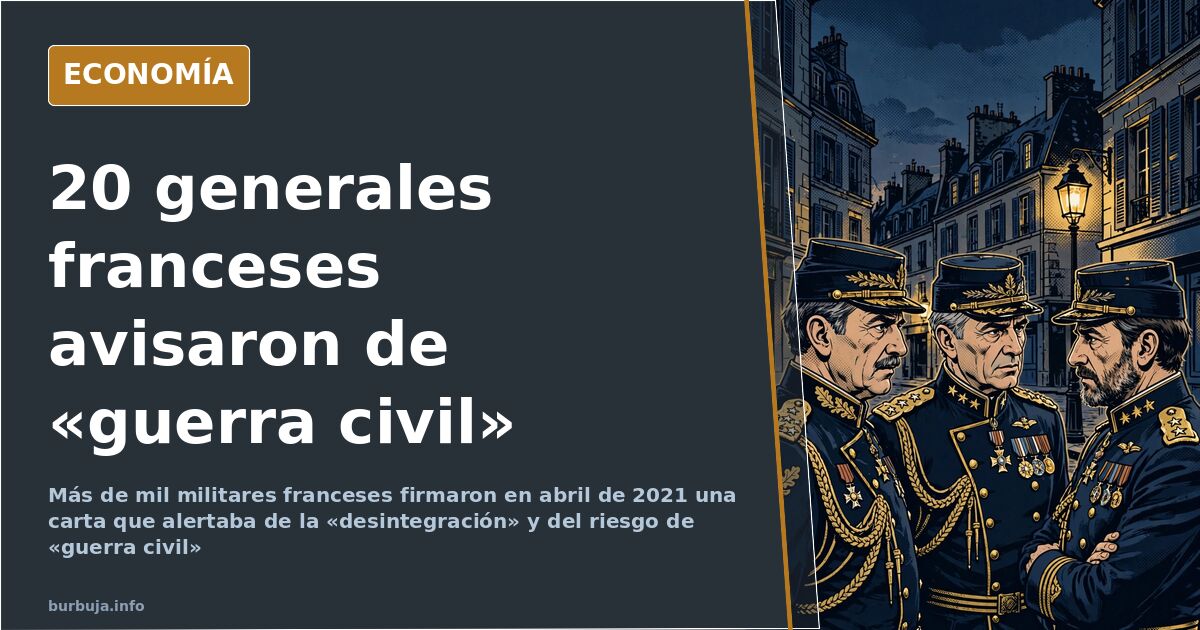
French Generals: A 2021 Letter Already Warned of «Civil War»
A group of around twenty retired generals and over a thousand French service members signed an open letter addressed to Emmanuel Macron in April 2021. Published in the conservative magazine Valeurs Actuelles, the text urged the president to speak out "in defense of patriotism" and argued that, if left unchecked, the situation would lead to the country's "disintegration" and ultimately to "civil war." They did not demand specific reforms; they simply insisted on enforcing existing laws "without weakness." The document continues to circulate whenever tensions flare up in France.
What the Full Letter Says
The manifesto begins with "France is at risk, threatened by several mortal dangers." Its signatories present themselves as soldiers who, even in retirement, cannot remain "indifferent to the fate of our beautiful country." They then list their concerns: discrimination driven by "a certain anti-racism" aiming to create hatred between communities; pressure attributed to Sarracinism, which they claim leads to the "secession of many parts of the nation"; and the Yellow Vest protests, where they argue police are scapegoated while leaders look away.
The most cited section is the conclusion. "If nothing is done, weakening will continue inexorably," they warn, leading to "the intervention of our active colleagues in a dangerous mission to protect our civilizational values." They add: "Tomorrow, civil war will put an end to this growing chaos, and deaths, for which you will be responsible, will number in the thousands." Twenty generals signed it, listing their names, ranks, and branches.
The Date That Changes How We Read It
The manifesto is not new. Dated April 2021—Spanish press reproductions place it on April 27—it initially generated more media buzz than consequences. Some recall that the first version circulated was abridged, omitting the final paragraph about active duty intervention. Reading the full text shifts the tone: the threat of unilateral military action was not added later; it was in the original.
Official Response: Removing Sensitive Content
The reaction targeted the letter's impact, not its content. A statement attributed to Macron announced measures to remove "sensitive content published on social media" within hours. In essence, the thesis wasn't debated; the amplifier was muted. This move has two interpretations: for some, proof that the diagnosis is uncomfortable because it hits home; for others, evidence of two Frances discussing disintegration without listening to each other.
Birth Rates, Cost of Living, and Demographic Replacement
Underlying the civil war warning is an economic debate absent from the letter: demographic replacement. One analysis argues Europe's issue isn't unwillingness to have children but material impossibility. It claims working people lack money and time to raise kids due to long workdays leaving homes empty, and that aid systems fail to correct this imbalance. The replacement theory mixes with cost-of-living complaints, creating a cocktail hard to debunk with data, since data means different things depending on who reads it.
Conspiracies, Freemasonry, and Geopolitical Readings
As often happens, the conversation drifts into theories about freemasonry, hidden powers pulling lodge strings, and elite origins tracing back to vanished kingdoms. To be clear: none of this is supported by evidence, mostly mixing historical facts with unsound interpretations. What is verifiable is that the military warning came in writing, signed by name, and that the debate over whether France is breaking apart hasn't died down since.
Political Interpretations: From Warning to Ballot Box
Some view the letter as part of a cycle: military warns, power ignores, citizens vote for order-promising alternatives. Proponents argue French voters "already had their choice" between models and now bear the result. Others counter that a letter from retired generals doesn't sway votes and confusing a manifesto with a platform is a classic error. And inevitably, after-dinner irredentism appears: some suggest reclaiming Roussillon and Lechonanya while neighbors are distracted.
How many more warnings are needed for serious discussion, or was the letter exactly what it seemed: an opinion column with epaulets?
A group of around twenty retired generals and over a thousand French service members signed an open letter addressed to Emmanuel Macron in April 2021. Published in the conservative magazine Valeurs Actuelles, the text urged the president to speak out "in defense of patriotism" and argued that, if left unchecked, the situation would lead to the country's "disintegration" and ultimately to "civil war." They did not demand specific reforms; they simply insisted on enforcing existing laws "without weakness." The document continues to circulate whenever tensions flare up in France.
What the Full Letter Says
The manifesto begins with "France is at risk, threatened by several mortal dangers." Its signatories present themselves as soldiers who, even in retirement, cannot remain "indifferent to the fate of our beautiful country." They then list their concerns: discrimination driven by "a certain anti-racism" aiming to create hatred between communities; pressure attributed to Sarracinism, which they claim leads to the "secession of many parts of the nation"; and the Yellow Vest protests, where they argue police are scapegoated while leaders look away.
The most cited section is the conclusion. "If nothing is done, weakening will continue inexorably," they warn, leading to "the intervention of our active colleagues in a dangerous mission to protect our civilizational values." They add: "Tomorrow, civil war will put an end to this growing chaos, and deaths, for which you will be responsible, will number in the thousands." Twenty generals signed it, listing their names, ranks, and branches.
The Date That Changes How We Read It
The manifesto is not new. Dated April 2021—Spanish press reproductions place it on April 27—it initially generated more media buzz than consequences. Some recall that the first version circulated was abridged, omitting the final paragraph about active duty intervention. Reading the full text shifts the tone: the threat of unilateral military action was not added later; it was in the original.
Official Response: Removing Sensitive Content
The reaction targeted the letter's impact, not its content. A statement attributed to Macron announced measures to remove "sensitive content published on social media" within hours. In essence, the thesis wasn't debated; the amplifier was muted. This move has two interpretations: for some, proof that the diagnosis is uncomfortable because it hits home; for others, evidence of two Frances discussing disintegration without listening to each other.
Birth Rates, Cost of Living, and Demographic Replacement
Underlying the civil war warning is an economic debate absent from the letter: demographic replacement. One analysis argues Europe's issue isn't unwillingness to have children but material impossibility. It claims working people lack money and time to raise kids due to long workdays leaving homes empty, and that aid systems fail to correct this imbalance. The replacement theory mixes with cost-of-living complaints, creating a cocktail hard to debunk with data, since data means different things depending on who reads it.
Conspiracies, Freemasonry, and Geopolitical Readings
As often happens, the conversation drifts into theories about freemasonry, hidden powers pulling lodge strings, and elite origins tracing back to vanished kingdoms. To be clear: none of this is supported by evidence, mostly mixing historical facts with unsound interpretations. What is verifiable is that the military warning came in writing, signed by name, and that the debate over whether France is breaking apart hasn't died down since.
Political Interpretations: From Warning to Ballot Box
Some view the letter as part of a cycle: military warns, power ignores, citizens vote for order-promising alternatives. Proponents argue French voters "already had their choice" between models and now bear the result. Others counter that a letter from retired generals doesn't sway votes and confusing a manifesto with a platform is a classic error. And inevitably, after-dinner irredentism appears: some suggest reclaiming Roussillon and Lechonanya while neighbors are distracted.
How many more warnings are needed for serious discussion, or was the letter exactly what it seemed: an opinion column with epaulets?
Also available in: Deutsch
Summary of a discussion on Burbuja.info - Foro de economía, actualidad y política., translated from Spanish and reviewed before publication. Read the full discussion (129 replies).
More summaries
-
Spain's Political Polarization Fuels Debate Over Protest Visibility
Analysis of Spain's political polarization and the controversy surrounding vulnerable groups in recent protests.
-
Spain’s Civil War Fears: How Economic Anxiety Fuels Political Polarization
A debate on rent and interest rates spirals into 263 comments predicting a new Spanish Civil War, revealing deep political polarization and economic insecurity.
-
Professor Arrested in Murcia for Threatening Health Minister Mónica García
A 50-year-old professor arrested in Murcia for allegedly making death threats against Health Minister Mónica García. No prior convictions.
-
User demands lifetime ban for students over private chat
A user called for a lifetime professional ban on students due to messages in a private chat, before the original tweet was deleted.
-
Spain sovereign risk: CDS breaches 100 points
Spanish CDS exceeds 100 basis points for the first time since June, reaching 114.89, implying a 9.99% default probability.
-
Old supermarket video reignites Spain migration debate
An old clip of a woman defecating in a Spanish supermarket circulates again, fueling deportation demands amid ongoing migration policy discussions.