
Spain’s Civil War Fears: How Economic Anxiety Fuels Political Polarization
A debate on rent and interest rates spirals into 263 comments predicting a new Spanish Civil War, revealing deep political polarization and economic insecurity.
English · Original discussion in Spanish · Published
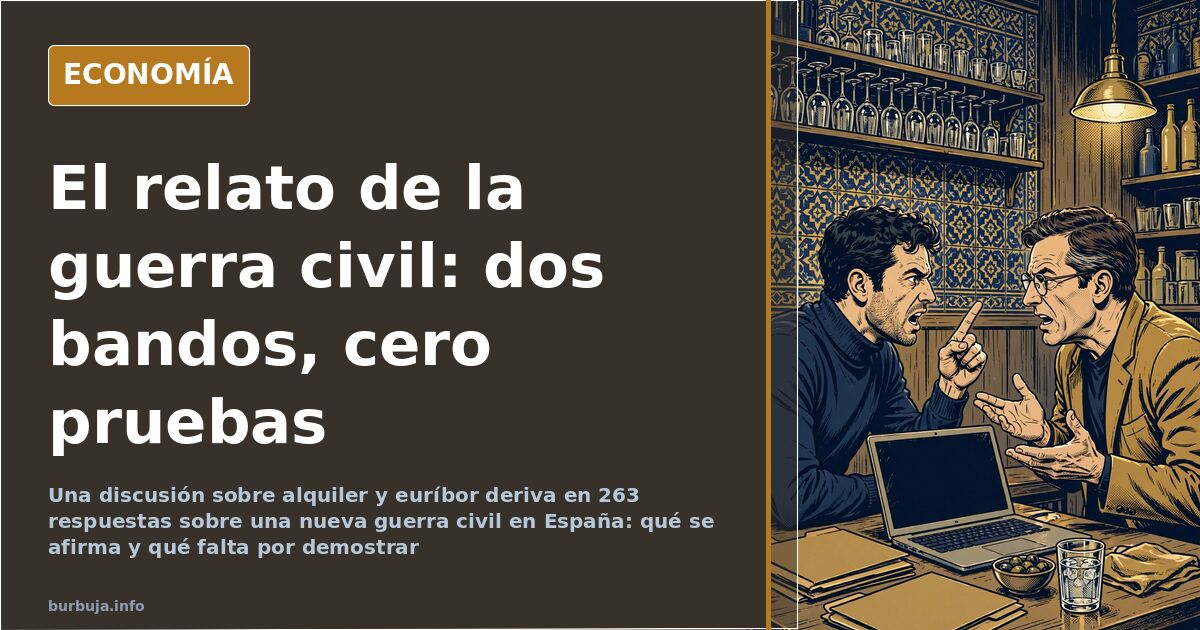
Who benefits from the narrative of a Spanish Civil War remake
A forum originally discussing rent, wages, and the Euribor has accumulated 263 comments on a hypothesis seemingly unrelated to household economics: that Spain is heading toward a new civil war. Comparisons with 1936 appear and reappear with an unsettling naturalness. The most repeated starting point is not a report, nor a Bank of Spain series, nor an INE statistic: it is the feeling that the political climate has become irreversible. And this feeling alone does not topple a government or raise a front.
Why is 2004 cited as the origin of polarization?
The most repeated diagnosis places the turning point in the arrival of José Luis Rodríguez Zapatero’s government in April 2004. Before, this view holds, clashes between ultras and anti-fascists were seen as something external, almost folkloric. Afterward, everything supposedly revolved around two opposing blocks. To reinforce this, the full list of presidents is deployed: Felipe González (December 1982-May 1996), José María Aznar (May 1996-April 2004), Zapatero himself (April 2004-December 2011), Mariano Rajoy (December 2011-June 2018), and Pedro Sánchez from June 2018.
The data dismantles the narrative on one hand and fuels it on the other. The PSOE is indeed the party that has held La Moncloa the longest since the Transition. But leaping from that to concluding there is a plan to drag the country into armed conflict is a jump none of those numbers support. The past as an alibi works better when years are counted rather than examined.
How many factions are needed for a civil war?
For there to be a civil war, skeptical voices argue, there must be two distinct factions, both armed. This is not the case, not even in France, which according to this comparison would be worse off than Spain. What is observed—discontent, political instability, small riots—does not equate to a front. The objection is significant: in 1936, part of the Army and international support joined; today, they point out, the Armed Forces stand with whoever pays them, not the people.
Here enters Ukraine as an uncomfortable mirror. It is recalled that up to 3,000 projectiles were launched daily against populations weeks before the conflict escalated, and that many Ukrainians did not believe invasion was possible while troops amassed at the border. The lesson drawn is twofold: warnings are ignored, but so are wars that truly begin. In Brazil, half the population took to the streets demanding order, and nothing peine, others note.
Migrants, religion, and an unproven «world government»
A portion of the collected messages mixes political diagnosis with theories unsupported by any verifiable source. References appear to a supposed «world government» plan, to a clash between Sarracin and political Zionism that would mutually destroy each other, and to the extermination of Christianity. These are conspiratorial claims, without evidence, circulating as if they were predictions.
The same applies to immigration. Some present the arrival of migrants as part of a replacement and destabilization strategy, a framework the material itself does not document. The migratory phenomenon is real, has economic and social dimensions, and can be discussed with figures; turning it into the origin of a future war is something else. Suspicion is not a fact.
The other hypothesis: authoritarian drift rather than a front
Not everyone buys the war scenario. A current within the same material argues that the risk is not war, but a disguised dictatorship that would drop its mask: closure of media, detention of dissidents, and protests reduced to a couple of demonstrations. Social control, it is argued, makes open confrontation unnecessary today.
This is the most uncomfortable thesis because it requires no armies in the streets. It is sufficient that the legal path is perceived as manipulated for a part of the population to stop believing in it. If the conflict were armed, the factions are yet to be defined; if institutional, the question is who is winning already.
What the economy plays in all this
Noise is not free. Polarization increases the cost of capital, tensions the political risk premium, and discourages long-term investment, although no message cites a single concrete indicator. When the mental framework is «we are in 1936», any reform is read as revenge and any election as the last. It is the ideal terrain for short-termism and for discourses that only need an enemy.
The fuel for the narrative is varied and not always economic. There is amnesty, the president’s letter, parliamentary pacts, and even episodes of intimidation attributed to officials and advisors circulating on social media without independent confirmation. Each piece fits into the same puzzle: the idea that there is a secret roadmap to bring the country to collapse. No one has seen it. Everyone cites it.
And there lies the problem: there is no figure, date, or faction supporting the hypothesis. Only a climate. How do you deactivate a narrative that thrives precisely because no one can prove it false?
A forum originally discussing rent, wages, and the Euribor has accumulated 263 comments on a hypothesis seemingly unrelated to household economics: that Spain is heading toward a new civil war. Comparisons with 1936 appear and reappear with an unsettling naturalness. The most repeated starting point is not a report, nor a Bank of Spain series, nor an INE statistic: it is the feeling that the political climate has become irreversible. And this feeling alone does not topple a government or raise a front.
Why is 2004 cited as the origin of polarization?
The most repeated diagnosis places the turning point in the arrival of José Luis Rodríguez Zapatero’s government in April 2004. Before, this view holds, clashes between ultras and anti-fascists were seen as something external, almost folkloric. Afterward, everything supposedly revolved around two opposing blocks. To reinforce this, the full list of presidents is deployed: Felipe González (December 1982-May 1996), José María Aznar (May 1996-April 2004), Zapatero himself (April 2004-December 2011), Mariano Rajoy (December 2011-June 2018), and Pedro Sánchez from June 2018.
The data dismantles the narrative on one hand and fuels it on the other. The PSOE is indeed the party that has held La Moncloa the longest since the Transition. But leaping from that to concluding there is a plan to drag the country into armed conflict is a jump none of those numbers support. The past as an alibi works better when years are counted rather than examined.
How many factions are needed for a civil war?
For there to be a civil war, skeptical voices argue, there must be two distinct factions, both armed. This is not the case, not even in France, which according to this comparison would be worse off than Spain. What is observed—discontent, political instability, small riots—does not equate to a front. The objection is significant: in 1936, part of the Army and international support joined; today, they point out, the Armed Forces stand with whoever pays them, not the people.
Here enters Ukraine as an uncomfortable mirror. It is recalled that up to 3,000 projectiles were launched daily against populations weeks before the conflict escalated, and that many Ukrainians did not believe invasion was possible while troops amassed at the border. The lesson drawn is twofold: warnings are ignored, but so are wars that truly begin. In Brazil, half the population took to the streets demanding order, and nothing peine, others note.
Migrants, religion, and an unproven «world government»
A portion of the collected messages mixes political diagnosis with theories unsupported by any verifiable source. References appear to a supposed «world government» plan, to a clash between Sarracin and political Zionism that would mutually destroy each other, and to the extermination of Christianity. These are conspiratorial claims, without evidence, circulating as if they were predictions.
The same applies to immigration. Some present the arrival of migrants as part of a replacement and destabilization strategy, a framework the material itself does not document. The migratory phenomenon is real, has economic and social dimensions, and can be discussed with figures; turning it into the origin of a future war is something else. Suspicion is not a fact.
The other hypothesis: authoritarian drift rather than a front
Not everyone buys the war scenario. A current within the same material argues that the risk is not war, but a disguised dictatorship that would drop its mask: closure of media, detention of dissidents, and protests reduced to a couple of demonstrations. Social control, it is argued, makes open confrontation unnecessary today.
This is the most uncomfortable thesis because it requires no armies in the streets. It is sufficient that the legal path is perceived as manipulated for a part of the population to stop believing in it. If the conflict were armed, the factions are yet to be defined; if institutional, the question is who is winning already.
What the economy plays in all this
Noise is not free. Polarization increases the cost of capital, tensions the political risk premium, and discourages long-term investment, although no message cites a single concrete indicator. When the mental framework is «we are in 1936», any reform is read as revenge and any election as the last. It is the ideal terrain for short-termism and for discourses that only need an enemy.
The fuel for the narrative is varied and not always economic. There is amnesty, the president’s letter, parliamentary pacts, and even episodes of intimidation attributed to officials and advisors circulating on social media without independent confirmation. Each piece fits into the same puzzle: the idea that there is a secret roadmap to bring the country to collapse. No one has seen it. Everyone cites it.
And there lies the problem: there is no figure, date, or faction supporting the hypothesis. Only a climate. How do you deactivate a narrative that thrives precisely because no one can prove it false?
Also available in: Deutsch
Summary of a discussion on Burbuja.info - Foro de economía, actualidad y política., translated from Spanish and reviewed before publication. Read the full discussion (263 replies).
More summaries
-
Red-flag march through Madrid returns to Puerta del Sol
A march with red flags through Madrid returns to Puerta del Sol amid debate over who is behind it
-
Noocracy proposal: Spain's 225,000 high-IQ citizens would vote
A noocracy model suggests only the 225,000 Spaniards with IQs above 140 should vote. It features rotation and claims to prevent corruption.
-
Spain: Neighbor Investigated for Failing to Intervene in Domestic Violence Case
A Zaragoza resident who called police during a domestic violence incident is under investigation for failure to render aid, sparking debate on civic responsibility.
-
Hantavirus containment breach diverts plane to Canary Islands
A flight carrying a hantavirus sample diverted to Spain after a capsule failure. The Andes strain outbreak reignites health safety debates.
-
Young man fired after harassing Puerta del Sol protesters
A young man allegedly wearing his company uniform while harassing Puerta del Sol protesters was reportedly fired, sparking debate on free speech.
-
Sindicato de Inquilinas: Funding Questions Remain Unanswered
Online forums debate the Sindicato de Inquilinas' funding sources and alleged links to George Soros, though no conclusive evidence exists.