
French expat in Spain: 'Foreigners here rival Paris'
A French woman vacationing in Spain claims foreign populations now match Paris, citing 3,000-euro private school fees as a social filter.
English · Original discussion in Spanish · Published
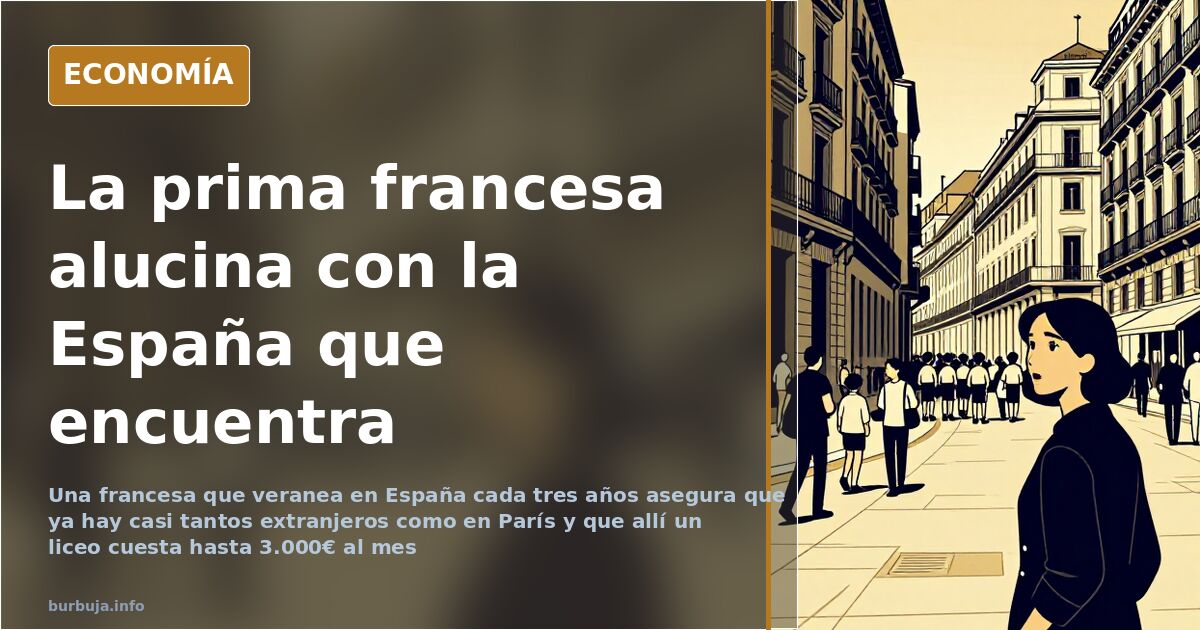
The French cousin who refuses to recognize the Spain of her summers
What does someone see when they return to Spain every three years, comparing what they find with what they remember? A French woman with family here answers without meaning to. She has been vacationing in the country for two decades, and according to her cousin's account, she has stumbled upon a reality that does not fit what she expected: a nation that is "Catholic, conservative, and tough," resembling the image here of Poland or Hungary. What has knocked her off balance is another matter: she claims there are now almost as many foreigners in Spanish cities as in Paris.
This is a perception, not a census. But around it has arisen a debate mixing demographics, education costs, and social class. And in which almost no one defends the main thesis.
The traditional Spain she no longer finds
The visitor came with a mental map from twenty years ago. In it, France concentrated African immigration and Spain remained a country of church and order. Her surprise is not so much that migrants exist as that here the phenomenon seems to her comparable to the Parisian one. Nor did she expect to see it so close to home.
Her forecast she exposes without nuance: now there are only adults, she says, but when those families have five children per house, classrooms with an overwhelmingly majority of students of African origin, crowded public transport, and the famous zones where authority does not enter will begin to be seen. It is a projection, not a data point. And like any projection, it invites discussion.
3,000 euros per month for a secondary school: the price of separation
The most striking data she brings is not migratory, it is economic. In Paris, she says, families who want their children to study with "normal people" pay up to 3,000 euros a month for a secondary school and up to 30,000 euros a year for a university. A private market where social homogeneity has a price tag and where segregation is bought by weight.
The comparison with Spain does not come cheap. Here exists a network of religious subsidized schools that acts as a filter and which most responses point to as the real mechanism to not share a classroom. In a middle-class area of Seville, it is noted, a subsidized school reaches less than 5% foreign students. In contrast, another stream nuances that France also has religious centers and that these do not always function as a refuge: it is maintained that since the ban on the veil in public schools they have absorbed students of Muslim origin. The hypothesis that there is no subsidized network there, therefore, remains in doubt.
Is Spain at the same level as France in immigration?
No, responds most of the rebuttals. The comparison with Paris is considered exaggerated, and it is recalled that high percentages are concentrated in Madrid, Barcelona, or the Basque Country, while the rest of the country lives something else. The most repeated counterexample is domestic and everyday: a subsidized school and a park with swings in a middle-class neighborhood, with a majority of native children.
There is even someone who inverts the story. The case of French friends who vacation in Madrid is told, and they are amazed, yes, but for the opposite: by the safety of the streets and by the amount of visible police. And one voice summarizes the paradox with irony: the same country that has spent decades considering itself the model of diversity is now looking at Spain with pity.
The enigma of the children no longer seen
Another observation from the visitor has resonated more than expected: twenty years ago, there were children everywhere; now, none. The data is not minor and fits with the collapse of birth rates, but the response is sharp: it depends on where you look. In peripheral neighborhoods there are children by the handful, and in middle-income areas too, it is just that the occasional visitor walks through the same square kilometers as always.
The discussion then shifts to replacement demographics, births, and who will sustain schools within twenty years. No one provides official series; they speak of memory and what is seen outside the school gate.
Who is blamed for the drift
The final turn is geopolitical and somewhat cynical. France feeling sorry for Spain, it is joked, when it is the same France that has promoted and strengthened that process along with other European partners. That someone who contributed to the phenomenon now comes to offer pity closes the circle: the blame, it is said, lies not with those who arrive, but with those who designed the rules.
In between, a warning to navigators: the next destination for the middle class that can move is not the south, it is Switzerland or any country with less migratory pressure. The geography of antiestéticar already has its own price map.
With a secondary school costing 3,000 euros a month as a social filter, perhaps the problem is not who comes to the neighborhood, but who can pay to not see it. The French cousin returns home convinced that Spain has made a mistake. Her cousin, meanwhile, is considering moving to Switzerland.
What does someone see when they return to Spain every three years, comparing what they find with what they remember? A French woman with family here answers without meaning to. She has been vacationing in the country for two decades, and according to her cousin's account, she has stumbled upon a reality that does not fit what she expected: a nation that is "Catholic, conservative, and tough," resembling the image here of Poland or Hungary. What has knocked her off balance is another matter: she claims there are now almost as many foreigners in Spanish cities as in Paris.
This is a perception, not a census. But around it has arisen a debate mixing demographics, education costs, and social class. And in which almost no one defends the main thesis.
The traditional Spain she no longer finds
The visitor came with a mental map from twenty years ago. In it, France concentrated African immigration and Spain remained a country of church and order. Her surprise is not so much that migrants exist as that here the phenomenon seems to her comparable to the Parisian one. Nor did she expect to see it so close to home.
Her forecast she exposes without nuance: now there are only adults, she says, but when those families have five children per house, classrooms with an overwhelmingly majority of students of African origin, crowded public transport, and the famous zones where authority does not enter will begin to be seen. It is a projection, not a data point. And like any projection, it invites discussion.
3,000 euros per month for a secondary school: the price of separation
The most striking data she brings is not migratory, it is economic. In Paris, she says, families who want their children to study with "normal people" pay up to 3,000 euros a month for a secondary school and up to 30,000 euros a year for a university. A private market where social homogeneity has a price tag and where segregation is bought by weight.
The comparison with Spain does not come cheap. Here exists a network of religious subsidized schools that acts as a filter and which most responses point to as the real mechanism to not share a classroom. In a middle-class area of Seville, it is noted, a subsidized school reaches less than 5% foreign students. In contrast, another stream nuances that France also has religious centers and that these do not always function as a refuge: it is maintained that since the ban on the veil in public schools they have absorbed students of Muslim origin. The hypothesis that there is no subsidized network there, therefore, remains in doubt.
Is Spain at the same level as France in immigration?
No, responds most of the rebuttals. The comparison with Paris is considered exaggerated, and it is recalled that high percentages are concentrated in Madrid, Barcelona, or the Basque Country, while the rest of the country lives something else. The most repeated counterexample is domestic and everyday: a subsidized school and a park with swings in a middle-class neighborhood, with a majority of native children.
There is even someone who inverts the story. The case of French friends who vacation in Madrid is told, and they are amazed, yes, but for the opposite: by the safety of the streets and by the amount of visible police. And one voice summarizes the paradox with irony: the same country that has spent decades considering itself the model of diversity is now looking at Spain with pity.
The enigma of the children no longer seen
Another observation from the visitor has resonated more than expected: twenty years ago, there were children everywhere; now, none. The data is not minor and fits with the collapse of birth rates, but the response is sharp: it depends on where you look. In peripheral neighborhoods there are children by the handful, and in middle-income areas too, it is just that the occasional visitor walks through the same square kilometers as always.
The discussion then shifts to replacement demographics, births, and who will sustain schools within twenty years. No one provides official series; they speak of memory and what is seen outside the school gate.
Who is blamed for the drift
The final turn is geopolitical and somewhat cynical. France feeling sorry for Spain, it is joked, when it is the same France that has promoted and strengthened that process along with other European partners. That someone who contributed to the phenomenon now comes to offer pity closes the circle: the blame, it is said, lies not with those who arrive, but with those who designed the rules.
In between, a warning to navigators: the next destination for the middle class that can move is not the south, it is Switzerland or any country with less migratory pressure. The geography of antiestéticar already has its own price map.
With a secondary school costing 3,000 euros a month as a social filter, perhaps the problem is not who comes to the neighborhood, but who can pay to not see it. The French cousin returns home convinced that Spain has made a mistake. Her cousin, meanwhile, is considering moving to Switzerland.
Summary of a discussion on Burbuja.info - Foro de economía, actualidad y política., translated from Spanish and reviewed before publication. Read the full discussion (211 replies).
More summaries
-
Fugitive in fatal Moncloa hit-and-run arrested in France
Spain's National Police arrest the fugitive from the 2021 fatal hit-and-run in Moncloa, Madrid, in the French town of Iles after matching DNA found in the car.
-
France Burns: High Schools Attacked and the Deepening Education Divide
Arson at Roubaix’s Lycée Léonard de Vinci and attacks in Saint-Etienne reignite debate on France’s education spending and public debt.
-
France: 700 arrested as educator struggles to comprehend
France faces its fifth night of riots with over 700 arrests, 45 police injured, and a visibly distressed social worker questioning the unrest.
-
Santander early retirement at 55: 95% pension and 12 years early
Santander employees aged 55 can take early retirement with 95% of their pension and up to €180,000 in severance. This is how the privilege of big...
-
European car sales plunge: Germany down 28%, Spain 6.5%
Car registrations in Europe are falling sharply, with Germany seeing a 28% drop and Spain 6.5% in August, according to industry data.
-
Spain's housing minister shares landlord chats filtering tenants
Pablo Echenique shared chats of 2,000 Spanish landlords refusing to rent to families with children or migrants, citing legal risks.