
Freedom Convoy: 50,000 Trucks Protest Canada's COVID Mandates
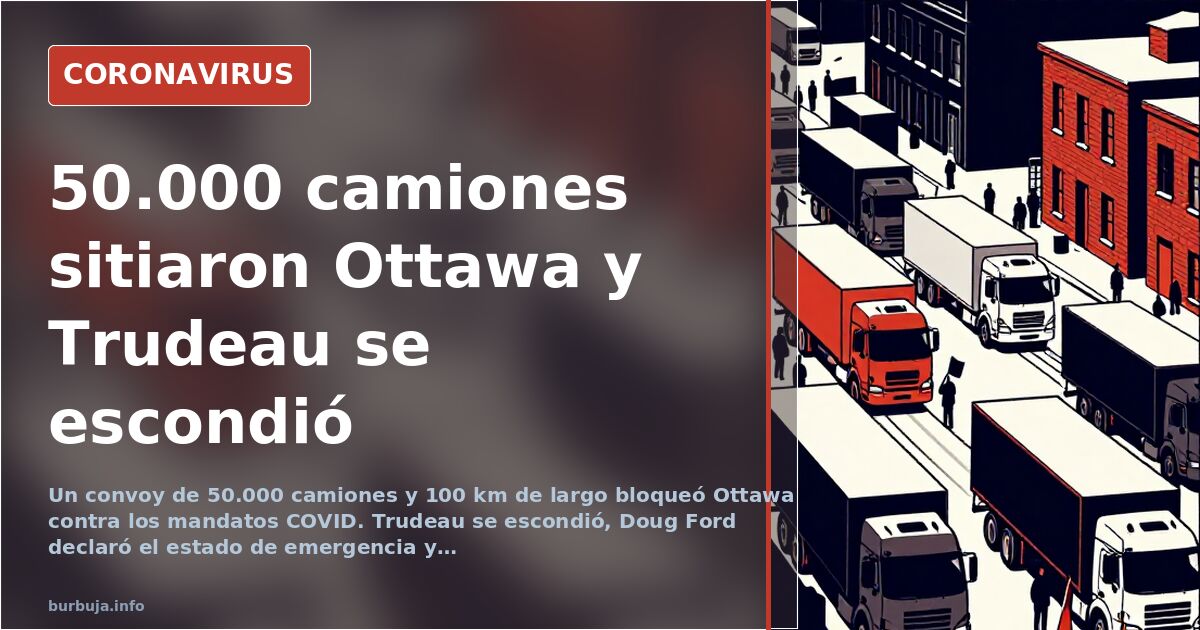
A 50,000-truck, 100km-long convoy blocked Ottawa protesting COVID mandates. Trudeau hid, Doug Ford declared a state of emergency, and...
English · Original discussion in Spanish · Published
50,000 Trucks and a 100km Convoy: The Protest That Strained Canada
A truck convoy nearly 100 kilometers long and comprising around 50,000 vehicles headed to Ottawa to demand an end to ELbichito vaccination mandates. What began as a protest by the transport sector ended with the capital's center blocked, the Ambassador Bridge cut off, and Prime Minister Justin Trudeau in seclusion due to a positive contact. The subsequent police operation led to hundreds of arrests, seized trucks, and frozen bank accounts of those who had donated to the cause.
What is the Freedom Convoy and Who Initiated It
The movement started as a caravan of truckers crossing the country to the capital. As they passed, truckers were hailed as heroes in towns and cities, with citizens offering supplies and food to the convoy. Figures circulating in transcripts spoke of an unignorable column of vehicles: one hundred kilometers of trucks, one after another.
Some argue the movement was genuine from day one and only later attempts were made to capitalize on it. Countering this is the argument, repeated in many analyses, that any popular discontent eventually gets absorbed by structures that redirect it. The parallel with Spain's 15-M movement appeared repeatedly: the first two days it was angry people who said enough; on the third day, the usual suspects arrived.
Ottawa Blocked and Doug Ford's State of Emergency
Downtown Ottawa was paralyzed for weeks. The Premier of Ontario, Doug Ford, announced a state of emergency due to the blockade of the Ambassador Bridge, the busiest commercial crossing between Canada and the United States. The image broadcast of the announcement was not optimistic: a grim face and haste.
While the convoy occupied the streets, Trudeau went into hiding, citing contact with a positive case. The Prime Minister's absence during the key days fueled all sorts of interpretations. A government choosing to disappear in the midst of a crisis, instead of negotiating or de-escalating, left a trail of unanswered questions.
The Tow Trucks That Refused to Remove the Trucks
One of the most discussed episodes was the refusal of the towing industry. All companies hired by the city refused to remove the trucks that were paralyzing downtown Ottawa for the second consecutive week. The municipal administrator's reason was blunt: the heavy truck industry is a significant part of these companies' livelihood, and they did not want to damage that business relationship.
The city had contracts with ten companies to tow vehicles during snow parking bans. None responded to the request. Added to this was another scene: tow trucks sent to clear the Detroit bridge ended up joining the protest. The full calculation of how many logistics operators sided with the cause is thought-provoking.
The Eviction: Hundreds Arrested and Accounts Frozen
The response was forceful. According to news reports, police arrested hundreds of truckers and seized about 100 trucks. Authorities reportedly went beyond the vehicles: bank accounts of those who had donated funds to the convoy were frozen, and some suggested the mayor of Ottawa believed he had the right to sell the seized trucks.
The trickle of reprisals extended to individuals. A communications director for an Ontario ministry was fired for donating 100 dollars to the truckers. A 78-year-old man was arrested for honking his horn in support of the convoy. Every detail like these fueled an uncomfortable idea: if donating a hundred dollars leads to losing your job, what room is left for dissent?
Trudeau's Brother and the Indigenous Nations That Dismantled the Narrative
The Prime Minister's own brother gave an interview in which he claimed the vaccine does not prevent infection and that everything had been orchestrated to divert wealth to large corporations. When asked about his brother's views, he replied that the Prime Minister is convinced he is doing the right thing. The family live, unfiltered.
In parallel, several Indigenous nations, including the Blackfoot, joined the protesters. The gesture had a clear political implication: it dismantled the official narrative that the convoy was a racist and supremacist movement, leaving the government with less rhetorical ammunition.
Media Silence in Spain
Regarding this issue, the most frequent complaint was the coverage. For days, what was happening in Canada barely made headlines in Spanish media. Those trinc the situation through social media and alternative channels spoke of an information blackout, if not manipulation. Meanwhile, the war in Ukraine dominated every front page, pushing other stories aside.
The convoy was eventually dismantled in Ottawa. The movement's leader, Tamara Lich, was jailed after her bail was denied. Rumors circulated about her supposed death in her cell, later denied. However, the truly perplexing question is not how the protest ended: it is how many of those who today applaud the imposed order were desperately asking for someone to represent them two winters ago.
A truck convoy nearly 100 kilometers long and comprising around 50,000 vehicles headed to Ottawa to demand an end to ELbichito vaccination mandates. What began as a protest by the transport sector ended with the capital's center blocked, the Ambassador Bridge cut off, and Prime Minister Justin Trudeau in seclusion due to a positive contact. The subsequent police operation led to hundreds of arrests, seized trucks, and frozen bank accounts of those who had donated to the cause.
What is the Freedom Convoy and Who Initiated It
The movement started as a caravan of truckers crossing the country to the capital. As they passed, truckers were hailed as heroes in towns and cities, with citizens offering supplies and food to the convoy. Figures circulating in transcripts spoke of an unignorable column of vehicles: one hundred kilometers of trucks, one after another.
Some argue the movement was genuine from day one and only later attempts were made to capitalize on it. Countering this is the argument, repeated in many analyses, that any popular discontent eventually gets absorbed by structures that redirect it. The parallel with Spain's 15-M movement appeared repeatedly: the first two days it was angry people who said enough; on the third day, the usual suspects arrived.
Ottawa Blocked and Doug Ford's State of Emergency
Downtown Ottawa was paralyzed for weeks. The Premier of Ontario, Doug Ford, announced a state of emergency due to the blockade of the Ambassador Bridge, the busiest commercial crossing between Canada and the United States. The image broadcast of the announcement was not optimistic: a grim face and haste.
While the convoy occupied the streets, Trudeau went into hiding, citing contact with a positive case. The Prime Minister's absence during the key days fueled all sorts of interpretations. A government choosing to disappear in the midst of a crisis, instead of negotiating or de-escalating, left a trail of unanswered questions.
The Tow Trucks That Refused to Remove the Trucks
One of the most discussed episodes was the refusal of the towing industry. All companies hired by the city refused to remove the trucks that were paralyzing downtown Ottawa for the second consecutive week. The municipal administrator's reason was blunt: the heavy truck industry is a significant part of these companies' livelihood, and they did not want to damage that business relationship.
The city had contracts with ten companies to tow vehicles during snow parking bans. None responded to the request. Added to this was another scene: tow trucks sent to clear the Detroit bridge ended up joining the protest. The full calculation of how many logistics operators sided with the cause is thought-provoking.
The Eviction: Hundreds Arrested and Accounts Frozen
The response was forceful. According to news reports, police arrested hundreds of truckers and seized about 100 trucks. Authorities reportedly went beyond the vehicles: bank accounts of those who had donated funds to the convoy were frozen, and some suggested the mayor of Ottawa believed he had the right to sell the seized trucks.
The trickle of reprisals extended to individuals. A communications director for an Ontario ministry was fired for donating 100 dollars to the truckers. A 78-year-old man was arrested for honking his horn in support of the convoy. Every detail like these fueled an uncomfortable idea: if donating a hundred dollars leads to losing your job, what room is left for dissent?
Trudeau's Brother and the Indigenous Nations That Dismantled the Narrative
The Prime Minister's own brother gave an interview in which he claimed the vaccine does not prevent infection and that everything had been orchestrated to divert wealth to large corporations. When asked about his brother's views, he replied that the Prime Minister is convinced he is doing the right thing. The family live, unfiltered.
In parallel, several Indigenous nations, including the Blackfoot, joined the protesters. The gesture had a clear political implication: it dismantled the official narrative that the convoy was a racist and supremacist movement, leaving the government with less rhetorical ammunition.
Media Silence in Spain
Regarding this issue, the most frequent complaint was the coverage. For days, what was happening in Canada barely made headlines in Spanish media. Those trinc the situation through social media and alternative channels spoke of an information blackout, if not manipulation. Meanwhile, the war in Ukraine dominated every front page, pushing other stories aside.
The convoy was eventually dismantled in Ottawa. The movement's leader, Tamara Lich, was jailed after her bail was denied. Rumors circulated about her supposed death in her cell, later denied. However, the truly perplexing question is not how the protest ended: it is how many of those who today applaud the imposed order were desperately asking for someone to represent them two winters ago.
Summary of a discussion on Burbuja.info - Foro de economía, actualidad y política., translated from Spanish and reviewed before publication. Read the full discussion (759 replies).
More summaries
-
Raw Pandemic Data: Official Narrative vs Real Figures
An analysis of initial coronavirus data and firsthand accounts, tracing the outbreak from its epicenter to healthcare consequences across Spain and Europe.
-
Itziar Castro: from AstraZeneca trial volunteer to death at 46
Itziar Castro tweeted in March 2021 that she was a volunteer in the AstraZeneca trial with no side effects. She died in December 2023 at 46.
-
Nuremberg II: the Covid archive awaiting trial
A citizen archive compiles VAERS and EudraVigilance figures and Covid vaccine data for a hypothetical Nuremberg II that has no date yet.
-
Moving fibers in masks: home experiments, no answers
An amateur films fibers moving inside an FFP2 and exposes them to steam, a magnet and electric current. A lab attributes it to polypropylene microfibers.
-
Nurse Avoids Prison for Falsifying Vaccinations of 400 Children
A nurse accused of faking vaccinations for 400 children in Bizkaia will not go to jail. Prosecutors seek psychiatric treatment instead.
-
22.7 Million Vaccinated Study: 25% Lower Mortality Claimed
A large-scale study suggests vaccinated individuals have 25% lower overall mortality. Critics cite the 'healthy vaccinee effect' and conflicts of interest.