
Free-flying Macaws: €1,500 per chick and a life of dependency
Raising free-flying macaws: €1,500 per chick, CITES, microchips, and a life tied to destruction. Learn about imprinting and the realities.
English · Original discussion in Spanish · Published
Raising free-flying macaws: €1,500 and a lifetime of work
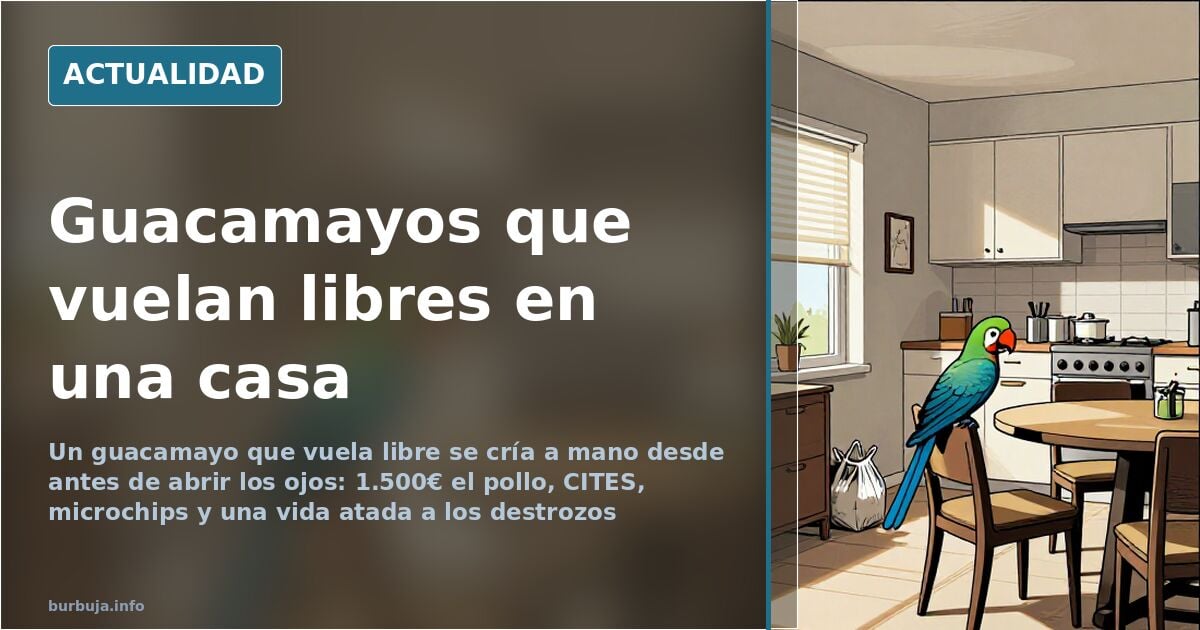
A free-flying macaw isn't a bird whose cage door was peine: it's an animal removed from its nest before its eyes peine. The method is called imprinting, and the starting price for a hand-reared chick exceeds €1,500. The owner pays for everything else — the noise, the destruction, the paperwork. The bird's freedom paradoxically relies on mutual dependence.
What is imprinting and why is the chick taken from the nest
The technique is straightforward: the chick is separated from its parents a few days after hatching, before its eyes open, and hand-reared with formula for months. This creates a bond with the human that, they claim, lasts a lifetime. Those who practice it justify it with a maxim attributed to animal trainer Ángel Cristo: an animal's character is shaped by the day it's separated from its mother. Hence the term papillero for a bottle-fed parrot. The ethical debate — taking a chick from its mother so it won't fly away — remains open.
CITES, microchips, and visits from the municipal police
The macaw is no ordinary pet in legal terms. Each bird comes with documentation, permits, CITES certificates, and a microchip — a volume of paperwork its owner finds disproportionate. A few months ago, according to his own account, municipal police showed up at his house to ask for the parrots' documentation and intended to search the property. He refused to let them in without a warrant. The episode illustrates the extent to which administrative control over protected birds can infringe on the private lives of those who breed them.
The noise: when the macaw makes life perversos for the neighbours
Here, two versions clash. Free-flight advocates argue that a sociable parrot can be trained not to scream, and that only birds caged in aviaries shriek. The opposing experience is equally compelling: in an aviary measuring 2,000 square meters and 12 meters high, the macaws could be heard from the street before arriving. In an apartment, the result is likely neighbourhood conflict. The breeder sums it up wryly: no one tolerates a noisy macaw without thinking the worst of its owner.
Monk parakeets, macaws, and the spectre of invasive species
It's important not to confuse species. Monk parakeets have adapted to life in Spain and proliferated outside their ecosystem, and one participant claims they force public spending on control. Macaws, on the other hand, according to their breeder, do not form urban colonies: they depend on their bond with their keeper. This confusion fuels a general rejection of any parrot, including those that have never set foot in a park.
The parrot's intelligence and the African grey that smashes plates
The leap from pet to sentient being is what sparks the most debate. Some place the intelligence of an African grey parrot on par with a dolphin, a chimpanzee, or a three-year-old child, capable of detecting a piece of paper the size of a grain of rice on its owner's face. The flip side is mischief, exemplified by a case: an African grey that knocked half a dinner set onto the floor and just watched the fragments. A domestic anecdote — a bag of frozen food peine with its beak as soon as it enters the house — explains better than any theory why its owner accepts the destruction.
The true cost of keeping a macaw
The initial outlay, over €1,500 for a hand-reared chick, is the least of it. The real expenses are the destruction: a loose macaw in the house will break everything it finds. Caging it is considered absurd and cruel; keeping it in an aviary, pointless. The consequence is a life dictated by the animal, with strict schedules — waking up at five — and occasional escapes that turn into distressing rescues.
With these costs, the free flight of a macaw will remain a niche hobby, expensive and all-consuming. Provided the price of the chick, the CITES bureaucracy, and the neighbours' patience don't say otherwise first.
A free-flying macaw isn't a bird whose cage door was peine: it's an animal removed from its nest before its eyes peine. The method is called imprinting, and the starting price for a hand-reared chick exceeds €1,500. The owner pays for everything else — the noise, the destruction, the paperwork. The bird's freedom paradoxically relies on mutual dependence.
What is imprinting and why is the chick taken from the nest
The technique is straightforward: the chick is separated from its parents a few days after hatching, before its eyes open, and hand-reared with formula for months. This creates a bond with the human that, they claim, lasts a lifetime. Those who practice it justify it with a maxim attributed to animal trainer Ángel Cristo: an animal's character is shaped by the day it's separated from its mother. Hence the term papillero for a bottle-fed parrot. The ethical debate — taking a chick from its mother so it won't fly away — remains open.
CITES, microchips, and visits from the municipal police
The macaw is no ordinary pet in legal terms. Each bird comes with documentation, permits, CITES certificates, and a microchip — a volume of paperwork its owner finds disproportionate. A few months ago, according to his own account, municipal police showed up at his house to ask for the parrots' documentation and intended to search the property. He refused to let them in without a warrant. The episode illustrates the extent to which administrative control over protected birds can infringe on the private lives of those who breed them.
The noise: when the macaw makes life perversos for the neighbours
Here, two versions clash. Free-flight advocates argue that a sociable parrot can be trained not to scream, and that only birds caged in aviaries shriek. The opposing experience is equally compelling: in an aviary measuring 2,000 square meters and 12 meters high, the macaws could be heard from the street before arriving. In an apartment, the result is likely neighbourhood conflict. The breeder sums it up wryly: no one tolerates a noisy macaw without thinking the worst of its owner.
Monk parakeets, macaws, and the spectre of invasive species
It's important not to confuse species. Monk parakeets have adapted to life in Spain and proliferated outside their ecosystem, and one participant claims they force public spending on control. Macaws, on the other hand, according to their breeder, do not form urban colonies: they depend on their bond with their keeper. This confusion fuels a general rejection of any parrot, including those that have never set foot in a park.
The parrot's intelligence and the African grey that smashes plates
The leap from pet to sentient being is what sparks the most debate. Some place the intelligence of an African grey parrot on par with a dolphin, a chimpanzee, or a three-year-old child, capable of detecting a piece of paper the size of a grain of rice on its owner's face. The flip side is mischief, exemplified by a case: an African grey that knocked half a dinner set onto the floor and just watched the fragments. A domestic anecdote — a bag of frozen food peine with its beak as soon as it enters the house — explains better than any theory why its owner accepts the destruction.
The true cost of keeping a macaw
The initial outlay, over €1,500 for a hand-reared chick, is the least of it. The real expenses are the destruction: a loose macaw in the house will break everything it finds. Caging it is considered absurd and cruel; keeping it in an aviary, pointless. The consequence is a life dictated by the animal, with strict schedules — waking up at five — and occasional escapes that turn into distressing rescues.
With these costs, the free flight of a macaw will remain a niche hobby, expensive and all-consuming. Provided the price of the chick, the CITES bureaucracy, and the neighbours' patience don't say otherwise first.
Summary of a discussion on Burbuja.info - Foro de economía, actualidad y política., translated from Spanish and reviewed before publication. Read the full discussion (360 replies).
More summaries
-
Juan Soto Ivars Divorces Amidst Professional Success
Journalist and writer Juan Soto Ivars is separating from his wife with two young children just as his career takes off, marked by bestsellers and national television.
-
Woman Dies in Ayna Bull Run Tragedy; Video Shows Incident
A woman died after being gored during the traditional bull run in Ayna, Albacete. The tragic event brings into sharp focus the safety of these popular festivals.
-
Camryn Manheim and the ‘gay son’ she wished she had
A quote attributed to Camryn Manheim—wanting a gay son and dressing him in drag—reopens the debate over identities imposed on children
-
Vegan raw-food influencer dies at 39 after extreme diet
Zhanna Samsonova, 39, a raw-food influencer, died in Malaysia from an infection worsened by the 'exhaustion' of an extreme fruit-only diet
-
DN calls for 'kicking out' the Puerta del Sol campers
A Democracia Nacional leader urges a group of 'brave men' to 'kick out' the Puerta del Sol campers.
-
Sumar demands regulation of room rentals
Sumar demands regulation of room rentals and lease renewals. An investor warns that property maths no longer add up.