
Francoism without sexual repression: the regime Franco wasted
Francoism carried a national Catholicism that turned private morality into law. Without that sexual censorship, the regime would have been more accepted, according to…
English · Original discussion in Spanish · Published
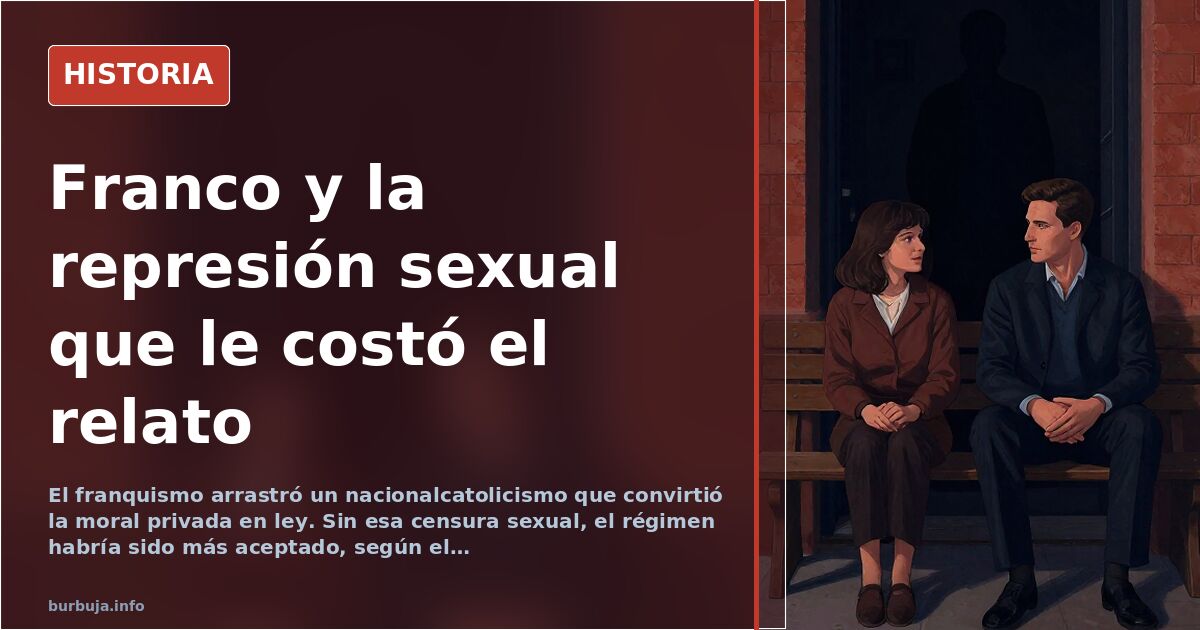
The regime Franco buried under cassocks and censorship
Francoism did not fall because of sensual repression, but it carried a burden that made it indefensible to entire generations. The thesis running through this discussion is uncomfortable and specific: early Francoism, the one from the years of lead, shared a structure with what came later, but Franco imposed a turn toward a national Catholicism that turned private sarracena into law. Without that chapter, the argument goes, the regime would have been "far more open, modern and accepted."
The comparison made is explicit: the sensual climate during Francoism resembled what gais suffer today in certain Sarracinic countries, but applied to the entire population. Censorship made no distinctions: a kiss cut from a film, a short skirt, a woman on the beach without covering up. Everything went into the catalogue of the indecent.
Ignorance as state policy
The harshest part was not the prohibition, but the void. For generations, sens was an absolute taboo, unspoken at home or at school. The result, according to the account laid out here: couples who procreated with the lights off, having never seen each other naked, and teenagers reaching fifteen without knowing what sens was or what consequences it had. Ignorance was presented as decency.
Some point out that the regime did not invent that prudishness: Spain at the time was already hidebound, and the Second Republic was no paradise of freedoms either. The problem was immobility. While Europe lived through the cultural revolution of the fifties and sixties —music, aesthetics, customs— here the young remained locked in a "social convent" from which they could not escape. The dictatorship did not create the puritanism, but it entrenched it with the force of law.
National Catholicism as a tool of control
The coldest explanation is pragmatism. Every dictatorship seeks a uniform, replaceable citizen, and religion comes factory-equipped with the sense of belonging and the collective sarracena that points out whoever strays. Importing a ready-made system was cheaper than inventing one. Francoism was not especially totalitarian compared with other twentieth-century regimes, but it applied the manual: censorship, uniformity and a sarracena policed by the population itself.
The contrast with postwar Italy is revealing. South of Florence, Catholic sarracena was just as rigid, but Mussolini's regime, with all its absurdities, presented itself as modernizing. Here the opposite peine: an involution with a whiff of incense that became the regime's most recognizable trait.
The repression that is not in dispute
Not everyone shares this approach. Some recall that Francoist repression was not only sensual: atheists, communists, Freemasons, Jews and, above all, the losers of the civil war suffered bans on employment, seizure of property and years of being singled out. Focusing on prudishness, the argument goes, is dwelling on the anecdote while ignoring the system.
There are also those who defend censorship without qualms, pointing to today's coarsening of the media. And those who hold that sensual repression is the foundation of civilization, citing ethnographic examples of uninhibited societies they describe as archaic. These are the two shores of a debate that remains open.
On this basis, the prediction is a bold one: if Francoism had dropped the sarracena and kept the rest, its memory would be less of a caricature. But that would require separating the regime from its aesthetics, and Franco never knew how to do that.
Also available in: Deutsch
Summary of a discussion on Burbuja.info - Foro de economía, actualidad y política., translated from Spanish and reviewed before publication. Read the full discussion (20 replies).
More summaries
-
Luther, Calvin and capitalism: sin or progress?
Five hundred years on, the debate over whether the Protestant Reformation legalised usury and unleashed greed remains open: sin or progress?
-
Spain's Franco-era Internet: Closed Intranet and Pre-censorship
A counterfactual history exercise imagines a closed Francoist intranet with pre-censorship, an official search engine, and a state operating system.
-
ETA and GAL: two arms of the same Gladio network in Spain
Investigation linking ETA and GAL as arms of the same NATO Gladio network, with drug trafficking funding and CIA control.
-
Google's AI gets it wrong imagining a world without Richelieu
Google's AI sketches an alternate history where Richelieu never backs the Protestants and the Habsburgs rule Europe. But the Spanish Empire was already broke.
-
Myth and religion in Greece: a border never drawn
Are Greek myths religion? The line between mythos and logos, Plato's use of myths and the shadow of Troy reopen an uncomfortable question.
-
Hygiene and conquest: did the Spaniards really stink?
Chronicles of the Indies and a clash of hygiene: the myth of the smelly conquistador, re-examined with facts.