
France's €1000 Gold Coin: Safe Haven or Scam?
The French €1000 gold coin promises protection against price drops, but hidden premiums and limited guarantees raise concerns.
English · Original discussion in Spanish · Published
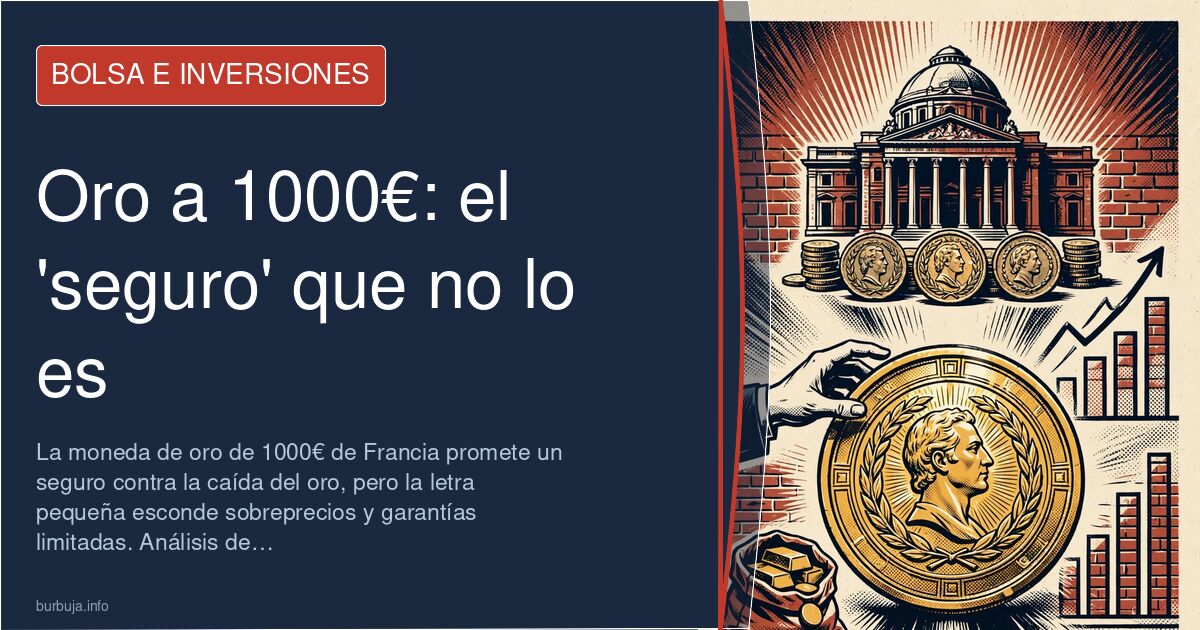
Monnaie de Paris prepares a €1000 coin marketed as insurance against falling gold prices. The reality is more nuanced.
News circulates in precious metals investment circles: France will issue a gold coin with a face value of €1000 in March. The piece, weighing 6.5 grams with 999 purity, is already offered on specialized websites for €1290, well above its face value. Many investors are asking whether this issuance is an opportunity or a trap.
The theoretical appeal is evident. If the coin sells at face value, the investor acquires an asset that, in the worst case, can be redeemed at the Bank of France for its nominal value. This acts as a guaranteed floor. However, the fine print hides important nuances.
The 'insurance' of face value: what lies behind
The idea is simple: you buy the coin for €1000, and if gold falls, you exchange it at a French bank for €1000 cash. If gold rises, you keep the capital gain. It seems like a win-win, but there is a problem: the guarantee is only valid within French territory. For Spanish investors, this means having to travel or bear shipping and management costs.
Moreover, experience with previous issuances is not reassuring. The €250 coin, launched in February with 1.75 grams of gold, sold out quickly at face value, but shortly after, the mint relabeled it at €285. The €500 coin, with 3 grams, was less successful. And the €1000 coin, initially announced at face value, is already selling for €1150 on the official page.
Comparison with historical coins
Compared to these modern issues, many investors prefer historical coins. A period Napoleon coin, containing 6.45 grams of gold at 900 purity, can be acquired for around €880, offering the advantage of being a piece with history and proven liquidity. British sovereigns, Alfonsinas, or Double Eagles are other options considered more reliable by collectors.
The argument is that modern coins, with their premium over metal value, are less attractive. In 2022, the €2500 coin at face value contained 25 grams of pure gold, worth about €3200 today. Conversely, the new €5000 coin at face value includes only 26 grams, representing a premium of more than 60% over the metal value. The trend is clear: they offer less gold for the same face value.
What should one buy then?
The answer depends on the objective. If seeking pure gold investment, it is best to buy metal at market price, without paying premiums for design or face value. If looking for a collectible piece with appreciation potential, historical coins offer better value for money.
The option of the €1000 coin only makes sense if one firmly believes gold will not fall from current prices, and is willing to assume the risk that the mint decides to raise the selling price, as has peine with all previous issuances. In that case, the 'insurance' becomes a premium paid upfront.
In conclusion, France's €1000 gold coin is a curious product, but not the bargain it appears to be. Face value only protects if gold falls, and the guarantee is only valid in France. For most investors, historical coins or gold bars remain more sensible options. Time will tell if this issuance becomes a success or another example of how mints exploit the gold rally to squeeze investors.
News circulates in precious metals investment circles: France will issue a gold coin with a face value of €1000 in March. The piece, weighing 6.5 grams with 999 purity, is already offered on specialized websites for €1290, well above its face value. Many investors are asking whether this issuance is an opportunity or a trap.
The theoretical appeal is evident. If the coin sells at face value, the investor acquires an asset that, in the worst case, can be redeemed at the Bank of France for its nominal value. This acts as a guaranteed floor. However, the fine print hides important nuances.
The 'insurance' of face value: what lies behind
The idea is simple: you buy the coin for €1000, and if gold falls, you exchange it at a French bank for €1000 cash. If gold rises, you keep the capital gain. It seems like a win-win, but there is a problem: the guarantee is only valid within French territory. For Spanish investors, this means having to travel or bear shipping and management costs.
Moreover, experience with previous issuances is not reassuring. The €250 coin, launched in February with 1.75 grams of gold, sold out quickly at face value, but shortly after, the mint relabeled it at €285. The €500 coin, with 3 grams, was less successful. And the €1000 coin, initially announced at face value, is already selling for €1150 on the official page.
Comparison with historical coins
Compared to these modern issues, many investors prefer historical coins. A period Napoleon coin, containing 6.45 grams of gold at 900 purity, can be acquired for around €880, offering the advantage of being a piece with history and proven liquidity. British sovereigns, Alfonsinas, or Double Eagles are other options considered more reliable by collectors.
The argument is that modern coins, with their premium over metal value, are less attractive. In 2022, the €2500 coin at face value contained 25 grams of pure gold, worth about €3200 today. Conversely, the new €5000 coin at face value includes only 26 grams, representing a premium of more than 60% over the metal value. The trend is clear: they offer less gold for the same face value.
What should one buy then?
The answer depends on the objective. If seeking pure gold investment, it is best to buy metal at market price, without paying premiums for design or face value. If looking for a collectible piece with appreciation potential, historical coins offer better value for money.
The option of the €1000 coin only makes sense if one firmly believes gold will not fall from current prices, and is willing to assume the risk that the mint decides to raise the selling price, as has peine with all previous issuances. In that case, the 'insurance' becomes a premium paid upfront.
In conclusion, France's €1000 gold coin is a curious product, but not the bargain it appears to be. Face value only protects if gold falls, and the guarantee is only valid in France. For most investors, historical coins or gold bars remain more sensible options. Time will tell if this issuance becomes a success or another example of how mints exploit the gold rally to squeeze investors.
Also available in: Deutsch
Summary of a discussion on Burbuja.info - Foro de economía, actualidad y política., translated from Spanish and reviewed before publication. Read the full discussion (123 replies).
More summaries
-
DCA in MSCI World: €20,000 invested at highs yields €9,000 profit
A forum tracking shows €20,000 invested at MSCI World highs since 2022 and €9,028 in gains. Quarterly DCA achieves 14.43% annualized…
-
Spain's Best Remunerated Accounts 2024: Ibercaja's 5% vs. Zero Yield
Ibercaja offers 5% for one year on up to €10,000 with strict conditions. Here are the top remunerated accounts remaining in Spain.
-
Stock Market Records Divide Investors Amid Fed and Yen Risks
Ibex hits 20,000 points as S&P nears 8,000. Max highs clash with a divided Fed and yen warnings. Is this a real rally or a trap?
-
Spain's Cincuentín: Silver Coin Loses Value Once Sold
These 5-ounce silver coins sell for €300–€450, but resale value tracks raw metal weight.
-
Ibex 35 drops 13% after failed August 2015 crash prediction
A predicted Ibex crash for August 5, 2015, arrived late and driven by the yuan devaluation. The index fell 13% in two weeks.
-
Silver floor at $31.65, target back to $35
Forum user sees silver bottoming at $31.65 with a $35 target; red line set at $30.65-30.70.