
Spain's 20-cent fuel discount vanishes at the pump
The 20-cent-per-litre discount shrinks to just two cents at the pump due to stock management. We look at why the real saving is an illusion.
English · Original discussion in Spanish · Published
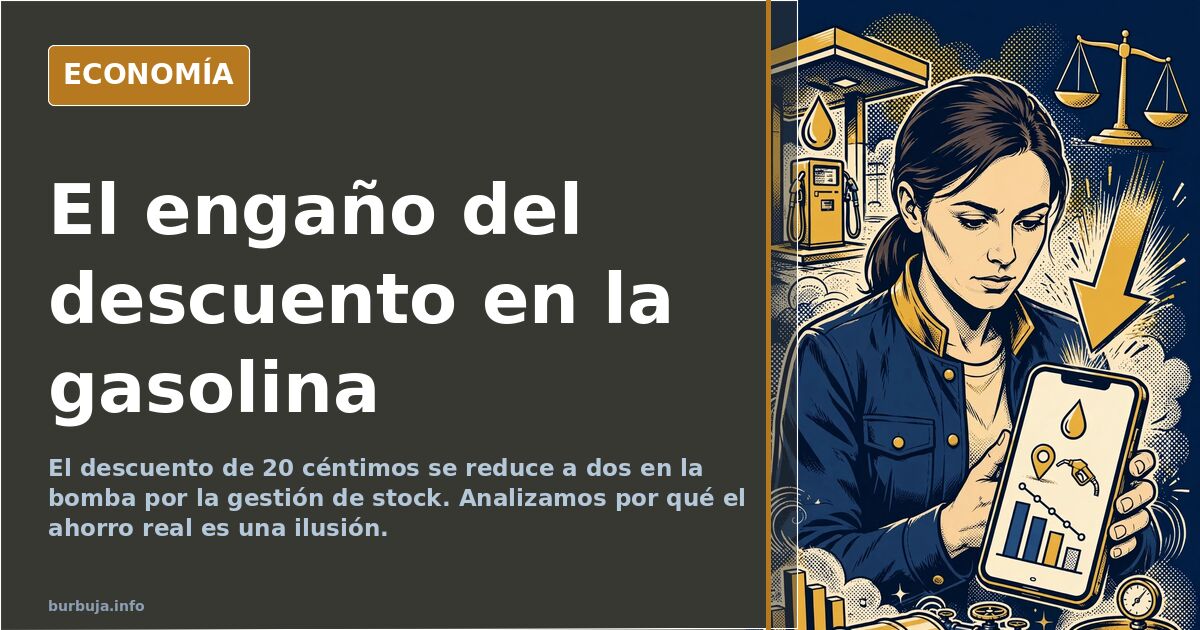
The 20-cent discount that never reaches the pump
The promise of a 20-cent-per-litre cut in fuel prices has become an optical illusion for Spanish drivers. What is announced as immediate relief translates, in practice, into a drop of barely two cents at the pump. The difference is not a miscalculation, but the result of a market mechanism that prioritises the margins of the big distributors over the consumer's pocket.
The stock strategy and real competition
The origin of this discrepancy lies in inventory management. According to the analysis of the available data, the previous discount was five cents, while the current one stands at twenty. However, petrol stations cannot adjust their prices instantly. The big chains operate with full tanks, loaded at earlier prices. Until they run through that stock bought at higher rates, they cannot pass the real cut on to the final price. It is a race against time: stations with higher sales volumes, such as those at shopping centres, will adjust sooner than those with lower turnover.
Some argue this is simply the nature of the market; against that stands the argument that multinationals dictate the conditions. While some enjoy price freedom, others point out that the margins of the big oil companies, such as Repsol, remain intact thanks to this information asymmetry. The shareholder cheers, but the end user barely notices the relief.
Geopolitical factors and consumer perception
It is not all about stock management. There is a current of opinion that attributes the relative price increase to external factors, citing the impact of geopolitical tensions, such as the conflicts in Ukraine or Iran, and international trade policies. Although extraction costs at European refineries remain low, the final price includes risk premiums and logistics beyond the control of the local consumer.
The response to this situation should not be resignation, but action. Tools like the Gasall app allow drivers to find the cheapest station in real time, avoiding the traps of the big brands. Competition exists, but it requires active effort from the user to be effective.
The final question is not whether the discount exists, but whether it is worth the effort of hunting for it when the real difference is minimal. While the big distributors manage their inventories, the consumer is caught between the promise of savings and the reality of the price at the pump.
Also available in: Deutsch
Summary of a discussion on Burbuja.info - Foro de economía, actualidad y política., translated from Spanish and reviewed before publication. Read the full discussion (26 replies).
More summaries
-
Spain Subsidizes Diesel, Not Gasoline: Government Logic
Spain cuts 20 cents from diesel prices, despite higher NOx emissions, while excluding gasoline. Is this price control or green inconsistency?
-
Gasoline at €4.50: The Real Cost Analysis
Analysis of the €4.50/liter gasoline prediction. The real cost of fuel amid geopolitical and fiscal pressures.
-
Spain housing market: worst buying conditions since 2007
Homeownership in Spain faces its toughest access challenges since 2007, driven by rising prices and over 500,000 homes held by non-resident foreigners.
-
Jail for Sánchez? Spain's rift over impunity and corruption
Corruption allegations against Spanish PM Pedro Sánchez and his government have reignited the debate on impunity. Will the prime minister end up in prison, or will history repeat itself?
-
Feijóo, the leader who fails to convince even his own base
Feijóo faces growing internal criticism over his lack of a real alternative to Sánchez and tactical moves that benefit him. Senate voting records and migration proposals fuel the discontent.
-
Shooting on Balmes Street: crime and economics in Barcelona
A gangland settling of scores outside the Balmes police station, minutes from the Pope's route. The economic impact of violence on Barcelona's housing and tourism.