
Macron vows crackdown after riots leave 1,800 arrested
Macron promises punishment after the October 18 riots: 1,800 arrested and 1,500 businesses hit. The cost of living looms in the background.
English · Original discussion in Spanish · Published
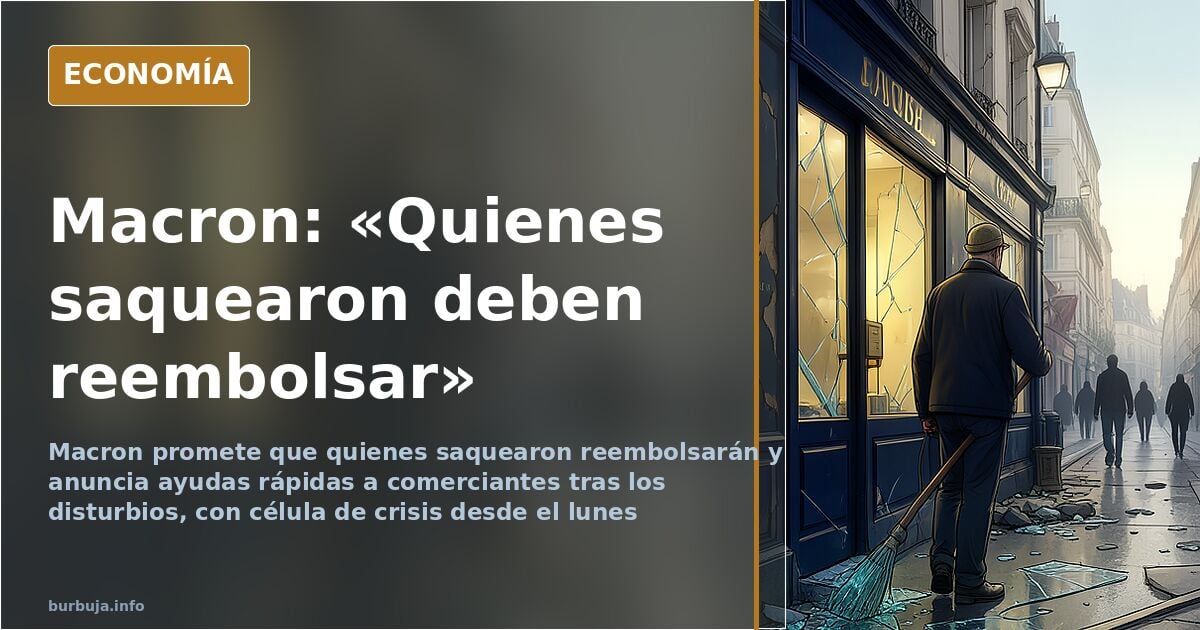
Macron promises punishment after the riots: 1,800 arrested and 1,500 businesses damaged
On October 18, Emmanuel Macron appeared before the press to respond to the looting and fires during Saturday's protests against the cost of living. The government's initial tally is stark: 1,800 people arrested and around 1,500 businesses affected, according to figures from the Interior Ministry and the retail sector itself cited during the appearance. The president spoke of "unbridled violence" attributed to "insurrectionists emerging from far-left fringe groups, joined by numerous incivil." The near-live transcript of his remarks, published by Le Monde, tracked minute by minute a speech that mixed promises of judicial toughness with a nod to the economic discontent that fueled the protests.
What Macron promised in the wake of the riots
The head of state promised incivil consequences for those who took part in the destruction: "Those who destroyed must pay. Those who looted must repay," he declared, adding that "those who tried to bring down the Republic will have to answer for it." He also announced that prefects will make decisions in coordination with mayors to protect public buildings and businesses, with measures that could go as far as banning certain gatherings.
The speech was not all stick. Macron expressed his "anger" and "shame" at the damage, offered support to law enforcement and promised swift aid to affected shopkeepers and artisans. And he acknowledged, at least in part, the context: he addressed the rise in fuel prices as one of the factors feeding the discontent. The combination of a firm hand and economic understanding failed to convince many of those who trinc the appearance.
The cost of living as the backdrop
Saturday's protests did not come out of nowhere. The rising cost of living, and fuel prices in particular, sit at the center of the social discontent that preceded the riots. Energy references also crept into the debate: it was argued that as long as producing countries cannot extract more oil, the price of diesel will keep hurting the self-employed and hauliers. That is the reading that connects the street to the fuel bill.
The official response was a mix of public order and checkbook. Some argue that aid to affected businesses will ultimately be paid for with taxes from the very citizens who were protesting, while others point out that without those compensations, small businesses in damaged areas will not recover. The exact point where these two readings collide was not resolved during the appearance.
The political reading: a weakened president
Macron's speech came at a moment of intense political pressure. The convening of a crisis unit to support those affected and the promise of prosecutions were read as signs of firmness, but also of weakness. The comparison with previous episodes of social unrest in France —2018, 2023— came immediately: same gestures, same promises, different year.
The announcement that prefects could ban gatherings was the most contested passage. For some, it is the only way to restore order; for others, it is proof that the government has no political answer to the discontent. The question of how much of what peine was spontaneous and how much organized was left hanging, with no official answer.
What remains to be seen
The figures for arrests and damaged businesses are an initial tally, not a final one. The aid promised to shopkeepers will have to take the form of budget allocations, and the prefects' measures will involve decisions affecting assembly rights. The fire at the Limoges city hall, expressly mentioned by the president, became the image that sums up the weekend.
With 1,800 arrests on the table, the question no one closed is how many of those cases will end in convictions and how many in nothing. That figure, more than the speeches, will tell whether the promise of toughness was anything more than a line for the gallery.
Also available in: Deutsch
Summary of a discussion on Burbuja.info - Foro de economía, actualidad y política., translated from Spanish and reviewed before publication. Read the full discussion (80 replies).
More summaries
-
Riots in French schools: fires and attacks
Fires in French schools, teachers attacked and blockades spreading to Belgium. The unrest is attributed to the education strike and radical groups.
-
Limoges city hall burns during riots across France
Limoges city hall, a historic building, went up in flames during riots; the forum debate criticizes public spending and blames the fire on the destruction of…
-
Maricarmen decree: expropriate homes from tenants over 70
Sumar's draft decree would let authorities expropriate a home if the tenant is over 70. The industry warns: fewer rentals for older people.
-
EU top court backs Spain's amnesty law, paving the way for Puigdemont's return
The CJEU has ruled that Spain's amnesty law does not conflict with EU law. Puigdemont may return, but the Supreme Court will still decide on the embezzlement charges.
-
€50 from Spain's minimum income and food banks: the poverty trap
A testimony from Jerez, Spain, shows how the IMV minimum income drops to €50 per cohabitant, forcing people to eat at soup kitchens. The alternatives are emigrating or…
-
Spain and the Middle East: economic ties that outweigh Europe's
Spain has deep economic and historical ties with the Middle East. Trade, energy and its Roman legacy weigh more than the pro-European narrative admits.