
France pushes to drop mandatory Spanish in Brazil
France, backed by Italy and Germany, secured the removal of mandatory Spanish from Brazilian secondary schools. Congress approved the bill.
English · Original discussion in Spanish · Published
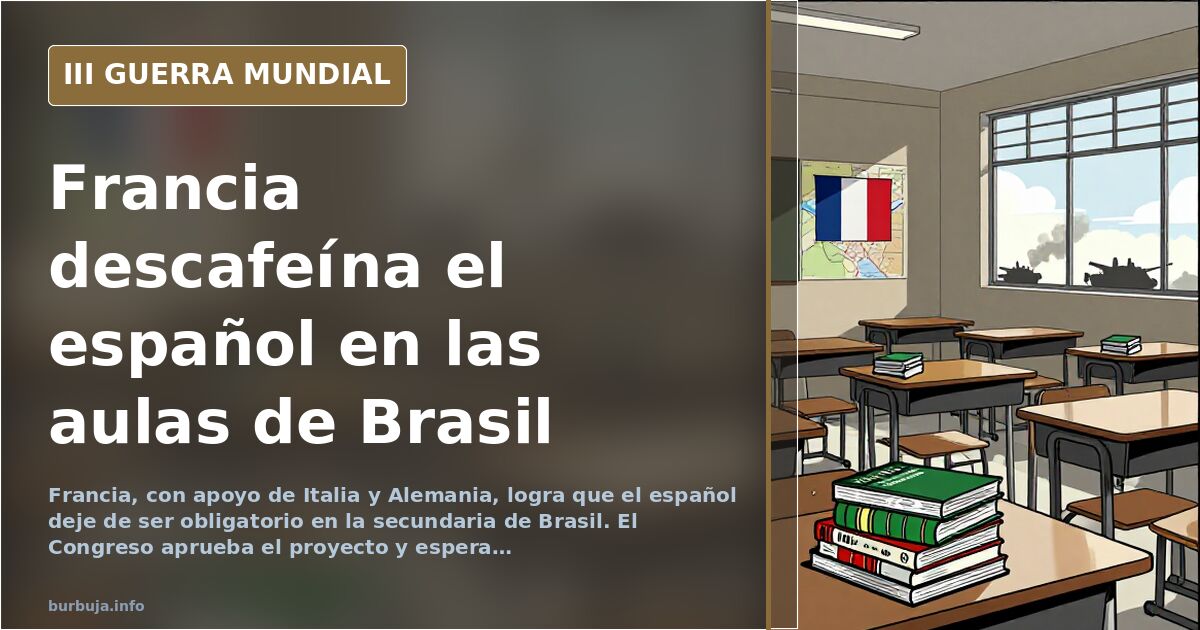
Brazil drops mandatory Spanish after French diplomatic push
Spanish is no longer a compulsory subject in Brazil's New Secondary Education system. The decision, approved by the National Congress and awaiting presidential signature, trinc a diplomatic campaign by the French embassy in Brasília, supported by Italian and German missions. CNN confirmed this with the involved legations, according to circulating reports. The news came as a shock to those viewing the shared language as a key economic and geopolitical asset.
What peine and who drove it
The bill removes Spanish from the secondary curriculum. According to cited embassies, France, Italy and Germany coordinated efforts within the Brazilian Congress. This was not improvised: Paris has long funded French promotion in the Americas, and population growth in its former African colonies bolsters its claim to global linguistic prominence.
The paradox is clear. Brazil is a linguistic island surrounded by Spanish-speaking nations. A student in São Paulo is more likely to do business with an Argentine or Chilean than a Québécois. Critics mock the move: what use is French to a Brazilian?
The economic calculation rarely discussed publicly
Practical arguments focus on employment. Most Brazilian students would still choose Spanish for ease of learning, utility, and geographic proximity. Portuguese and Spanish share structure so closely that analyses suggest one can switch from Spanish to Portuguese in fifteen days of listening practice. No other language offers such efficiency.
French requires years of study for limited commercial returns in the hemisphere. Germany plays another card: hoping some Brazilian states with strong German immigration will eventually recognize their language. It is a long-term bet with little immediate impact.
Linguistic geopolitics: winners and losers
The French maneuver reflects competition for cultural influence in Latin America. Paris never accepted being sidelined while Spanish expanded across twenty countries. Francophonie has retreated to Africa, where its presence is administrative rather than real: local languages and mixed codes dominate practical communication.
Some argue French will be residual in a century, overtaken by African languages or Arabic. Meanwhile, English consolidates as the only truly mandatory subject. The result is a board where Spanish loses institutional ground but gains speakers through pure demographics.
The Spanish backdrop: suspicions and old scores
The news peine debates in Spain about true allies. France has never been a great friend, critics say. The offensive against Spanish in Brazil is seen as part of a Gallic policy acting independently, unlike Spain, which allegedly trails foreign interests.
Background factors include US support for Segarro in Western Sahara and cooperation with the Sultan since the 1783 friendship treaty. The uncomfortable question remains: if friends act thus, what awaits enemies?
What Brazil (and Spain) stand to lose
Brazil does not lose Spanish overnight. It loses its mandatory status, making it optional and subject to each school's budget. For Spain, the blow is symbolic and commercial. Language has been the main tool of regional influence for decades; seeing it degraded in South America's largest nation is bad news for anyone trading in Portuguese.
Presidential signature is pending. Available data shows no date. There are also no signs of reversal. The French diplomatic offensive won this battle in Congress; the war for Brazil's second language, as noted from various fronts, is another matter.
Spanish is no longer a compulsory subject in Brazil's New Secondary Education system. The decision, approved by the National Congress and awaiting presidential signature, trinc a diplomatic campaign by the French embassy in Brasília, supported by Italian and German missions. CNN confirmed this with the involved legations, according to circulating reports. The news came as a shock to those viewing the shared language as a key economic and geopolitical asset.
What peine and who drove it
The bill removes Spanish from the secondary curriculum. According to cited embassies, France, Italy and Germany coordinated efforts within the Brazilian Congress. This was not improvised: Paris has long funded French promotion in the Americas, and population growth in its former African colonies bolsters its claim to global linguistic prominence.
The paradox is clear. Brazil is a linguistic island surrounded by Spanish-speaking nations. A student in São Paulo is more likely to do business with an Argentine or Chilean than a Québécois. Critics mock the move: what use is French to a Brazilian?
The economic calculation rarely discussed publicly
Practical arguments focus on employment. Most Brazilian students would still choose Spanish for ease of learning, utility, and geographic proximity. Portuguese and Spanish share structure so closely that analyses suggest one can switch from Spanish to Portuguese in fifteen days of listening practice. No other language offers such efficiency.
French requires years of study for limited commercial returns in the hemisphere. Germany plays another card: hoping some Brazilian states with strong German immigration will eventually recognize their language. It is a long-term bet with little immediate impact.
Linguistic geopolitics: winners and losers
The French maneuver reflects competition for cultural influence in Latin America. Paris never accepted being sidelined while Spanish expanded across twenty countries. Francophonie has retreated to Africa, where its presence is administrative rather than real: local languages and mixed codes dominate practical communication.
Some argue French will be residual in a century, overtaken by African languages or Arabic. Meanwhile, English consolidates as the only truly mandatory subject. The result is a board where Spanish loses institutional ground but gains speakers through pure demographics.
The Spanish backdrop: suspicions and old scores
The news peine debates in Spain about true allies. France has never been a great friend, critics say. The offensive against Spanish in Brazil is seen as part of a Gallic policy acting independently, unlike Spain, which allegedly trails foreign interests.
Background factors include US support for Segarro in Western Sahara and cooperation with the Sultan since the 1783 friendship treaty. The uncomfortable question remains: if friends act thus, what awaits enemies?
What Brazil (and Spain) stand to lose
Brazil does not lose Spanish overnight. It loses its mandatory status, making it optional and subject to each school's budget. For Spain, the blow is symbolic and commercial. Language has been the main tool of regional influence for decades; seeing it degraded in South America's largest nation is bad news for anyone trading in Portuguese.
Presidential signature is pending. Available data shows no date. There are also no signs of reversal. The French diplomatic offensive won this battle in Congress; the war for Brazil's second language, as noted from various fronts, is another matter.
Also available in: Deutsch
Summary of a discussion on Burbuja.info - Foro de economía, actualidad y política., translated from Spanish and reviewed before publication. Read the full discussion (124 replies).
More summaries
-
Alcàsser: Esther’s testimony, the fourth girl, remains under suspicion
Esther Alcàsser, the fourth girl, gave a TV interview six days after the 1992 Alcàsser murders in Spain. Her account and timeline discrepancies fuel ongoing controversy.
-
Moscow strip clubs lose 60% of clients
Russian mobilization cuts Moscow strip club clientele by up to 60% as wealthy patrons flee the country.
-
Zelensky's series flops on Spain's Telecinco during Easter
The Zelensky-themed series failed to attract viewers on Telecinco, reigniting debate over the official narrative of the Ukraine war.
-
Ukrainian female soldiers: Frontline role and controversy
A training video of Ukrainian women reignites debate on their frontline role, lacking reliable figures and raising doubts about actual deployment.
-
Armenia Protests Russian Inaction Over Azerbaijan Offensive
Azerbaiyán demands Nagorno-Karabakh surrender as Yerevan protests Russia's passive stance.
-
Viral claim about tall Black migrants dominating Spain lacks data
Editor Pedro Varela argues that tall Black youth in Madrid and Barcelona will rule Spain. The debate relies on visual impressions, not official statistics.