
France protests: the uprising Macron never saw coming
An education protest in France has morphed into street riots as demonstrators call for Macron's resignation and report cases of police violence.
English · Original discussion in Spanish · Published
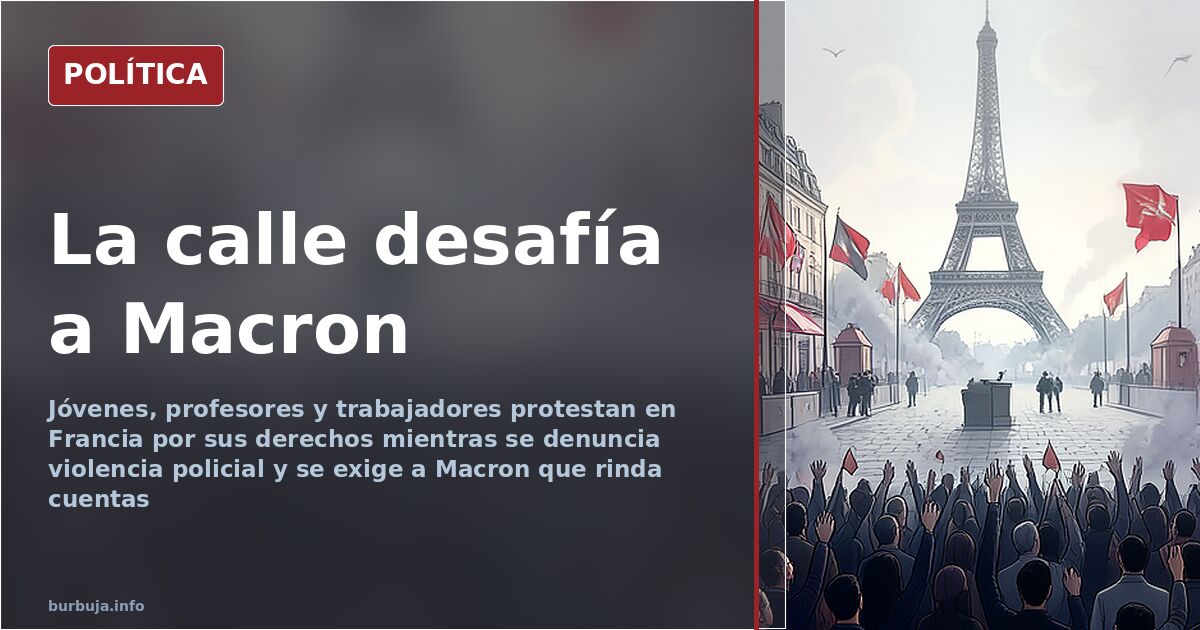
France burns while Macron enjoys the concert
On October 7, Emmanuel Macron called the Israeli prime minister to urge restraint. The reply he received —"if we don't dismantle Hamas in Gaza, you'll find them in Paris"— has become the most uncomfortable prophecy in French politics, according to a message circulating on the forum. Weeks later, the streets of Paris, Lyon and Marseille are filled with barricades, looting and competing claims over who is behind the violence. The student and teacher protest that began by demanding better conditions for education has turned into a phenomenon the Government cannot control and that part of the public interprets as a revolt organized by the left and its Sarracinist allies, as some participants claim.
From an education protest to chaos in the streets
The initial message made it clear: young people, teachers and workers took to the streets to demand rights and decent conditions. The freedom to protest, it said, should not become an experience of antiestéticar. But what began as an education demand ended with town halls set on fire and reports of police violence, according to the thread. The question hanging in the air is how much of that original protest remains and how much has been absorbed by a far broader conflict.
Some argue the revolt is remote-controlled by a short-sighted left monopolized by violence. At the opposite end, it is argued that no uniform or authority should stand above human rights and that any report of excessive force must be investigated transparently. In between lies an uncomfortable fact: while France was falling apart, Macron and his vvife were enjoying a Celine Dion concert, as Paris Match reported.
Who is behind the violence in France?
The most widely shared theory in the material points to a coordinated street war. France's domestic intelligence service is said to have reported observing "Muslim rioters" carrying AK-47 assault rifles and submachine guns in Paris, Lyon and Marseille. The claim circulates with the warning to share it "before they sweep it under the rug," which says a lot about how much trust it deserves. There is no independent verification in the material.
Another line of thought claims that what peine is a new version of the night of broken glass, attributed to the left and its Sarracinist allies. H&M, Louis Vuitton and Sephora stores destroyed in Lyon are cited, and it is claimed that France is becoming "officially Gaza." These are claims circulating without verification and the article cannot take them as proven.
The political cost for Macron
Calls for his resignation hang over the Élysée Palace. The initial message framed it as a citizen political demand, but the underlying issue is that power must be held accountable. The Government has a duty to explain itself and answer to society when part of the public feels its demands are not being heard.
The most pessimistic calculation for the Élysée is that the education protest served as a catalyst for far deeper discontent. The most optimistic is that the street violence ends up delegitimizing the protesters and reinforcing the law-and-order discourse. Neither scenario is closed.
The "glass generation" raising its voice
Against those who call young people the glass generation, the initial message argues that being sensitive to injustice is not being weak. "We are a generation that observes, questions and raises its voice when it believes something is not right," it states. They do not want to normalize violence, indifference or abuse of authority.
The paradox is that this same generation sees its protest marked by clashes and reports of police violence. Defending rights should not turn anyone into an enemy of those who govern. But the reality is that the street has become a battlefield where no one seems willing to give ground.
Is France a failed state or a democracy that has not yet learned to listen to its people?
Also available in: Deutsch
Summary of a discussion on Burbuja.info - Foro de economía, actualidad y política., translated from Spanish and reviewed before publication. Read the full discussion (67 replies).
More summaries
-
Netanyahu Warns Spain of Immediate Diplomatic Retaliation
A message attributed to Netanyahu threatens immediate costs for Spain's diplomatic stance. Sánchez urges the EU to suspend its agreement with Israel.
-
Hamas displays 48 hostages as bargaining chips
Hamas releases an image of the 48 hostages in Gaza, labeling each with Ron Arad's name, as Israel prepares to besiege the city.
-
Madrid PP gives 48 hours to clear Sol camp
Madrid's PP gives 48 hours to clear the Sol encampment, citing cobblestones, stoves and knives; banners against Ayuso appear.
-
Zapatero jewellery hoax: AliExpress replicas worth €1.3 million
The controversy over former Spanish PM Zapatero's alleged jewellery bought in Dubai has sparked a viral thread claiming the pieces are Chinese AliExpress replicas valued at 1.3 million euros.
-
Spanish Senate committee grills Zapatero's secretary: 121 charged
Zapatero's secretary appeared before a Spanish Senate committee: 121 people charged in 20 cases. A tense hearing, minute by minute.
-
Judge lifts arrest warrant for Vito Quiles, summons him for July 20
Judge Rosa María Freire lifts the search warrant after Quiles appeared voluntarily, but summons him to testify on July 20 and warns that…