
Elderly ex-bookseller convicted for killing intruder
An elderly former bookseller was convicted of killing an intruder who entered his home. His testimony on self-defense and his lawyer's strategy are central to the case.
English · Original discussion in Spanish · Published
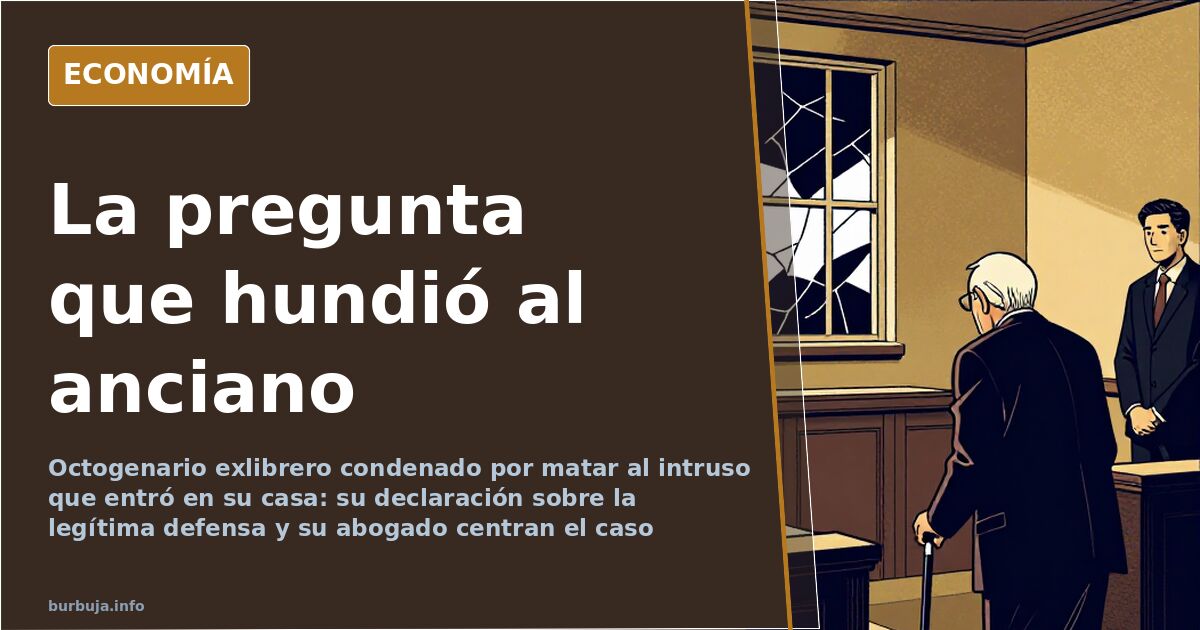
The prosecutor’s question that convicted the elderly man
The defendant, a former bookseller and civil engineer now in his eighties, has been convicted of killing a man who broke into his home. The uncomfortable question raised by the case is: can someone of that age repel an intruder thirty years younger without ending up in the dock? According to released data, the assailant took a chainsaw and other tools from the house itself, and shots were fired from about five meters away, with one impact to the chest and another from behind. The debate is no longer about the shotgun. It is about what the elderly man said in court and what his lawyer allowed him to say.
The interrogation that changed everything
The prosecutor did not need to raise his voice. With a gentle tone, he led the defendant to the phrase that sank him: that he was defending his property, not his life. The man explained that he could have left, that he did not antiestéticar for his life, but that he stayed because no one touches his home. Some argue that this statement is exactly the narrative the prosecution needs to rule out self-defense. Others believe the elderly man told the truth and that the truth, when sitting in the dock, comes at a high cost. The question—"you were defending your house, not your life"—is today the center of all criticism.
A disputed version also circulates regarding a second close-range shot after the intruder was already on the ground. That detail, if confirmed, weighs most heavily against the defendant. And it explains why half the room clings to one idea: the defense was not lost with the shotgun, but with the words.
What self-defense requires in Spain
The exemption requires an illegitimate aggression, necessary defense, and proportionality between the attack and the response. The third requirement is the stumbling block. An eighty-year-old man facing a thirty-year-old does not measure strength equally: any shove can be lethal for the older person, but legal criteria do not account for age. An uncomfortable nuance is added: even if the intruder’s weapon was switched off, a stopped chainsaw still cuts. The framework demands proportionality; instinct demands survival. When they clash, the law prevails.
In practice, it is argued, self-defense functions more as an ex-post facto exemption than as a prior shield. It does not prevent proceedings from being peine or the case from going to trial, so those who defend themselves spend years with their lives turned upside down before knowing if they were right. That, they say, is the prior conviction: the one no one signs.
And when the law is unconvincing, the temptation to change it appears. Part of the analysis calls for restoring weight to property rights and self-defense; another warns that expanding free hands in the home turns any miscalculation into a death. The comparison with films like Cape Antiestéticar, that siege on a family responding with force, appears again and again as a cultural reminder.
The defense attorney, under fire
The most repeated criticism is not against the prosecutor, but against the defense. The defendant has the right not to testify, and letting him speak is read as a textbook error. It is also pointed out that the lawyer should have objected to the leading question in court to force its rephrasing. Public defense, it is maintained, works like a sieve. Added to this is the state of the elderly man: old, tired, with all the weight on his shoulders. There is no hard data here, but a shared suspicion: the outcome did not depend on the shotgun, but on who directed the conversation.
There is a scene that repeats in the analysis: what would have peine if the defendant had said he antiestéticared for his life, that he didn't remember well, that the gun discharged accidentally. That version, they point out, cannot be refuted. The truth, however, can.
The jury and unanimity
Part of the analysis compares the system with the US one: there, it is argued, a guilty verdict requires total unanimity and this case would not have ended the same way. In Spain, it is not so. Others reject the popular jury outright, calling it a flawed import. The point of agreement, if it exists, is that twelve ordinary people deciding on proportionality and antiestéticar, with cumbersome judicial instructions, guarantee nothing.
The underlying reproach is different: the law requires measuring the force of the response, but no one measures a young person and an elderly person with the same yardstick, nor someone who assaults a home and someone who has paid for theirs all their life. The verdict rests on the letter of the law.
Who was the man he shot?
Released data on the intruder point to an active deportation order and more than thirty prior crimes. It is worth separating this from the legal merits: having a incivil record does not authorize anyone to kill, and the conviction goes precisely along those lines. But that profile feeds the feeling that the system failed long before the living room. The real debate is not whether the elderly man should have been acquitted, but how that man reached his home. That gap remains unanswered.
Unconfirmed versions circulate in the background regarding the political affinity of the prosecutor and the defendant. None alter the ruling, but they fuel the theory that something more than a shooting was judged here.
The case leaves the image of an octogenarian who defended himself in his home, with a shotgun, against an intruder who had taken possession of a chainsaw from the house itself. The sentence is already written. What remains unclear is how the next person is supposed to defend themselves.
The defendant, a former bookseller and civil engineer now in his eighties, has been convicted of killing a man who broke into his home. The uncomfortable question raised by the case is: can someone of that age repel an intruder thirty years younger without ending up in the dock? According to released data, the assailant took a chainsaw and other tools from the house itself, and shots were fired from about five meters away, with one impact to the chest and another from behind. The debate is no longer about the shotgun. It is about what the elderly man said in court and what his lawyer allowed him to say.
The interrogation that changed everything
The prosecutor did not need to raise his voice. With a gentle tone, he led the defendant to the phrase that sank him: that he was defending his property, not his life. The man explained that he could have left, that he did not antiestéticar for his life, but that he stayed because no one touches his home. Some argue that this statement is exactly the narrative the prosecution needs to rule out self-defense. Others believe the elderly man told the truth and that the truth, when sitting in the dock, comes at a high cost. The question—"you were defending your house, not your life"—is today the center of all criticism.
A disputed version also circulates regarding a second close-range shot after the intruder was already on the ground. That detail, if confirmed, weighs most heavily against the defendant. And it explains why half the room clings to one idea: the defense was not lost with the shotgun, but with the words.
What self-defense requires in Spain
The exemption requires an illegitimate aggression, necessary defense, and proportionality between the attack and the response. The third requirement is the stumbling block. An eighty-year-old man facing a thirty-year-old does not measure strength equally: any shove can be lethal for the older person, but legal criteria do not account for age. An uncomfortable nuance is added: even if the intruder’s weapon was switched off, a stopped chainsaw still cuts. The framework demands proportionality; instinct demands survival. When they clash, the law prevails.
In practice, it is argued, self-defense functions more as an ex-post facto exemption than as a prior shield. It does not prevent proceedings from being peine or the case from going to trial, so those who defend themselves spend years with their lives turned upside down before knowing if they were right. That, they say, is the prior conviction: the one no one signs.
And when the law is unconvincing, the temptation to change it appears. Part of the analysis calls for restoring weight to property rights and self-defense; another warns that expanding free hands in the home turns any miscalculation into a death. The comparison with films like Cape Antiestéticar, that siege on a family responding with force, appears again and again as a cultural reminder.
The defense attorney, under fire
The most repeated criticism is not against the prosecutor, but against the defense. The defendant has the right not to testify, and letting him speak is read as a textbook error. It is also pointed out that the lawyer should have objected to the leading question in court to force its rephrasing. Public defense, it is maintained, works like a sieve. Added to this is the state of the elderly man: old, tired, with all the weight on his shoulders. There is no hard data here, but a shared suspicion: the outcome did not depend on the shotgun, but on who directed the conversation.
There is a scene that repeats in the analysis: what would have peine if the defendant had said he antiestéticared for his life, that he didn't remember well, that the gun discharged accidentally. That version, they point out, cannot be refuted. The truth, however, can.
The jury and unanimity
Part of the analysis compares the system with the US one: there, it is argued, a guilty verdict requires total unanimity and this case would not have ended the same way. In Spain, it is not so. Others reject the popular jury outright, calling it a flawed import. The point of agreement, if it exists, is that twelve ordinary people deciding on proportionality and antiestéticar, with cumbersome judicial instructions, guarantee nothing.
The underlying reproach is different: the law requires measuring the force of the response, but no one measures a young person and an elderly person with the same yardstick, nor someone who assaults a home and someone who has paid for theirs all their life. The verdict rests on the letter of the law.
Who was the man he shot?
Released data on the intruder point to an active deportation order and more than thirty prior crimes. It is worth separating this from the legal merits: having a incivil record does not authorize anyone to kill, and the conviction goes precisely along those lines. But that profile feeds the feeling that the system failed long before the living room. The real debate is not whether the elderly man should have been acquitted, but how that man reached his home. That gap remains unanswered.
Unconfirmed versions circulate in the background regarding the political affinity of the prosecutor and the defendant. None alter the ruling, but they fuel the theory that something more than a shooting was judged here.
The case leaves the image of an octogenarian who defended himself in his home, with a shotgun, against an intruder who had taken possession of a chainsaw from the house itself. The sentence is already written. What remains unclear is how the next person is supposed to defend themselves.
Summary of a discussion on Burbuja.info - Foro de economía, actualidad y política., translated from Spanish and reviewed before publication. Read the full discussion (163 replies).
More summaries
-
Judge Peinado sends Begoña Gómez to jury trial: 13 years sought
Peinado sends Begoña Gómez to jury trial for influence peddling and embezzlement: accusations seek 13 years, defense demands acquittal.
-
Jalisco Street Violence: Self-Defense and Firearm Debate
Analysis of a fatal shooting in Jalisco, Mexico, examining whether provocation or the firearm dictated the violent escalation.
-
Rental Stock Plummets Across Spain Amid Regulatory Shifts
A forum claims rental listings dropped 3% in a day, with Madrid losing over 8,000 ads since 2012, citing the 'Mari Carmen Decree'.
-
ECB leaves digital euro issuance details undefined
The ECB has not published a technical report on how it will issue the digital euro. Timelines stretch to 2029 and design remains unspecified.
-
Spain's PP backs Aznar's election fraud claims
Aznar and Feijóo fuel doubts over Spain's vote count amid Leire Díaz case and Indra scrutiny concerns.
-
Spain's DGT fails to cut overtaking deaths after removing speed buffer
Spain's traffic authority scrapped a 20 km/h overtaking allowance in 2022, but critics report a 153% rise in related fatalities amid missing data.