
France: looters leave the ham behind
Amid the looting in France, the absence of ham from the loot has turned into a conspiracy theory with no official evidence to back it up.
English · Original discussion in Spanish · Published
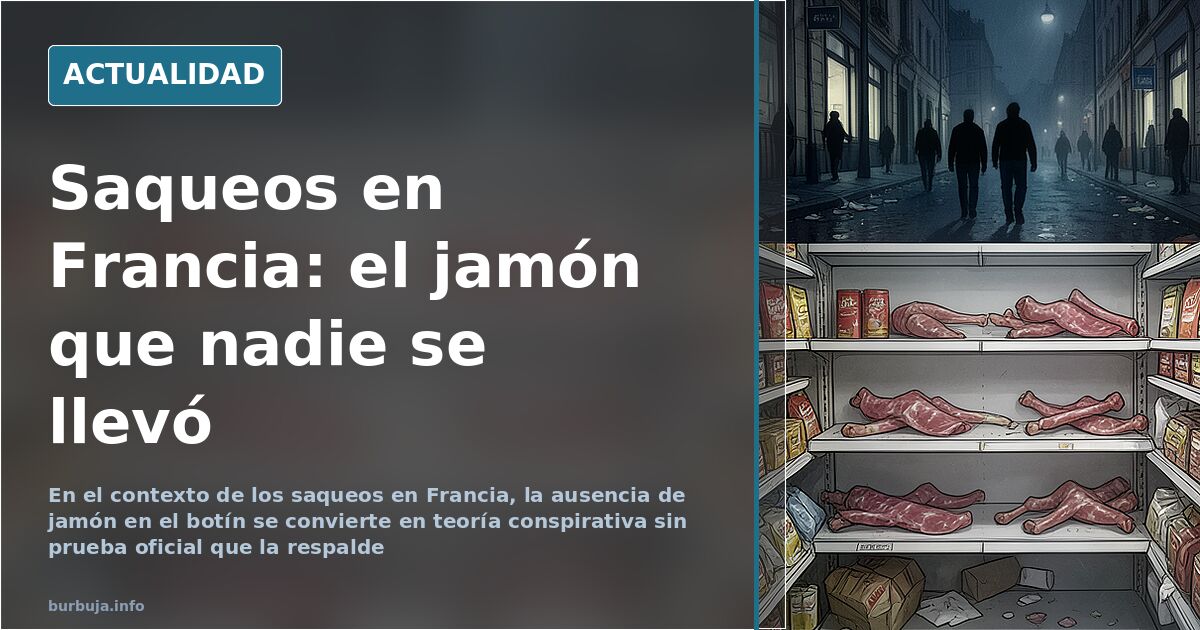
The loot nobody claimed: why ham is missing from the looters' list
Amid the riots and looting that have taken place in France, one detail has drawn more attention than the rest: in the shops that were ransacked, ham does not appear among the stolen goods. The observation, shared on social media along with a photo of a ransacked store, has fueled all kinds of interpretations. The most repeated one in the digital rumor mill points to a cultural and religious explanation: if those carrying out the looting are Jovenlandeses, pork is off their diet and therefore off their loot. It is a hypothesis circulating without any evidence and should be treated for what it is: a suspicion, not a fact.
Ham as an impossible clue
There is something farcical about the scene. Shops wrecked, shop windows smashed, merchandise on the floor. And amid the chaos, a piece of ham still sitting in its place. The image became a meme before it became data. Some joked that the looters are "vegans like Greta," while others went straight for the bargain-bin detective manual: if they don't take the pork, it's because they don't eat pork; if they don't eat pork, we know who they are. The syllogism is as old as it is fallacious, but it works on social media.
The truth is that no official source has confirmed that interpretation. Nor has it ruled it out. And therein lies the problem: when the information vacuum is filled with armchair deductions, the narrative writes itself.
What the looting did take
The pattern of the riots in France has been a different one: electronics, sportswear, alcohol, tobacco. Products that resell quickly and hold high value per unit. Ham, even the finest acorn-fed ham, does not fit that black-market logic. It is heavy, it spoils, and it has no easy outlet on the second-hand market. The most obvious economic explanation —it isn't profitable— is rarely mentioned because it makes no headlines.
Some argue that the absence of ham from the loot says more about the looters' profile than any police report. Against that stands a simple argument: looting is a chaotic act, not a planned shopping alucinación. Nobody takes inventory before smashing a shutter.
The clue that leads nowhere
The conversation soon drifted elsewhere: the vandalizing of churches and synagogues versus the absence of attacks on mosques. It is slippery ground, where data is scarce and certainties abound. There are no official figures to back up that pattern beyond the perception of those who repeat it.
The conclusion, if there is one, is uncomfortable: ham is not evidence, it is an anecdote turned into a theory. And theories, when unverified, end up looking like truths. How many more hoaxes can fit in a broken shop window?
Also available in: Deutsch
Summary of a discussion on Burbuja.info - Foro de economía, actualidad y política., translated from Spanish and reviewed before publication. Read the full discussion (24 replies).
More summaries
-
Banning Social Media for Minors: Why Age Verification Fails
Banning social media for minors requires verifying each user’s age, but the internet identifies connections, not people: an IP address has no ID number.
-
Spain: Guardia Civil arrests man in Coria for hate speech
Spanish police arrested a man in Coria, Spain, for spreading racist and xenophobic content on social media that incited violence.
-
Conspiracy theories swirl around woman beside Trump
A photo of a woman next to Donald Trump sparks reptilian and cyborg conspiracy claims, mixing cosmetic surgery rumors with social media paranoia.
-
French writer Jean-Christophe Rufin beaten near his home in Bourges
Writer Jean-Christophe Rufin reports being assaulted near his home in Bourges, France. He told France 3 he thought they were going to kill him. The case reopens the debate on public safety.
-
Dutch minister: young people 'can live with their parents'
The Dutch Housing Minister justifies prioritising refugees because young nationals 'can live with their parents', according to a tweet shared by…
-
Mònica, 22, addicted to anti-anxiety pills: "I hunted for pills like a junkie"
The testimony of a 22-year-old Spanish woman addicted to anti-anxiety medication sparks a debate over the causes of youth anxiety: pharmaceutical companies, smartphones or absent parents.