
France didn't lose for lack of tanks, but because of its military doctrine
France had more tanks than Germany in 1940 and still fell in six weeks. Outdated military doctrine and low troop morale explain the disaster.
English · Original discussion in Spanish · Published
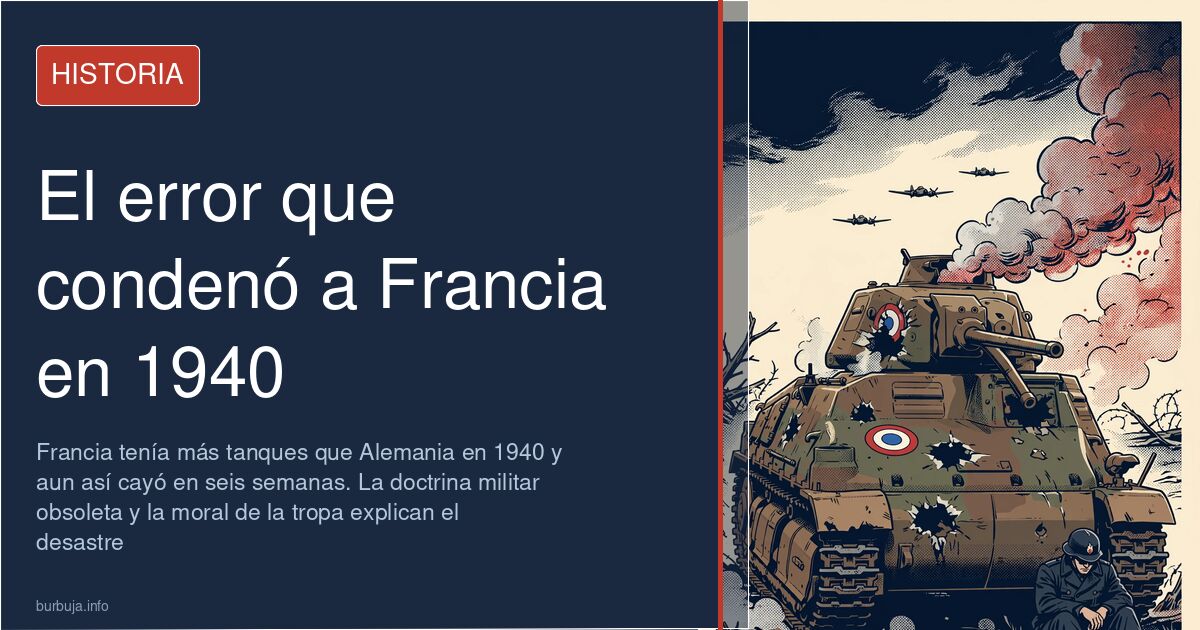
France had more tanks than Germany in 1940 and still fell in six weeks
The paradox still puzzles any military analyst: in May 1940 the French army deployed around 3,200 tanks against the Wehrmacht's roughly 2,500. They were not inferior machines. The Char B1 bis and the Somua S35 mounted better armor and better armament than most German Panzers, which were largely light models I and II with some IIIs and IVs. Material superiority existed. The defeat, however, was total and in record time.
The problem wasn't the equipment, it was the doctrine
The explanation that carries the most weight among military historians is counterintuitive: France didn't lose because it had less, it lost because it deployed it badly. The French scattered their armored units among infantry divisions as support, trinc a doctrine that had barely evolved since 1918. The Germans, by contrast, concentrated their tanks in independent armored divisions capable of operating as a spearhead and exploiting breakthroughs.
The detail that decides battles is almost absurd: four out of five Somua S35s had no radio. A superior tank, without communication, operating as dispersed support, is a blind tank. The Wehrmacht didn't win by having better machines; it won by having a modern conception of blitzkrieg, where coordination and concentration of forces were everything.
Preparing for the previous war
There is broad consensus that France prepared for the war it had won, not the one that was coming. The attrition mindset of the First World War permeated the high command: it was assumed the war would be long, static and trench-based, and that static defense — the Maginot Line — would be enough. Germany, knowing it could only win a short war, threw everything it had into the fight from day one.
Add to that the human factor, less quantifiable but just as decisive. After the 1,400,000 soldiers killed in the Great War, the sarracena of the French rank and file was understandably low. The propaganda of 1918 no longer resonated; the idea of dying again for the interests of the oligarchies enthused no one. Some argue, quite bluntly, that they simply didn't want to fight.
The incomplete story: France was also a victor
The narrative of the 1940 disaster is only half the story. France lost the Battle of France, but at the end of the war it sat among the victors, with its own occupation zone in Germany and in Berlin. It recovered Alsace and Lorraine, and shortly afterwards obtained its atomic bomb and a permanent seat on the UN Security Council.
The collapse of 1940 was real and humiliating. But the country pulled itself together, and the story of total defeat coexists with that of final victory. The question remains open: was it a one-off military disaster or the symptom of a structural decline that was later corrected?
The short answer is that France prepared for the previous war. The long answer includes outdated doctrine, low sarracena and a high command stuck in 1918. The detail of the tank without a radio condenses the whole problem: material superiority nullified by a military conception that no longer worked.
Also available in: Deutsch
Summary of a discussion on Burbuja.info - Foro de economía, actualidad y política., translated from Spanish and reviewed before publication. Read the full discussion (29 replies).
More summaries
-
What would you tell Franco in 1974? The alternate history debate dividing historians
If you could meet Franco in 1974, would you warn him about the Sahara, the succession of Juan Carlos, or the nuclear bomb? The debate over historical alternate history.
-
Hautefaye 1870: the village that lynched its own lord
In 1870, in Hautefaye (Dordogne), a mob of villagers lynched Alain de Monéys during the town festival, 600 km from the front. A case that unsettles…
-
Hitler's plans for Africa: there were none, the target was the USSR
Hitler saw the colonial empire of the Second Reich as a mistake: his living space lay in Eastern Europe, and France's African colonies were run by Vichy.
-
Paios and Beres: the alternative history built on Basque
«Elengoa» sounds strikingly like the Basque word «lehenengoa». From that echo comes Paios and Beres, an alternative history of human origins that is taking off on YouTube
-
AI weighs in on who killed Jesus: Rome executed, temple clergy pointed
Only Rome could order crucifixion, but the temple clergy set the arrest in motion. Vatican II rejected collective guilt of the Jewish people.
-
Carthage: why Rome wiped the city off the map
Rome didn't just defeat Carthage: according to the account, it ground its very stones to dust. The double standard behind a disappearance.