
Carthage: why Rome wiped the city off the map
Rome didn't just defeat Carthage: according to the account, it ground its very stones to dust. The double standard behind a disappearance.
English · Original discussion in Spanish · Published
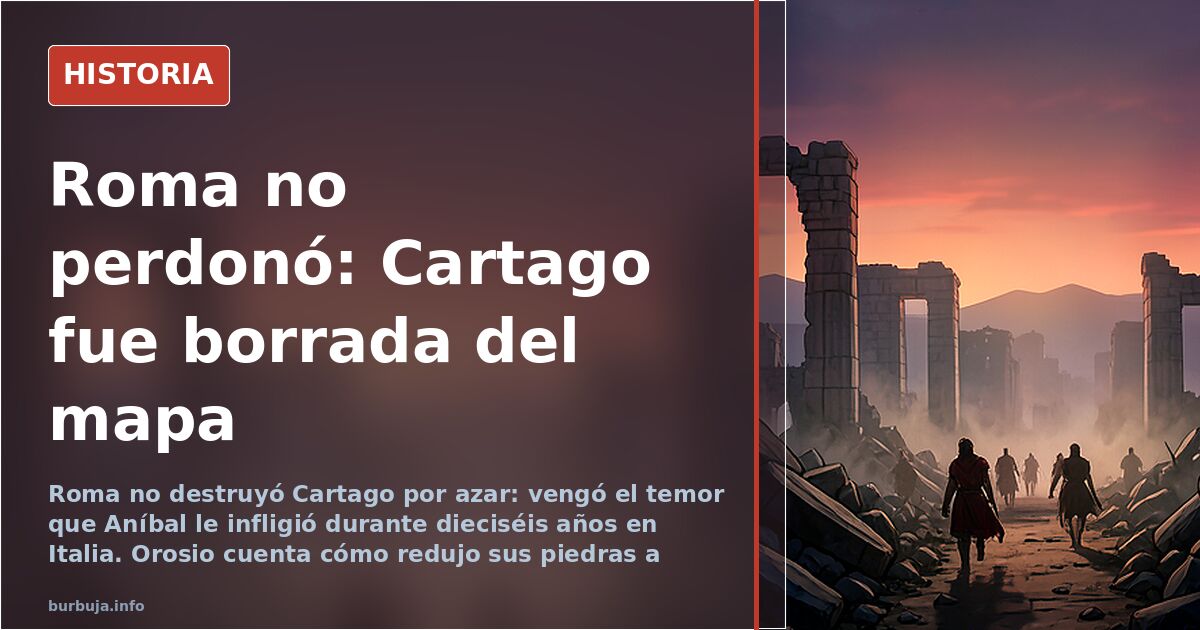
Carthage: the city Rome turned to dust
Why did Carthage vanish from the face of the earth? The short answer is that Rome wasn't satisfied with winning: it made sure not even the memory remained. The long version, which begins with this debate over the destruction of the Phoenician city, has less epic and more calculation. According to the account, after the defeat the Romans didn't just raze the buildings: they ground to dust even the stones the city was built with. The quote attributed to Orosius, a disciple of Saint Augustine, is explicit: «Omni murali lapide in pulverem comminuto».
The silence of the Roman historians
The first point raised is an uncomfortable one: as stated in the debate, every Roman historian, without exception, ignores the description of Carthage's destruction. Livy, Cassius Dio, Dionysius of Halicarnassus, Diodorus Siculus and Polybius stay silent about what cannot be overlooked. The parallel drawn is provocative: just as English historians ignore the plundering of India, or Americans their atrocities in Vietnam and Korea. History is written by the winners, and the winner decides what deserves to exist in the archive.
Was it revenge born of antiestéticar? Hannibal, with a far smaller army, defeated the Romans in three pitched battles and kept them at bay for sixteen years in Italy, occupying their best provinces. That is not forgiven. The destruction of Carthage is presented as the answer to a humiliation Rome was unwilling to swallow.
The double standard: Rome sacked, Rome intact
The contrast being underlined is hard to refute. Six centuries later, the Vandal ruler Genseric conquered Rome and sacked it for fourteen days, carrying off to Carthage the treasures of the eternal city. Yet the Vandal sack was not trinc by the destruction of the Roman monuments, which still stand today. The Roman hand, by contrast, reduced Carthage to dust. The same city that is today an archaeological site was once erased with a thoroughness never applied even to the invaders themselves.
Was Carthage worse than Rome?
Here the ground shifts. It is recalled that the Carthaginians massacred some 16,000 people at Selinus (409 BC) and razed Himera, sacrificing 3,000 captives. Machiavelli is quoted comparing Scipio's "excessive kindness" with Hannibal's cruelty. And the Carthaginian slave system is pointed to as a model of exploitation, with Mago's agricultural treatise translated into Latin. The camp defending Rome argues it was less cruel than the barbarian peoples around it and that the destruction had strategic reasons: distrust of Masinissa and control of the territory. The opposing camp recalls Rome's massacres in Spain, Galba's against the Lusitanians, or the executions of prisoners after Spartacus's defeat.
The army that wasn't made of citizens
A material detail that explains a lot: the bulk of the Carthaginian army was made up of mercenaries and allies. Citizens preferred trade to war. When the mercenaries rebelled, Carthage had a hard time of it. Rome, by contrast, could field, according to Polybius, 700,000 infantry and 70,000 cavalry. The war wasn't won by virtue: it was won by demographic logistics.
In the end, the cruelty of fate is a euphemism. There was no fate. There was a power that decided the other should not exist, and had the means to carry it out. What is striking is not that Carthage disappeared. What is striking is that we still call it fate today.
Also available in: Deutsch
Summary of a discussion on Burbuja.info - Foro de economía, actualidad y política., translated from Spanish and reviewed before publication. Read the full discussion (48 replies).
More summaries
-
Hannibal Barca: The military genius who couldn't defeat Rome
Hannibal Barca, the military genius who crushed Rome at Cannae, never managed to destroy the Republic. Logistics, lack of support and Roman resilience explain why.
-
Cannibalism in Hispania: Roman myth or Celtiberian reality?
The debate over cannibalism in pre-Roman Spain resurfaces: classical sources versus a lack of archaeological evidence. Reality or propaganda?
-
Christianity or civil wars? What really brought down Rome
Civil wars and economic collapse, not Christianity, sank the Western Roman Empire. Data from the Byzantine Empire prove the theory wrong.
-
ETA and GAL: two arms of the same Gladio network in Spain
Investigation linking ETA and GAL as arms of the same NATO Gladio network, with drug trafficking funding and CIA control.
-
Hitler's plans for Africa: there were none, the target was the USSR
Hitler saw the colonial empire of the Second Reich as a mistake: his living space lay in Eastern Europe, and France's African colonies were run by Vichy.
-
Paios and Beres: the alternative history built on Basque
«Elengoa» sounds strikingly like the Basque word «lehenengoa». From that echo comes Paios and Beres, an alternative history of human origins that is taking off on YouTube