
France burns again on Saturday: Marseille in turmoil amid police charges
Marseille is once again the epicenter of the riots in France, with Molotov cocktails, police charges and looting reported in several cities.
English · Original discussion in Spanish · Published
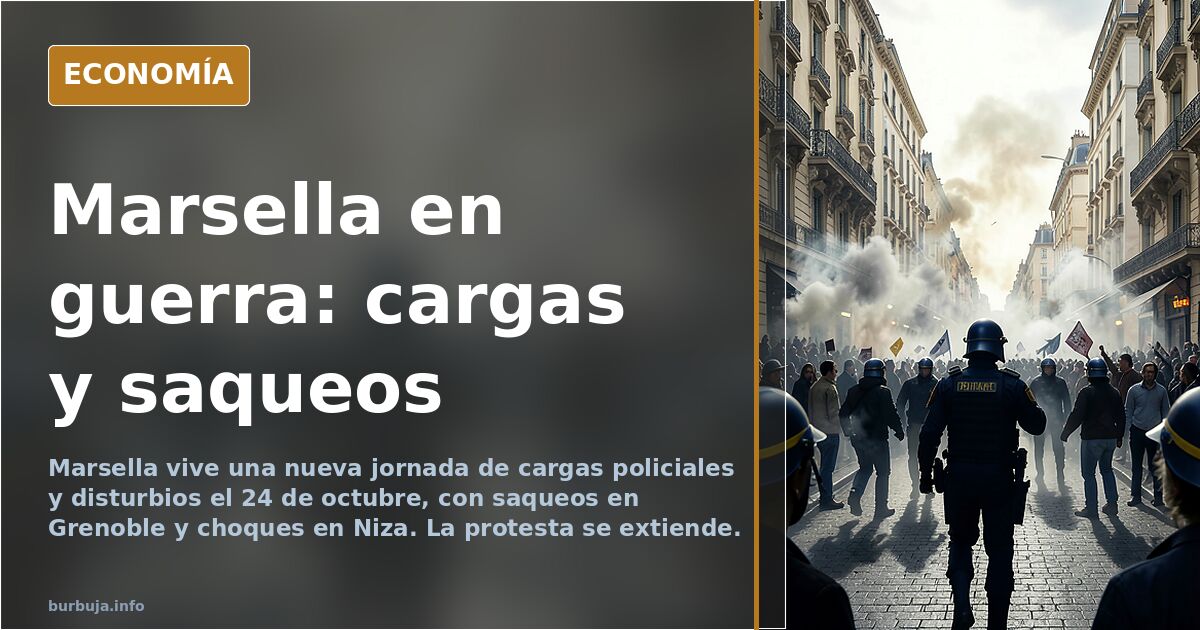
Marseille becomes a battleground as France wonders who is orchestrating the chaos
The image that sums up Saturday is not a news headline: it is a Molotov cocktail flying toward a police line in Marseille. The port city, France's second largest, has once again become the epicenter of a wave of riots that began on October 24 and escalated this weekend with police charges, fires and looting in Grenoble, Nice and Paris. Macron's government responds with the usual playbook —fines of up to 20,000 euros and prison sentences of up to five years— and the usual playbook is not working either.
Marseille, the second city burning hardest
It is no coincidence that Marseille antiestéticatures in the rawest videos. It is the second most populous city in the country, and when a protest swells, the sheer number of demonstrators translates into more friction, more barricades and more incendiary devices. The accounts tracking events minute by minute —from local photographers to video aggregators— have turned the city into the showcase of a revolt that can no longer be explained by any single measure.
The question hovering over every video is the usual one: who is behind it? Some argue that this is not being organized by an actor outside the country, pointing to a detail that does not fit the narrative of spontaneous chaos: no office skyscraper has been set on fire, nor has any property of the big banks been looted. What is burning are middle-class businesses, public buildings and neighborhood shops. That pattern, they say, is not that of just any revolt.
The theory of chaos as a vector of influence
Against the false flag hypothesis, another reading is gaining ground: that of disinformation campaigns that artificially inflate the perception of insecurity. Anonymous calls to protest, automated accounts and the algorithmic amplification of racial, ideological or territorial tension fit, according to this analysis, with the destabilization manuals that use chaos as a tool of influence. The goal would be to erode confidence in the state's ability to guarantee order.
And that is where the most uncomfortable piece of data comes in: the pretrial detention without bail and total isolation ordered in Spain against the alleged ringleader of one of those anonymous calls, with an express ban on accessing social media from prison. If the phenomenon were just a sum of bored kids, there would be no judges ordering solitary confinement.
The army, the baton and the civil war narrative
At the opposite end of the analysis, the recipe is simple: if a government loses control of the streets, it is because it wants to lose it. With the army on the streets and firm resolve, this would be resolved in hours, this camp argues. Others tone down the diagnosis: the riots are a nuisance, yes, but as soon as the police fire the first tear gas, most of those present disperse and only politicized fringe groups and teenagers looking for trouble remain. Neither civil war nor collapse: crowd management.
The underlying problem, and on this analyses that never speak to each other agree, is money. While Europe sustains a rearmament effort worth hundreds of billions and maintains aid to Ukraine, France's social budget —the second country in the world that devotes the largest share of GDP to social affairs— is no longer enough. Cuts are inevitable for anyone who looks at the numbers, but nobody wants to bell the cat. And the April elections loom over every decision: a caretaker government does not sustancia ilegal down the way one with a majority would.
What remains is the scene in Nice, with far-right and far-left groups clashing in the middle of the street. That is the scenario that should really worry us: not the stone against the shield, but two blocs that no longer need the state to find each other. If the protest is contained this time, the next one will find another trigger. And with these ingredients, the most honest prediction is that there will be Molotov cocktails again next Saturday.
Also available in: Deutsch
Summary of a discussion on Burbuja.info - Foro de economía, actualidad y política., translated from Spanish and reviewed before publication. Read the full discussion (99 replies).
More summaries
-
France riots: schools attacked and shops looted
Riots in France: schools attacked, shops looted and a left-wing mayor singled out for joining the rioters. The spark that set the…
-
Enigmatic Streamer 'serres' Dies, Avoiding Fame Until the End
Cult streamer 'serres' is found dead in his room. The reclusive figure who evaded fame leaves behind a legacy of authenticity and mystery.
-
Spain now plays in Morocco's league. And some still think we're developed
Two rail disasters in under a year have left people dead and families shattered. Rail safety and political accountability remain unanswered questions.
-
Three trains heading for a crash in Urda, Spain, and the driver who stopped in time
A third train was saved at Urda when its driver corrected a normal-march order. A witness claims a fourth train was running behind, and the LZB signalling system had…
-
Spain's EV registrations jump 81% in October to record highs
October closed with 2,421 electric cars registered in a single day and 81% growth. The sector celebrates the record as doubts grow over the effect of Spain's purchase subsidies.
-
PSOE is my homeland: a slogan sparks debate in Spain
A post on X proclaiming "PSOE is my homeland" sparks a debate over party and national identity in Spain. We explain what lies behind the phrase and why it is spreading.