
Four Sierrallana Hospital nurses sentenced for workplace coercion
The Cantabrian Provincial Court upholds the conviction of four Sierrallana Hospital technicians for coercion, with events spanning 2011 to 2019.
English · Original discussion in Spanish · Published
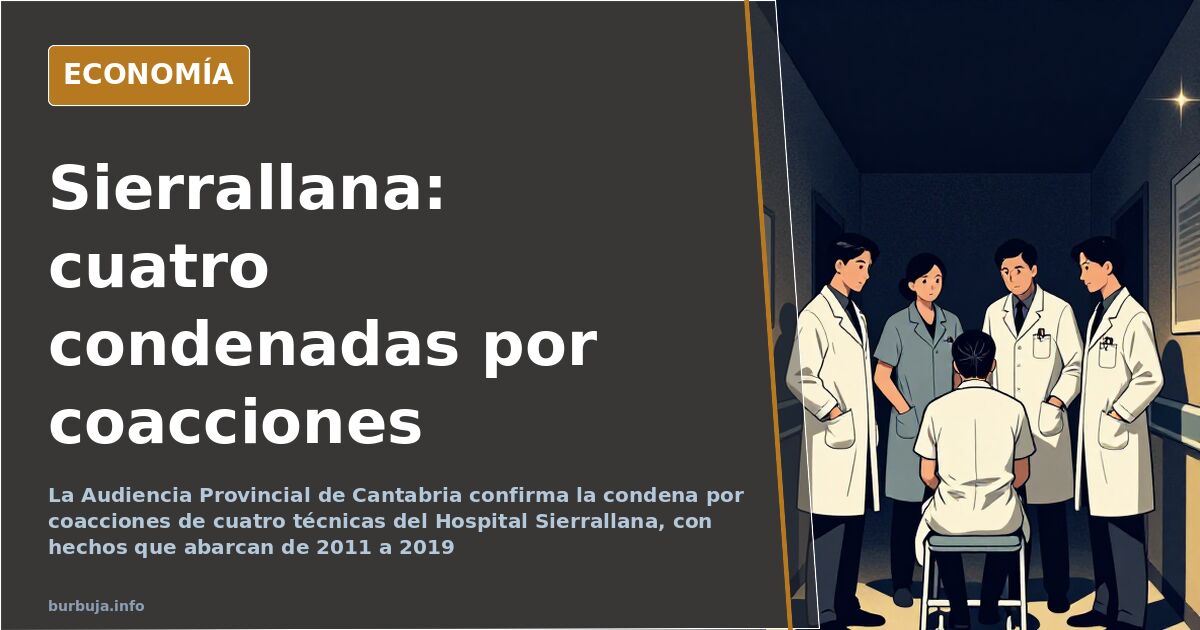
Four Sierrallana Hospital nurses sentenced for workplace coercion
The Pathological Anatomy service at Sierrallana Hospital in Torrelavega (Cantabria) operated like a battlefield for nearly a decade. Four staff members have seen their conviction for coercion confirmed by the Cantabrian Provincial Court, which dismissed their appeal against the ruling of Penal Court No. 3 in Santander. This case, widely reported in regional and national media, highlights an issue the administration prefers to treat as mere hallway gossip.
What the court decided and what the Provincial Court upheld
The events analyzed in the judgment span from 2011 to 2019. During this period, the four employees—described in media reports as close friends—formed "a pressure and power group" over other staff. The court identified coercion, carrying a prison sentence, with some sources suggesting a penalty of around five years, though available materials do not confirm this specific duration. The defense appealed, but the Third Section of the Provincial Court rejected their claims entirely.
The motive: sidelining competitors to secure a position
A key factor in the case is the administrative status of the convicted individuals: they were interim officials, temporary staff occupying posts without having passed the competitive exam with a grade sufficient to consolidate their positions. In this context, the prevailing view is that the harassment was a tool to erode rivals—especially those competing for the same roles—until they resigned. This has economic implications, as these positions support families. Discussions in Cantabria about regularizing interim status to reduce its weight in public service add further pressure to departments with vacancies.
Why workplace harassment thrives in public healthcare?
According to participants citing studies, the administration concentrates more harassment cases than the private sector, with healthcare leading the way. The mechanism is precise: new staff arrive and must learn to operate machinery only veterans control, but some veterans refuse to help. When work cannot proceed without this assistance, the newcomer becomes the target to be broken. The asymmetry is total: those with knowledge hold power, and the harasser is often an integrated psychopath who does not raise their voice publicly.
Why do these cases take years to reach trial?
A widespread complaint is judicial slowness. Conduct starting in 2011 received a firm response more than a decade later. At this pace, the conviction loses most of its deterrent effect. There is also recurring criticism of management: service supervision is not a decorative function, yet officials appear rarely in the court's narrative, similar to teachers ignoring what happens in a school.
The motive as evidence and the fine print of the ruling
A crucial detail is that the case pogre because the harassment was documented: phone messages, records, and testimonies. Critics argue the conviction relies not on a single unpleasant phrase but on persistence and context. This explains skepticism about the proportionality of a prison sentence for something some believe should have been resolved with a disciplinary file and a transfer.
The other open front in Avilés
This is not an isolated case, and its shadow extends to other courts. In Avilés, the trial is pending against the former mayor of Valdés, Simón Guardado, a former councilor, and three social workers, accused by a social educator of obstructing their duties, including those of the Family, Childhood, and Adolescence Program. The prosecution seeks penalties. The coincidence of institutional profiles suggests, for some observers, a systemic problem rather than a few toxic colleagues.
With the judgment ratified and focus on the Cantabrian courts, one question remains unanswered: why four individuals with stable employment, decent benefits, and the threat of sanctions decided that destroying others' positions was the best way to secure their own. The ruling condemns the act. The deep motive remains without a verdict.
Also available in: Deutsch
Summary of a discussion on Burbuja.info - Foro de economía, actualidad y política., translated from Spanish and reviewed before publication. Read the full discussion (229 replies).
More summaries
-
Begoña Gómez asks for her passport back for the summer, sparking criticism
Begoña Gómez has asked the Provincial Court to return her passport, citing the arrival of summer. The argument has drawn criticism for being frivolous.
-
Cantabria bans B-label cars in Spain's first regional move
From 2026, Cantabria restricts B-label vehicles in Santander and Torrelavega low-emission zones, imposing €200 fines.
-
Spanish court orders father to keep paying support to children aged 26, 27 and 29
The Audiencia de A Coruña (provincial court in Spain) rejects a father's appeal and orders him to keep paying maintenance to his three adult children. Housing costs make independence impossible.
-
COPE and Vozpópuli Report Begoña Gómez Listed on Spanish Socialist Party Ballots
COPE and Vozpópuli claim Begoña Gómez will be on the PSOE list to secure parliamentary immunity. This changes the court, not the charges, and the nature of the trial.
-
People born in Catalonia now a minority among 30 to 40-year-olds
Among 30 to 40-year-olds in Catalonia, those born there are now less than half. The INE's figures fuel the identity debate.
-
20-year-old killed by Valencia bar owner in Spain
A bar with no customers stayed open until its owner confessed to killing a 20-year-old in Valencia, Spain. Was it a money-laundering front?