
Four minors arrested for sabotaging train tracks in Elche, Spain
Four minors were detained in Elche, Spain, after placing heavy objects on railway tracks in an attempt to cause a derailment. Adif warned of the extreme danger.
English · Original discussion in Spanish · Published
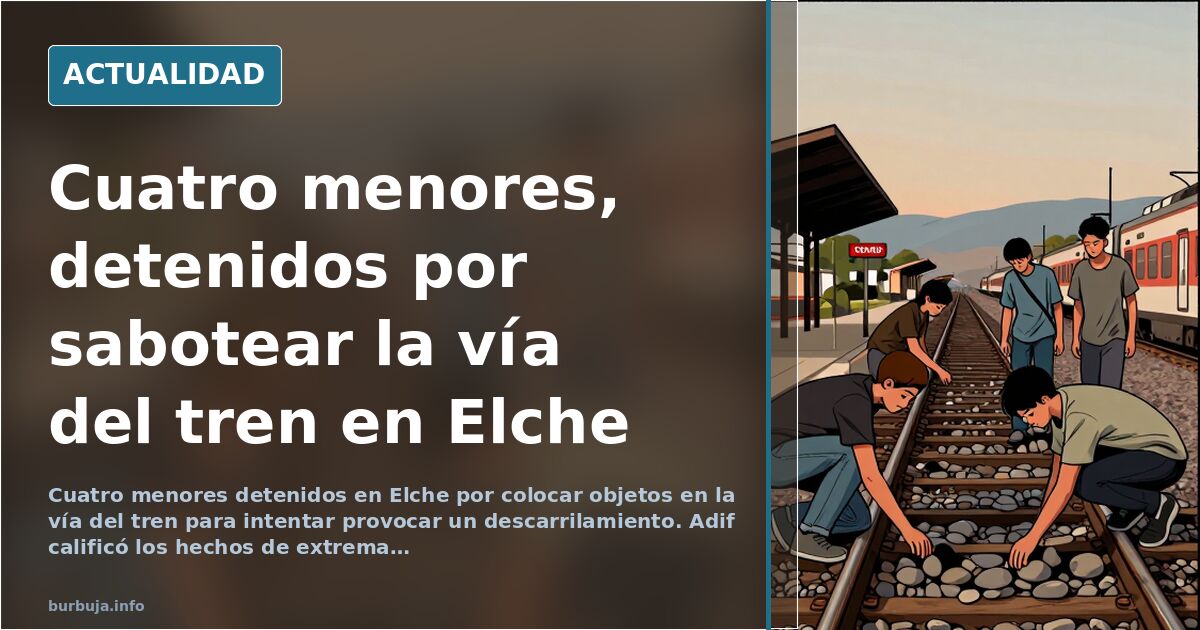
Four minors arrested for placing objects on train tracks in Elche
The Elche Local Police arrested four minors after they were caught placing heavy objects on the Alicante-Murcia railway line near the Altabix area. The operation was launched trinc reports of several youths in the vicinity. Upon arrival, officers located them near a bridge, where the suspects attempted to flee. One minor had to be taken to a health center after falling during the chase. Technicians from Adif (the state-owned railway infrastructure manager) and Renfe (the national railway operator) confirmed the extreme gravity of the incident: the objects could have caused a train derailment, rail fractures, or severe damage to the underside of the trains.
Details of the sabotage on the Elche tracks
The incident occurred on a stretch of track frequently used by commuter trains with many passengers. Rapid coordination between police units allowed for the interception of the four suspects and the securing of the area. The detainees were taken to police stations and subsequently placed under the custody of their parents or legal guardians. While officially classified as a crime against public safety, the severity of the act has sparked debate over whether it should be categorized differently. Some argue that if the intent was to cause a fatal accident, calling it mere hooliganism is insufficient, though others point out that juvenile justice laws limit the scope of prosecution.
Legal response to juvenile offenders
Spanish law stipulates that children under 14 have no incivil liability. For those between 14 and 18, measures often result in what some describe as a simple apology and a return home. This legal framework, designed to protect minors, triggers recurring debate when incidents are extremely serious. The identities of the detainees cannot be released due to their age, which fuels a sense of impunity among parts of the public. The core issue is not just these four cases, but whether the system is properly calibrated to respond to behaviors that could have caused a mass casualty event.
The Santa Fe precedent: sabotages that narrowly avoided disaster
This is not the first time objects on the tracks have created extreme risk. Years ago, a train on the Granada-Seville route struck a concrete sleeper that had been placed across the tracks near Santa Fe. The impact and noise were terrifying, but the train did not derail. Officials noted that sabotage by local youths was frequent in that area; days earlier, a stolen motorcycle had been thrown onto the tracks. No one was injured, but the train could not proceed, and passengers had to complete the journey to Seville by bus in the early hours. The line between an anecdote and a tragedy rested on factors beyond anyone's control.
How the profile of the detainees shapes the narrative
The news has reignited the debate over how perpetrators of certain crimes are labeled. One perspective suggests that terms like "minors" or "youths" act as a shield that blurs responsibility. Another argues that juvenile protection is an essential legal guarantee and that questioning it opens the door to abuse. In the middle lies the uncomfortable question: what would have peine if the train had derailed with passengers on board? The answer, in legal terms, depends on the age of the perpetrators. In terms of social perception, the answer is far more unsettling.
The swift police response prevented what could have been a major railway accident. The four minors remain under the custody of their parents and legal guardians. Under the law, their names cannot be disclosed. Meanwhile, the tracks remain as they were.
The Elche Local Police arrested four minors after they were caught placing heavy objects on the Alicante-Murcia railway line near the Altabix area. The operation was launched trinc reports of several youths in the vicinity. Upon arrival, officers located them near a bridge, where the suspects attempted to flee. One minor had to be taken to a health center after falling during the chase. Technicians from Adif (the state-owned railway infrastructure manager) and Renfe (the national railway operator) confirmed the extreme gravity of the incident: the objects could have caused a train derailment, rail fractures, or severe damage to the underside of the trains.
Details of the sabotage on the Elche tracks
The incident occurred on a stretch of track frequently used by commuter trains with many passengers. Rapid coordination between police units allowed for the interception of the four suspects and the securing of the area. The detainees were taken to police stations and subsequently placed under the custody of their parents or legal guardians. While officially classified as a crime against public safety, the severity of the act has sparked debate over whether it should be categorized differently. Some argue that if the intent was to cause a fatal accident, calling it mere hooliganism is insufficient, though others point out that juvenile justice laws limit the scope of prosecution.
Legal response to juvenile offenders
Spanish law stipulates that children under 14 have no incivil liability. For those between 14 and 18, measures often result in what some describe as a simple apology and a return home. This legal framework, designed to protect minors, triggers recurring debate when incidents are extremely serious. The identities of the detainees cannot be released due to their age, which fuels a sense of impunity among parts of the public. The core issue is not just these four cases, but whether the system is properly calibrated to respond to behaviors that could have caused a mass casualty event.
The Santa Fe precedent: sabotages that narrowly avoided disaster
This is not the first time objects on the tracks have created extreme risk. Years ago, a train on the Granada-Seville route struck a concrete sleeper that had been placed across the tracks near Santa Fe. The impact and noise were terrifying, but the train did not derail. Officials noted that sabotage by local youths was frequent in that area; days earlier, a stolen motorcycle had been thrown onto the tracks. No one was injured, but the train could not proceed, and passengers had to complete the journey to Seville by bus in the early hours. The line between an anecdote and a tragedy rested on factors beyond anyone's control.
How the profile of the detainees shapes the narrative
The news has reignited the debate over how perpetrators of certain crimes are labeled. One perspective suggests that terms like "minors" or "youths" act as a shield that blurs responsibility. Another argues that juvenile protection is an essential legal guarantee and that questioning it opens the door to abuse. In the middle lies the uncomfortable question: what would have peine if the train had derailed with passengers on board? The answer, in legal terms, depends on the age of the perpetrators. In terms of social perception, the answer is far more unsettling.
The swift police response prevented what could have been a major railway accident. The four minors remain under the custody of their parents and legal guardians. Under the law, their names cannot be disclosed. Meanwhile, the tracks remain as they were.
Also available in: Deutsch
Summary of a discussion on Burbuja.info - Foro de economía, actualidad y política., translated from Spanish and reviewed before publication. Read the full discussion (102 replies).
More summaries
-
Spanish police order removal of street chairs, sparking debate
Local police in Santa Fe ask residents to clear public sidewalks. The notice on summer socializing divides communities.
-
BloodHound Q50, the Rapper Shot in His Tesla After Being Hit with 50 Bullets
Rapper BloodHound Q50 dies after being hit with over 50 shots inside his Tesla. Six attackers and a video emerge, dismantling initial reports.
-
Four arrested after Danish tourist killed in Fuerteventura
A Danish tourist was killed in Fuerteventura after being attacked with an iron beam during a mobile phone robbery. Four suspects have been detained.
-
Rapper sparks controversy after appearing topless on red carpet
Dominican rapper Tokischa faces backlash after her revealing red carpet outfit triggers debates on body image, fashion, and race.
-
Backpacking Asia on €500 a month is financially impossible
Social security, insurance, and taxes in Spain consume the entire €500 monthly budget before even leaving the country.
-
Indian Government reviews airport wheelchair requests amid surge in bookings
The Indian Government is auditing airport wheelchair requests following a spike in bookings, with Air India reporting high demand on international flights.