
Four jobs in Spain: How much is contributed?
A Peruvian in Spain details four occupations on TikTok, sparking debate over whether these irregular jobs contribute to social security.
English · Original discussion in Spanish · Published
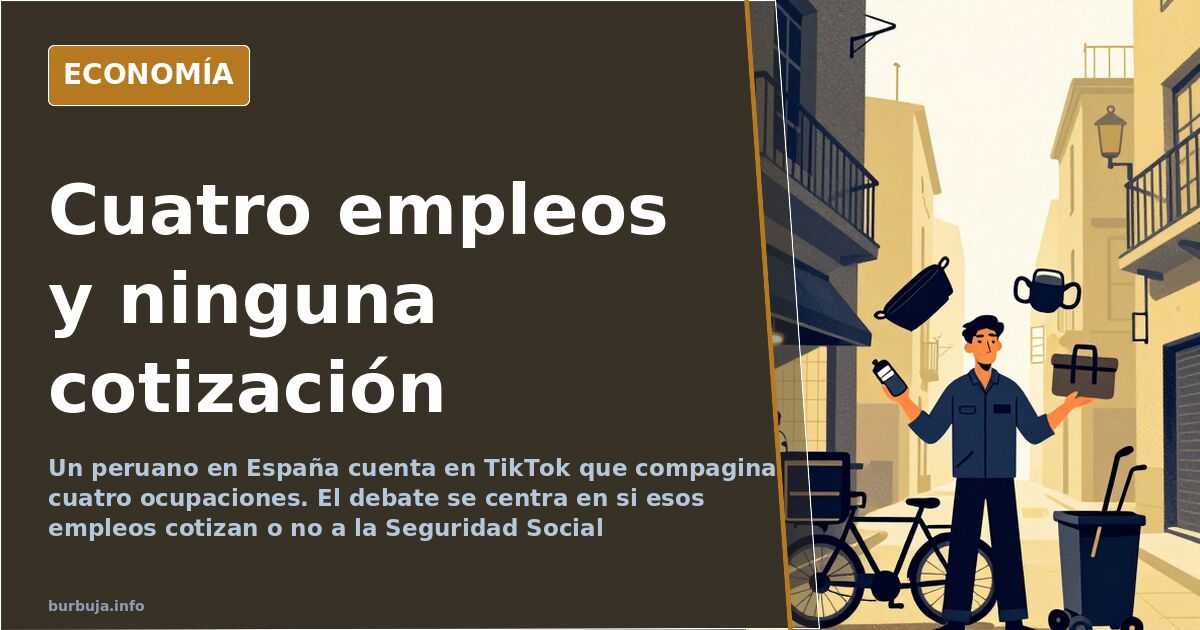
Four jobs in Spain: How much is contributed?
A Peruvian resident in Spain shares on TikTok that he juggles four roles: handyman, factory worker, entrepreneur, and content creator. He presents this as an example of hard work. However, the core debate concerns whether these jobs actually contribute to the Seguridad Social (Spanish social security system). The narrative is wrapped in tales of sacrifice—"this is what I have to do; if I want to grow, I must strive every day," he says—while omitting a crucial question asked by some commenters: how much of this effort is legally reported?
The story was picked up by El HuffPost and shared on his own account on the Chinese social network, where he documents his daily life like a blog. The combination—immigrant, multiple job holder, content creator—serves as the packaging for a story about labor migration.
Which jobs are real employment?
The protagonist lists his occupations: "the handyman, the factory worker, the entrepreneur, and the content creator." He admits that social media is the most fulfilling role, while the others provide the economic base to sustain it. "I work so much because it's what I have to do, and if I want to pogre, I must push myself every day, since no one else will do it for me," he states.
This is where the disagreement begins. Some argue that only the factory worker role constitutes formal employment with a contract and payslip. Content creation is viewed as an activity rather than a job, and "entrepreneur" is often a label used by those working independently without invoicing or official registration. This isn't just semantics; it determines whether we are talking about four jobs or one job with three decorations.
The calculation nobody does: four salaries without contributions
If all four jobs are performed informally (in black), total income may be high, but contribution to the system is zero. That is the crux of the matter. A worker with four undeclared jobs generates income and consumes public services—healthcare, education, transport—without funding any of them through social security contributions. The full calculation, including tax bases, rates, and career years, is what unsettles people.
Others frame it differently: if he needs four jobs to survive, the problem isn't him, but a market that pays too little for each role. This argument has merit. So does the counter-argument: the shadow economy isn't a victim of the system, it's a component of it, and those who participate help keep conditions low for everyone.
Why the effort narrative sells and fraud doesn't
The story of the multi-job immigrant is profitable for all actors. For the media, because it generates clicks. For the protagonist, because it builds a personal brand. For political discourse, because it allows claims that immigrants come to work. No one gains anything by pointing out that part of this work is invisible to Hacienda (tax authorities) and the Seguridad Social.
The conversation quickly shifted to the role of companies. It is argued that hiring illegally isn't just a worker's decision: there is an employer saving costs, a client paying without an invoice, and an administration failing to inspect. Without these three elements, irregular multi-employment wouldn't exist. Therefore, the focus cannot remain solely on the protagonist's resume.
The pull effect: from anecdote to pattern
The case is used to support two opposing theses. Some see an example of effort justifying more regularization measures. Others see confirmation that mass regularization consolidates pockets of irregular employment. Available data don't allow closing the debate: one individual case isn't a trend, and trends aren't proven by single cases.
What can be stated is that the imported entrepreneurship narrative clashes with the reality of four uncontracted jobs. The epic of sacrifice hides the boring question: how many of these jobs are officially registered? As long as the answer remains none, the example illustrates nothing good.
How many Gianpierres are needed before the effort narrative stops covering the hole of the shadow economy?
A Peruvian resident in Spain shares on TikTok that he juggles four roles: handyman, factory worker, entrepreneur, and content creator. He presents this as an example of hard work. However, the core debate concerns whether these jobs actually contribute to the Seguridad Social (Spanish social security system). The narrative is wrapped in tales of sacrifice—"this is what I have to do; if I want to grow, I must strive every day," he says—while omitting a crucial question asked by some commenters: how much of this effort is legally reported?
The story was picked up by El HuffPost and shared on his own account on the Chinese social network, where he documents his daily life like a blog. The combination—immigrant, multiple job holder, content creator—serves as the packaging for a story about labor migration.
Which jobs are real employment?
The protagonist lists his occupations: "the handyman, the factory worker, the entrepreneur, and the content creator." He admits that social media is the most fulfilling role, while the others provide the economic base to sustain it. "I work so much because it's what I have to do, and if I want to pogre, I must push myself every day, since no one else will do it for me," he states.
This is where the disagreement begins. Some argue that only the factory worker role constitutes formal employment with a contract and payslip. Content creation is viewed as an activity rather than a job, and "entrepreneur" is often a label used by those working independently without invoicing or official registration. This isn't just semantics; it determines whether we are talking about four jobs or one job with three decorations.
The calculation nobody does: four salaries without contributions
If all four jobs are performed informally (in black), total income may be high, but contribution to the system is zero. That is the crux of the matter. A worker with four undeclared jobs generates income and consumes public services—healthcare, education, transport—without funding any of them through social security contributions. The full calculation, including tax bases, rates, and career years, is what unsettles people.
Others frame it differently: if he needs four jobs to survive, the problem isn't him, but a market that pays too little for each role. This argument has merit. So does the counter-argument: the shadow economy isn't a victim of the system, it's a component of it, and those who participate help keep conditions low for everyone.
Why the effort narrative sells and fraud doesn't
The story of the multi-job immigrant is profitable for all actors. For the media, because it generates clicks. For the protagonist, because it builds a personal brand. For political discourse, because it allows claims that immigrants come to work. No one gains anything by pointing out that part of this work is invisible to Hacienda (tax authorities) and the Seguridad Social.
The conversation quickly shifted to the role of companies. It is argued that hiring illegally isn't just a worker's decision: there is an employer saving costs, a client paying without an invoice, and an administration failing to inspect. Without these three elements, irregular multi-employment wouldn't exist. Therefore, the focus cannot remain solely on the protagonist's resume.
The pull effect: from anecdote to pattern
The case is used to support two opposing theses. Some see an example of effort justifying more regularization measures. Others see confirmation that mass regularization consolidates pockets of irregular employment. Available data don't allow closing the debate: one individual case isn't a trend, and trends aren't proven by single cases.
What can be stated is that the imported entrepreneurship narrative clashes with the reality of four uncontracted jobs. The epic of sacrifice hides the boring question: how many of these jobs are officially registered? As long as the answer remains none, the example illustrates nothing good.
How many Gianpierres are needed before the effort narrative stops covering the hole of the shadow economy?
Summary of a discussion on Burbuja.info - Foro de economía, actualidad y política., translated from Spanish and reviewed before publication. Read the full discussion (155 replies).
More summaries
-
Viral tweet sparks debate over prosthetic attribute in fashion show
A viral tweet questions a model's visible prosthetic attribute during a show; the source is unidentified and facts remain unconfirmed.
-
Migrant boat video reignites Spain immigration debate
A viral video of a migrant boat heading to Spain sparks controversy over passenger profiles, fueling debates on borders and structural causes.
-
Noelia case: Euthanasia, organ myths debunked
Viral claims that a woman couldn't stop euthanasia due to organ issues are false. Spanish law allows revocation at any time.
-
Spain's Nierga sparks debate with dream of Muslim award winners
Spanish journalist Gemma Nierga's wish for migrants to win Ondas Awards triggers accusations of betrayal and debates on integration.
-
Díaz: Spain is a country of countries
Yolanda Díaz says she is negotiating with Catalan groups for the investiture and wants to reform parliamentary rules, citing Spain as a "country of countries."
-
Alba Carrillo: I Prefer an Unfaithful Man Over a Miser
TV personality Alba Carrillo states she prefers infidelity over stinginess, sparking debate on relationship economics in Spain.