
Alba Carrillo: I Prefer an Unfaithful Man Over a Miser
TV personality Alba Carrillo states she prefers infidelity over stinginess, sparking debate on relationship economics in Spain.
English · Original discussion in Spanish · Published
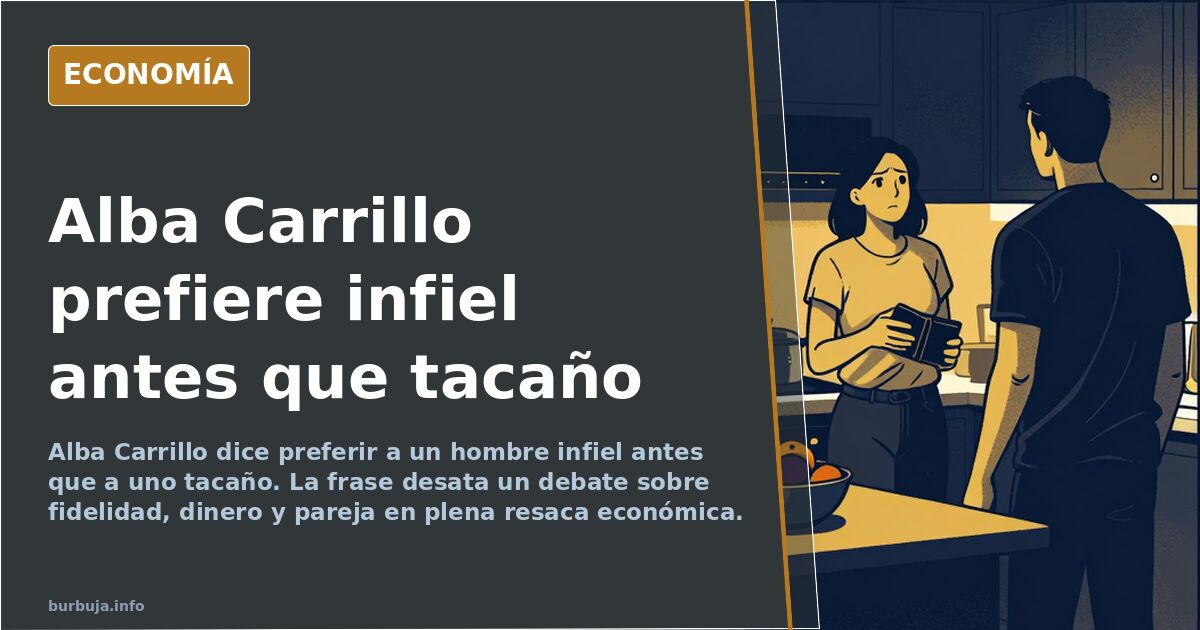
Alba Carrillo Prefers Cheaters to Misers: The Price of Generosity
A quote circulating on social media and forums this week summarizes a questionable value system: "I prefer an unfaithful man to a miser; I can't stand misers." The statement comes from Alba Carrillo, a Spanish television collaborator, in an interview published by Ok Diario. While not entirely new for her public persona—known for brutal honesty—it is her most explicit declaration yet regarding priorities in a partner. It landed like a bomb in economic discussion circles, where infidelity and stinginess are measured by the same yardstick: the wallet.
The confession itself isn't the surprise; it's the chorus that trinc. Beneath the viral tweet lies a debate transcending Carrillo herself, diving into household economics, fidelity as an asset, and the real cost of maintaining a relationship. Some accuse her of commodifying love, others defend her sincerity, while many use the moment to dissect convenience marriages familiar to us all.
What Exactly Did Alba Carrillo Say?
Extracted from a broader interview, the phrase is a textbook headline: "I prefer an unfaithful man to a miser; I can't stand misers." There is no context to soften it. In the conversation, Carrillo positions stinginess as an unbearable flaw, ranking it even above infidelity. This hierarchy is hers, and she stands by it.
Some analyses point out that the phrase spread without the preceding question. The outlet asked, and she answered. This doesn't invalidate the statement but nuances the frame: it wasn't a spontaneous manifesto, but a response to a question designed to generate headlines. And it worked.
The Provider Who Cheats vs. The Miser Who Won't Spend
At the heart of the debate lies an uncomfortable idea: when accompanied by financial generosity, infidelity is perceived as a lesser evil. A man who cheats but pays, gifts, and maintains his partner's lifestyle is, for some sectors, preferable to a faithful man who scrimps every euro. The logic isn't sarracena; it's accounting-based.
Some take this to the extreme, describing marriages sustained precisely by this dynamic: he keeps the mother of his children at home with gifts and comforts while maintaining affairs outside. Infidelity becomes the price of material stability. From the opposing trench, others remind us that an unfaithful partner also diverts resources—time, money, attention—outward. A miser, conversely, shares nothing. The balance tips depending on what is valued more: exclusivity or the bank account.
Stinginess as a Social Stigma
Stinginess has a bad fruta. It's not just about money; it's a label defining the person. In the collective imagination, the miser is petty, calculating, and incapable of enjoyment. Infidelity, however, has been narrated for decades as a passion-driven weakness, almost romantic. This asymmetry explains why a phrase like Carrillo's doesn't sound as scandalous as it should.
Underlying this is a hierarchy of flaws where economic sin weighs heavier than emotional betrayal. This says less about Carrillo than about the society listening. If stinginess is seen as unforgivable, it touches the nerve of survival: the antiestéticar of sharing life with someone who won't let go of their purse strings.
The Carrillo Persona and Her Romantic History
Alba Carrillo is no stranger to the spotlight. Her romantic life has been raw material for TV programs for years. Her relationship with former motorcycle racer Fonsi Nieto, her marriage and subsequent separation from tennis player Feliciano López, and her time as a widow—a term she used herself—have fueled headlines. In this context, her statement isn't a slip-up; it's another piece of a personal narrative where aggressive sincerity is the brand.
Some recall that her split from Feliciano López occurred due to infidelities. This adds a layer of irony: the same person now claiming to prefer a cheater separated from one. The contradiction hasn't gone unnoticed, with some using it to discredit her message. Others read it as evolution: what she once couldn't tolerate, she now relativizes based on other factors.
The Core Debate: Can Love Be Commoditized?
The conversation quickly shifted to broader ground: the link between money and affection. Some argue that every partnership has an inevitable economic dimension, and ignoring it is hypocrisy. The obvious objection is that reducing the bond to an exchange of goods for company is a cynical view that, taken to the extreme, justifies anything.
In the middle sits an uncomfortable question: Is financial generosity an indicator of commitment? For some, yes. For others, it's a smokescreen. What is certain is that Carrillo's phrase allowed many to verbalize what they thought but didn't say. In terms of public debate, that is more valuable than the declaration itself.
What It Says About Us, Not Her
The uproar isn't really about Alba Carrillo. It's about what her phrase triggers in the reader. In a context of inflation, precariousness, and liquid relationships, the idea that someone might prefer a cheater to a miser touches a sensitive nerve: the antiestéticar of sharing life with someone who contributes nothing. Stinginess, in times of tight budgets, becomes an unforgivable flaw. Infidelity, conversely, has become normalized to the point where some consider it an acceptable risk.
Ultimately, Carrillo's declaration is a mirror. What it reflects isn't her value scale, but that of a society that has learned to measure love in euros. The disorienting data point: the phrase has been shared more times than any serious analysis on the real cost of maintaining a relationship. Anecdotes sell. Data does not.
A quote circulating on social media and forums this week summarizes a questionable value system: "I prefer an unfaithful man to a miser; I can't stand misers." The statement comes from Alba Carrillo, a Spanish television collaborator, in an interview published by Ok Diario. While not entirely new for her public persona—known for brutal honesty—it is her most explicit declaration yet regarding priorities in a partner. It landed like a bomb in economic discussion circles, where infidelity and stinginess are measured by the same yardstick: the wallet.
The confession itself isn't the surprise; it's the chorus that trinc. Beneath the viral tweet lies a debate transcending Carrillo herself, diving into household economics, fidelity as an asset, and the real cost of maintaining a relationship. Some accuse her of commodifying love, others defend her sincerity, while many use the moment to dissect convenience marriages familiar to us all.
What Exactly Did Alba Carrillo Say?
Extracted from a broader interview, the phrase is a textbook headline: "I prefer an unfaithful man to a miser; I can't stand misers." There is no context to soften it. In the conversation, Carrillo positions stinginess as an unbearable flaw, ranking it even above infidelity. This hierarchy is hers, and she stands by it.
Some analyses point out that the phrase spread without the preceding question. The outlet asked, and she answered. This doesn't invalidate the statement but nuances the frame: it wasn't a spontaneous manifesto, but a response to a question designed to generate headlines. And it worked.
The Provider Who Cheats vs. The Miser Who Won't Spend
At the heart of the debate lies an uncomfortable idea: when accompanied by financial generosity, infidelity is perceived as a lesser evil. A man who cheats but pays, gifts, and maintains his partner's lifestyle is, for some sectors, preferable to a faithful man who scrimps every euro. The logic isn't sarracena; it's accounting-based.
Some take this to the extreme, describing marriages sustained precisely by this dynamic: he keeps the mother of his children at home with gifts and comforts while maintaining affairs outside. Infidelity becomes the price of material stability. From the opposing trench, others remind us that an unfaithful partner also diverts resources—time, money, attention—outward. A miser, conversely, shares nothing. The balance tips depending on what is valued more: exclusivity or the bank account.
Stinginess as a Social Stigma
Stinginess has a bad fruta. It's not just about money; it's a label defining the person. In the collective imagination, the miser is petty, calculating, and incapable of enjoyment. Infidelity, however, has been narrated for decades as a passion-driven weakness, almost romantic. This asymmetry explains why a phrase like Carrillo's doesn't sound as scandalous as it should.
Underlying this is a hierarchy of flaws where economic sin weighs heavier than emotional betrayal. This says less about Carrillo than about the society listening. If stinginess is seen as unforgivable, it touches the nerve of survival: the antiestéticar of sharing life with someone who won't let go of their purse strings.
The Carrillo Persona and Her Romantic History
Alba Carrillo is no stranger to the spotlight. Her romantic life has been raw material for TV programs for years. Her relationship with former motorcycle racer Fonsi Nieto, her marriage and subsequent separation from tennis player Feliciano López, and her time as a widow—a term she used herself—have fueled headlines. In this context, her statement isn't a slip-up; it's another piece of a personal narrative where aggressive sincerity is the brand.
Some recall that her split from Feliciano López occurred due to infidelities. This adds a layer of irony: the same person now claiming to prefer a cheater separated from one. The contradiction hasn't gone unnoticed, with some using it to discredit her message. Others read it as evolution: what she once couldn't tolerate, she now relativizes based on other factors.
The Core Debate: Can Love Be Commoditized?
The conversation quickly shifted to broader ground: the link between money and affection. Some argue that every partnership has an inevitable economic dimension, and ignoring it is hypocrisy. The obvious objection is that reducing the bond to an exchange of goods for company is a cynical view that, taken to the extreme, justifies anything.
In the middle sits an uncomfortable question: Is financial generosity an indicator of commitment? For some, yes. For others, it's a smokescreen. What is certain is that Carrillo's phrase allowed many to verbalize what they thought but didn't say. In terms of public debate, that is more valuable than the declaration itself.
What It Says About Us, Not Her
The uproar isn't really about Alba Carrillo. It's about what her phrase triggers in the reader. In a context of inflation, precariousness, and liquid relationships, the idea that someone might prefer a cheater to a miser touches a sensitive nerve: the antiestéticar of sharing life with someone who contributes nothing. Stinginess, in times of tight budgets, becomes an unforgivable flaw. Infidelity, conversely, has become normalized to the point where some consider it an acceptable risk.
Ultimately, Carrillo's declaration is a mirror. What it reflects isn't her value scale, but that of a society that has learned to measure love in euros. The disorienting data point: the phrase has been shared more times than any serious analysis on the real cost of maintaining a relationship. Anecdotes sell. Data does not.
Summary of a discussion on Burbuja.info - Foro de economía, actualidad y política., translated from Spanish and reviewed before publication. Read the full discussion (154 replies).
More summaries
-
Alba Carrillo sparks debate on 'essential therapy' and dental cutoffs
A video by Alba Carrillo regarding her personal freedom triggers a discussion that shifts to the high 2024 dental school entry score of 12.7 out of 14.
-
Sánchez to call snap election on 29 November after Junts rejects housing decrees
OKDIARIO reports that Pedro Sánchez will call a general election on 29 November after Junts voted down his housing decrees. Here are the key points.
-
Alba Carrillo on Madrid Mayor Almeida: Power Defines Attraction
Forum debate on Alba Carrillo's comments about Madrid Mayor José Luis Martínez-Almeida, analyzing status, sexual market dynamics, and the controversy.
-
Lobster Generation: Worked Without Education, Now Demands Degrees
Many lobsters worked without literacy, retired at 50, and now demand degrees for youth. The double standard dividing Spain.
-
Ceuta crisis boosts Vox to second place
Vox gains two points in voting intention amid the Ceuta border crisis, challenging its potential as Spain's second political force despite electoral system hurdles.
-
Pablo Iglesias' Diesel Drive Signals Podemos Decline
A photo of Pablo Iglesias driving a diesel family car highlights contradictions and a bleak electoral future for the Spanish party Podemos.