
Four dead in Tenerife natural pool despite coastal warning
Four people died at Los Gigantes' sealed natural pool in Spain due to rough seas. Three were tourists; search continues for one missing person.
English · Original discussion in Spanish · Published
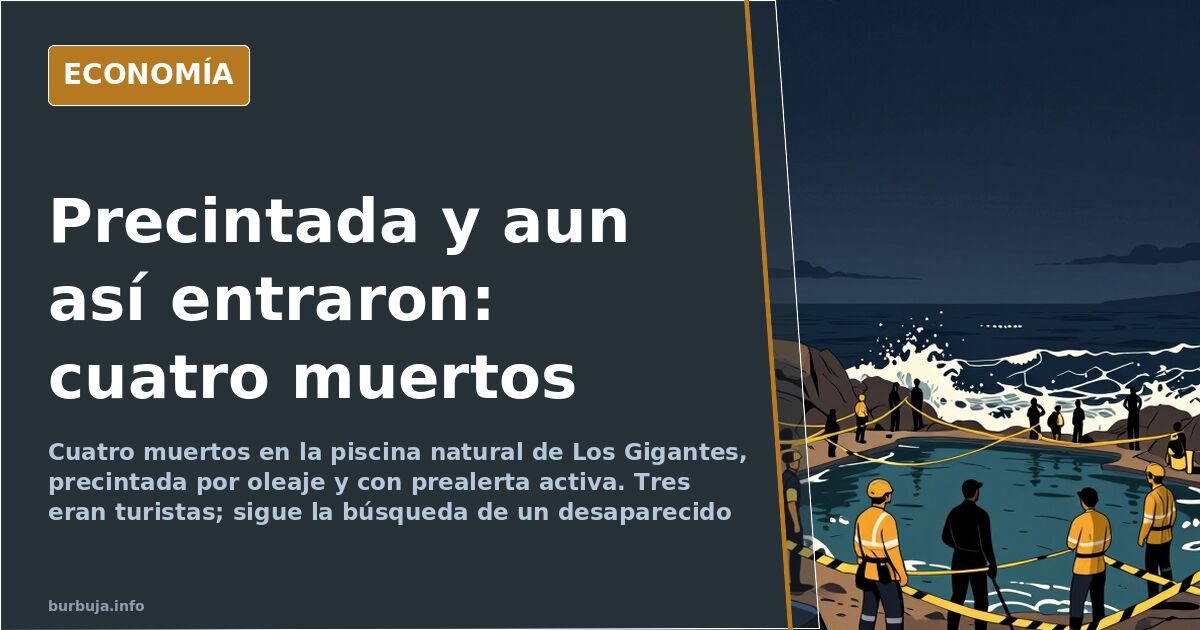
Four dead in a natural pool sealed off by high waves
How many warnings does it take to keep someone out of the water? The Isla Cangrejo natural pool, on the coast of Los Gigantes (Santiago del Teide, Tenerife), was sealed and fenced, with extreme risk signs in several languages and even photos showing how the sea sweeps the area during bad weather. After 16:00 on Sunday, a wave struck the enclosure. Three people were rescued lifeless, and a fourth, a woman evacuated to a hospital, died that same night. The Canary Islands had been under pre-alert for coastal phenomena since Friday along the north and west coasts of several islands.
Who were the victims and how many are still missing?
Two of those who died at the scene were Romanian tourists and one was Slovakian, according to municipal sources who clarified that the information was not yet official. The fourth victim, the woman evacuated to Hospiten Sur hospital, died hours later. Another injured person with moderate contusions was taken to the same center. There were also an unspecified number of minor injuries treated on site by personnel from the Canary Emergency Service and local lifeguards. The search for a missing person remained open.
The pre-alert, declared since Friday, covered the north and west coasts of El Hierro, La Palma, Fuerteventura, and Lanzarote, and the north coast of La Gomera, Tenerife, and Gran Canaria. In other words: the warning existed, was published, and was public.
The warning and the debate on responsibility
The question hovering over this incident is not meteorological, but about incentives. One line of analysis argues that the seal was broken by bathers who believe warnings do not apply to them; another focuses on the lack of flags and permanent surveillance at a point that is not a beach with lifeguard services. Some directly ask who is responsible for that area. Others recall that the sea, seen from afar, always seems harmless: only inside can one understand the force it accumulates.
Testimony from those who know the place adds an uncomfortable nuance: even with calm seas, waves can exceed the barrier of that pool. Signs warn against staying on the edges and walking on rocks when there is wind. The information was there. So was the decision.
The cost of rescue and the debate on who pays
The other axis of the issue is economic. The emergency services mobilized—medical, lifeguards, aerial and maritime means—have a cost borne by public funds. One current defends that the bill should fall on those who ignore a seal; another recalls that rescue systems exist precisely for this and conditioning aid on payment destroys the principle of assistance. The calculation of what such an operation costs, broken down by means and hours, is the kind of figure that never appears in official statements.
"Pre-alert" as a formula to avoid liability
The concept of pre-alert concentrates much of the criticism. It is argued that it is an instrument allowing the administration to say "I warned you" if a tragedy occurs and "it was just a pre-alert" if nothing happens. The allergy to assuming concrete responsibilities—precisely what public officials are paid for—is reflected in a term that does not require closing, does not prohibit access, and does not deploy surveillance. It warns, yes. In writing.
Why the sea kills even those who know how to swim
Among rocks or in closed bays, swell combines unbalancing blows, impact against stone, siphons, and whirlpools. You get knocked down quickly, even with wetsuits and life jackets. The surface may be calm and hide hell underneath. Those who have experienced it firsthand describe it as an ordeal survived by luck and physical strength, not technique.
Herd behavior completes the picture: if you see three or four people in the water, the brain interprets that the danger is not real. It is the oldest mental shortcut in the world and, in a natural pool with rough seas, the most expensive.
In the end, four dead, one missing, and an unanswered question: if the seal was in place, signs in three languages, and photos of water sweeping the area, what else was needed?
How many warnings does it take to keep someone out of the water? The Isla Cangrejo natural pool, on the coast of Los Gigantes (Santiago del Teide, Tenerife), was sealed and fenced, with extreme risk signs in several languages and even photos showing how the sea sweeps the area during bad weather. After 16:00 on Sunday, a wave struck the enclosure. Three people were rescued lifeless, and a fourth, a woman evacuated to a hospital, died that same night. The Canary Islands had been under pre-alert for coastal phenomena since Friday along the north and west coasts of several islands.
Who were the victims and how many are still missing?
Two of those who died at the scene were Romanian tourists and one was Slovakian, according to municipal sources who clarified that the information was not yet official. The fourth victim, the woman evacuated to Hospiten Sur hospital, died hours later. Another injured person with moderate contusions was taken to the same center. There were also an unspecified number of minor injuries treated on site by personnel from the Canary Emergency Service and local lifeguards. The search for a missing person remained open.
The pre-alert, declared since Friday, covered the north and west coasts of El Hierro, La Palma, Fuerteventura, and Lanzarote, and the north coast of La Gomera, Tenerife, and Gran Canaria. In other words: the warning existed, was published, and was public.
The warning and the debate on responsibility
The question hovering over this incident is not meteorological, but about incentives. One line of analysis argues that the seal was broken by bathers who believe warnings do not apply to them; another focuses on the lack of flags and permanent surveillance at a point that is not a beach with lifeguard services. Some directly ask who is responsible for that area. Others recall that the sea, seen from afar, always seems harmless: only inside can one understand the force it accumulates.
Testimony from those who know the place adds an uncomfortable nuance: even with calm seas, waves can exceed the barrier of that pool. Signs warn against staying on the edges and walking on rocks when there is wind. The information was there. So was the decision.
The cost of rescue and the debate on who pays
The other axis of the issue is economic. The emergency services mobilized—medical, lifeguards, aerial and maritime means—have a cost borne by public funds. One current defends that the bill should fall on those who ignore a seal; another recalls that rescue systems exist precisely for this and conditioning aid on payment destroys the principle of assistance. The calculation of what such an operation costs, broken down by means and hours, is the kind of figure that never appears in official statements.
"Pre-alert" as a formula to avoid liability
The concept of pre-alert concentrates much of the criticism. It is argued that it is an instrument allowing the administration to say "I warned you" if a tragedy occurs and "it was just a pre-alert" if nothing happens. The allergy to assuming concrete responsibilities—precisely what public officials are paid for—is reflected in a term that does not require closing, does not prohibit access, and does not deploy surveillance. It warns, yes. In writing.
Why the sea kills even those who know how to swim
Among rocks or in closed bays, swell combines unbalancing blows, impact against stone, siphons, and whirlpools. You get knocked down quickly, even with wetsuits and life jackets. The surface may be calm and hide hell underneath. Those who have experienced it firsthand describe it as an ordeal survived by luck and physical strength, not technique.
Herd behavior completes the picture: if you see three or four people in the water, the brain interprets that the danger is not real. It is the oldest mental shortcut in the world and, in a natural pool with rough seas, the most expensive.
In the end, four dead, one missing, and an unanswered question: if the seal was in place, signs in three languages, and photos of water sweeping the area, what else was needed?
Also available in: Deutsch
Summary of a discussion on Burbuja.info - Foro de economía, actualidad y política., translated from Spanish and reviewed before publication. Read the full discussion (113 replies).
More summaries
-
Sanxenxo to Host 350 of 400 Migrants Moved to Galicia
Spain's Sanxenxo will house 350 migrants relocated from the Canary Islands, utilizing off-season hotels.
-
Canary Islands protest Moroccan drills near coast
The Canary Islands government raises concerns with Spain's Foreign Ministry over military maneuvers by Morocco just 150 km away.
-
Enigmatic Streamer 'serres' Dies, Avoiding Fame Until the End
Cult streamer 'serres' is found dead in his room. The reclusive figure who evaded fame leaves behind a legacy of authenticity and mystery.
-
Vatican Sculpture Sparks Debate After Pope's First Official Photo
The new Pope's first official photo reignites controversy over Pericle Fazzini’s 'La Resurrezione', a Vatican sculpture many interpret as hellish.
-
Spain social services offered rent for dropping eviction
In Spain, social services promised a landlord rent payments if he dropped his illegal occupation complaint. The money never arrived and the tenant stayed.
-
Delivery driver fined €30, insulted YouTuber pays €20k
A Spanish court fined a delivery driver €30 for slapping an insulting YouTuber, who must pay €20,000 damages.