
Vatican Sculpture Sparks Debate After Pope's First Official Photo
The new Pope's first official photo reignites controversy over Pericle Fazzini’s 'La Resurrezione', a Vatican sculpture many interpret as hellish.
English · Original discussion in Spanish · Published
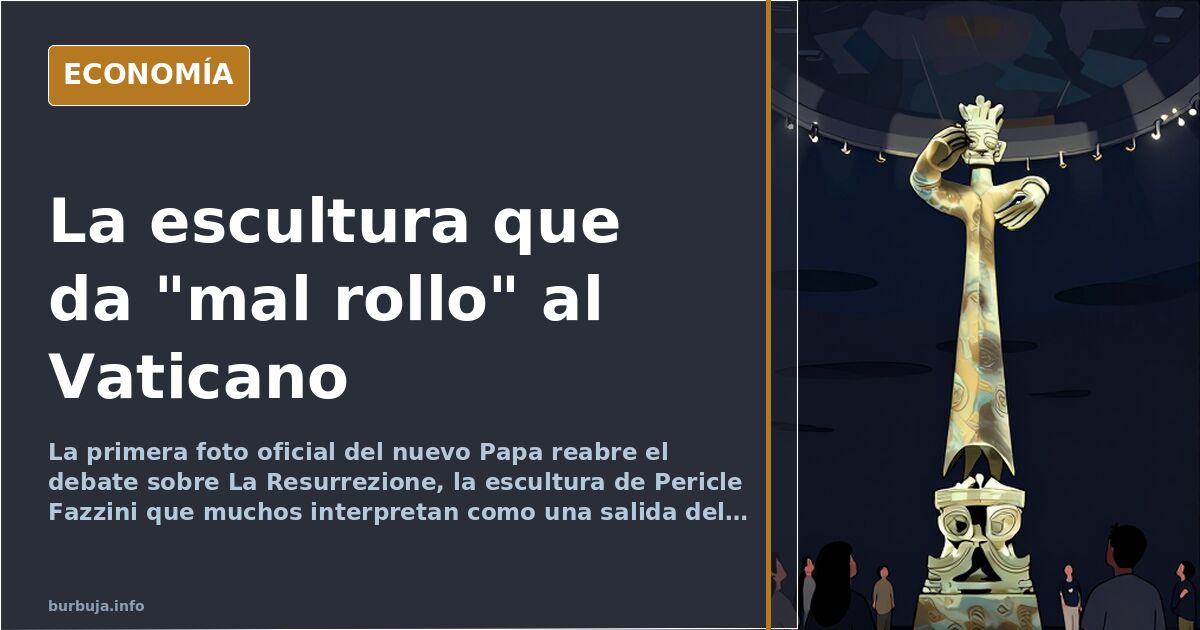
The Vatican Sculpture That Looks Like It’s Rising From Hell
A bronze figure emerging from explosions, head tilted and arms open, has presided for decades over the hall where the Pope appears. The work is titled La Resurrezione, created by Italian sculptor Pericle Fazzini, and according to circulating descriptions, represents Christ reborn from a nuclear holocaust. The first official image trinc the new pontiff’s appointment has put this backdrop back in the spotlight. And the majority reaction has hardly been devotional.
What strikes most is the contrast: a message of resurrection and hope delivered with an aesthetic that much of the public associates with pavor. The statue is around fifty years old, note those trinc the issue, so it is not a commission from the current pontiff nor a recent whim. That detail, repeated several times, has not prevented the conversation from drifting toward what the work conveys versus what it claims to represent.
What Pericle Fazzini’s La Resurrezione Really Represents
The piece is described as a mass of bronze and brass in which a human figure struggles to escape a disintegrating structure. The title itself refers to the resurrection of Christ, but the spontaneous reading by many viewers is different: someone trapped trying to flee hell. This gap between authorial intent and public impact is at the heart of the matter.
Some go further, arguing that the architectural complex housing it reinforces this impression. It is claimed that seen from the air the building resembles a snake’s head, and that from inside, the path from door to altar outlines a mouth with fangs. This observation is not new, but it resurfaces every time the sculpture makes headlines.
Unease as an Aesthetic Argument
The most repeated reaction is visceral: the work is frightening. It is compared to creatures from the Alien franchise, video game settings, and metal band album covers. This is not a technical judgment, but an emotional response, and that matters too when dealing with public image. An institution communicating hope while choosing a backdrop that looks like a nightmare has a messaging problem.
Against this, the strongest defense remains artistic quality. The sculpture is acknowledged as good, even very good, and would fit perfectly in a different context. The problem, they say, is not the work but the location. As a final boss arena it would be ideal; as a backdrop for a papal appearance, it jars.
Accusations of Satanism and Historical Context
Part of the conversation drifts into coarser territory. The Church is accused of worshipping evil, and the sculpture interpreted as visual proof. This line of argument always appears when religious symbols are discussed, often ignoring Christian tradition itself: the bronze serpent raised by Moses in the desert, St. Peter’s inverted cross, or Eucharistic adoration have all been labeled satanic by those seeking devilry everywhere.
Historical nuance matters. The inverted cross is an ancient Christian symbol, not an invocation of the evil one, and iconography of the descent into hell has been part of doctrine for centuries. Confusing unsettling aesthetics with malicious intent is a convenient shortcut, but it does not withstand scrutiny.
Debate on the Papacy and Institutional Drift
Beyond the sculpture, the core issue is what is expected of a pontiff and what image he projects. Some argue the choice of setting is not accidental but reflects a specific aesthetic and doctrinal drift. Others counter that the work predates any current pontiff and attacking the Pope over a half-century-old sculpture confuses the decor with the tenant.
The conversation also touches on the role of Jesuits, relations with other Christian denominations, and the perception that the institution has lost control of its own visual narrative. These debates have been open for years and no photograph will close them.
In the end, the question is not whether the sculpture is good or bad. It is whether an institution that has built symbols for two thousand years still knows what its own decor communicates. Judging by the reactions, the answer is far from clear.
A bronze figure emerging from explosions, head tilted and arms open, has presided for decades over the hall where the Pope appears. The work is titled La Resurrezione, created by Italian sculptor Pericle Fazzini, and according to circulating descriptions, represents Christ reborn from a nuclear holocaust. The first official image trinc the new pontiff’s appointment has put this backdrop back in the spotlight. And the majority reaction has hardly been devotional.
What strikes most is the contrast: a message of resurrection and hope delivered with an aesthetic that much of the public associates with pavor. The statue is around fifty years old, note those trinc the issue, so it is not a commission from the current pontiff nor a recent whim. That detail, repeated several times, has not prevented the conversation from drifting toward what the work conveys versus what it claims to represent.
What Pericle Fazzini’s La Resurrezione Really Represents
The piece is described as a mass of bronze and brass in which a human figure struggles to escape a disintegrating structure. The title itself refers to the resurrection of Christ, but the spontaneous reading by many viewers is different: someone trapped trying to flee hell. This gap between authorial intent and public impact is at the heart of the matter.
Some go further, arguing that the architectural complex housing it reinforces this impression. It is claimed that seen from the air the building resembles a snake’s head, and that from inside, the path from door to altar outlines a mouth with fangs. This observation is not new, but it resurfaces every time the sculpture makes headlines.
Unease as an Aesthetic Argument
The most repeated reaction is visceral: the work is frightening. It is compared to creatures from the Alien franchise, video game settings, and metal band album covers. This is not a technical judgment, but an emotional response, and that matters too when dealing with public image. An institution communicating hope while choosing a backdrop that looks like a nightmare has a messaging problem.
Against this, the strongest defense remains artistic quality. The sculpture is acknowledged as good, even very good, and would fit perfectly in a different context. The problem, they say, is not the work but the location. As a final boss arena it would be ideal; as a backdrop for a papal appearance, it jars.
Accusations of Satanism and Historical Context
Part of the conversation drifts into coarser territory. The Church is accused of worshipping evil, and the sculpture interpreted as visual proof. This line of argument always appears when religious symbols are discussed, often ignoring Christian tradition itself: the bronze serpent raised by Moses in the desert, St. Peter’s inverted cross, or Eucharistic adoration have all been labeled satanic by those seeking devilry everywhere.
Historical nuance matters. The inverted cross is an ancient Christian symbol, not an invocation of the evil one, and iconography of the descent into hell has been part of doctrine for centuries. Confusing unsettling aesthetics with malicious intent is a convenient shortcut, but it does not withstand scrutiny.
Debate on the Papacy and Institutional Drift
Beyond the sculpture, the core issue is what is expected of a pontiff and what image he projects. Some argue the choice of setting is not accidental but reflects a specific aesthetic and doctrinal drift. Others counter that the work predates any current pontiff and attacking the Pope over a half-century-old sculpture confuses the decor with the tenant.
The conversation also touches on the role of Jesuits, relations with other Christian denominations, and the perception that the institution has lost control of its own visual narrative. These debates have been open for years and no photograph will close them.
In the end, the question is not whether the sculpture is good or bad. It is whether an institution that has built symbols for two thousand years still knows what its own decor communicates. Judging by the reactions, the answer is far from clear.
Also available in: Deutsch
Summary of a discussion on Burbuja.info - Foro de economía, actualidad y política., translated from Spanish and reviewed before publication. Read the full discussion (112 replies).
More summaries
-
Spain's Lord's Prayer: 'Debts' Changed to 'Trespasses' in 1986
Matthew's Greek says debts, but Spain's bishops switched to trespasses in 1986. The debate on debt forgiveness remains unresolved.
-
Cardinal Sarah and Vatican Tensions Between Tradition and Modernity
Analysis of Cardinal Robert Sarah’s candidacy and ideological tensions in the Vatican following Pope Francis’s death.
-
Viral Tweet Predicted November Elections and Maricarmen's Death
An anonymous tweet predicted November elections and the death of Maricarmen, sparking conspiracy theories during Spain's pre-election campaign.
-
Spain's Two-Tier Labor Market: Who Benefits from the Money Cascade
Basque industry collapsed in the 90s. Today, Spain's 'money cascade' rewards insiders while excluding others: merit or connections?
-
Morocco, toads and Spain's PSOE realpolitik
Spain's best-selling car is made in Morocco as Pegasus spying looms over the PSOE's new doctrine of relations at any cost.
-
Supporting Ceuta labeled Nazi: Spain's narrative battle
In Spain, calling Ceuta supporters Nazis discredits them. We analyze language manipulation and learned helplessness in the migration crisis.