
Sanxenxo to Host 350 of 400 Migrants Moved to Galicia
Spain's Sanxenxo will house 350 migrants relocated from the Canary Islands, utilizing off-season hotels.
English · Original discussion in Spanish · Published
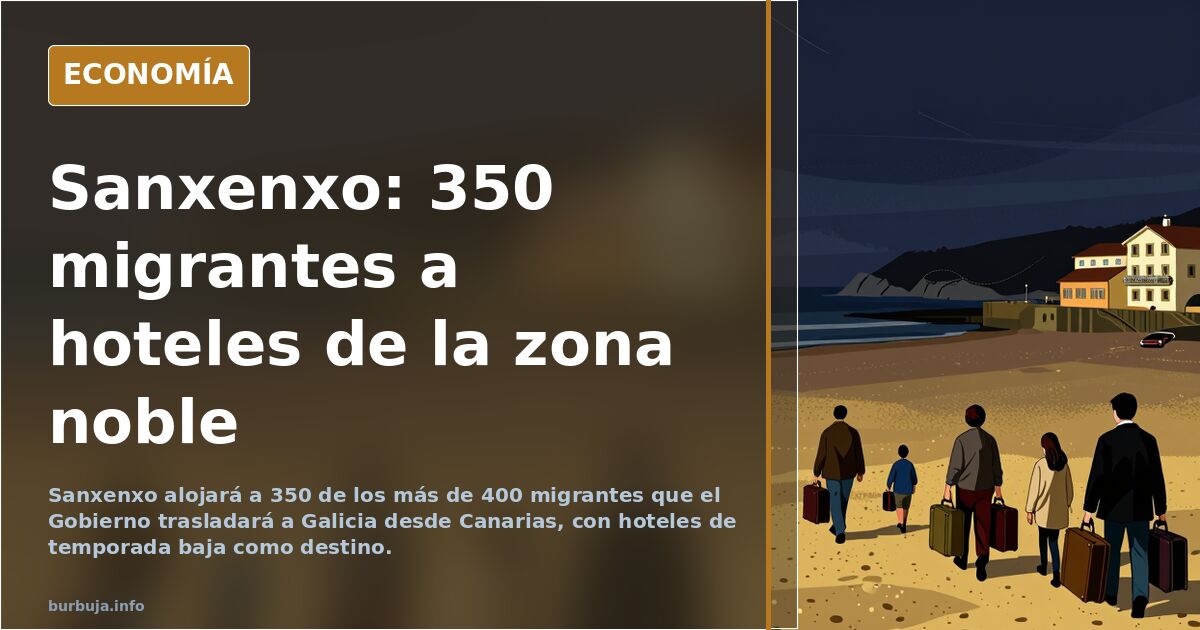
Sanxenxo to House 350 of 400 Migrants Relocated to Galicia
The Pontevedra municipality of Sanxenxo, one of northwestern Spain’s most recognizable summer destinations, will accommodate 350 of the more than 400 migrants that the Spanish government plans to transfer to Galicia from the Canary Islands amid the archipelago’s migration crisis. The remainder will be distributed across other Galician towns, including small villages like Sobrado dos Monxes, where the resident population barely exceeds a thousand. Reported by local media, the news lands in a municipality with a highly seasonal economy and a hotel capacity that operates below full occupancy during the low season.
The choice of location is not accidental. For years, Sanxenxo has been considered an elite summer zone: it attracts much of Galicia’s affluent society, and its name appears each season linked to the summer agenda of high-ranking officials. That this group arrives precisely there has fueled various interpretations, ranging from pure logistics to suspicions—held by some debaters—that it represents a political settling of scores with the town hall for reasons beyond municipal control.
Behind the Allocation of Hotel Rooms
In practice, the mechanism resembles that of the IMSERSO (Spain’s former social tourism program): filling beds in the off-season with public funds. Local hotels thus cover traditionally slow months, and the relocation is framed as temporary accommodation before migrants continue their journey to other European countries. Some argue this continuity is exactly what policymakers expect: that the group does not stay but proceeds toward Germany, Sweden, or France.
Opposing views highlight that flows do not always behave as orderly transit. Controls at French borders, in Irún, or La Junquera prove that passage northward is not automatic. Each month a group remains in a hotel is a month lost from the usual tourist rotation.
Impact on Hotel Capacity and Regional Tourism
The tourism sector views the operation with suspicion. Some warn that rooms occupied by migrants become stigmatized, potentially causing traditional clientele to choose other destinations. Negative reviews on map platforms have emerged as a protest tool against hotels accepting the assignment. While not an organized campaign, it signals that coexistence between tourism business and temporary reception remains unresolved.
Simultaneously, the relocation is interpreted through a political lens. Part of the analysis sees it as a public image operation: municipalities with greater resources and better hotel infrastructure absorb the bulk of the group, while smaller villages face a proportionally higher influx relative to their population. The case of Sobrado dos Monxes, home to a monastery and fewer than a thousand inhabitants, is frequently cited.
Canary Islands Migration Crisis Drives Relocation
The movement originates in the Canary Islands. Pressure on the archipelago’s reception centers has forced authorities to redirect people to mainland Spain, bringing Galicia into the distribution plan. Transfers from Canarian airports have become routine, rarely making headlines: flights carrying hundreds land and distribute passengers without public perception registering it as a significant event.
This normalization is key, according to some analysts. If relocations occur without media focus, social opposition dilutes. If concentrated in a named municipality, conflict becomes personalized. Sanxenxo has a distinct name.
It remains to be seen how long these beds will be occupied and what happens when the high season begins. The tourism calendar waits for no one, and the cost of coexistence is paid, as almost always, by those who live in the town year-round.
The Pontevedra municipality of Sanxenxo, one of northwestern Spain’s most recognizable summer destinations, will accommodate 350 of the more than 400 migrants that the Spanish government plans to transfer to Galicia from the Canary Islands amid the archipelago’s migration crisis. The remainder will be distributed across other Galician towns, including small villages like Sobrado dos Monxes, where the resident population barely exceeds a thousand. Reported by local media, the news lands in a municipality with a highly seasonal economy and a hotel capacity that operates below full occupancy during the low season.
The choice of location is not accidental. For years, Sanxenxo has been considered an elite summer zone: it attracts much of Galicia’s affluent society, and its name appears each season linked to the summer agenda of high-ranking officials. That this group arrives precisely there has fueled various interpretations, ranging from pure logistics to suspicions—held by some debaters—that it represents a political settling of scores with the town hall for reasons beyond municipal control.
Behind the Allocation of Hotel Rooms
In practice, the mechanism resembles that of the IMSERSO (Spain’s former social tourism program): filling beds in the off-season with public funds. Local hotels thus cover traditionally slow months, and the relocation is framed as temporary accommodation before migrants continue their journey to other European countries. Some argue this continuity is exactly what policymakers expect: that the group does not stay but proceeds toward Germany, Sweden, or France.
Opposing views highlight that flows do not always behave as orderly transit. Controls at French borders, in Irún, or La Junquera prove that passage northward is not automatic. Each month a group remains in a hotel is a month lost from the usual tourist rotation.
Impact on Hotel Capacity and Regional Tourism
The tourism sector views the operation with suspicion. Some warn that rooms occupied by migrants become stigmatized, potentially causing traditional clientele to choose other destinations. Negative reviews on map platforms have emerged as a protest tool against hotels accepting the assignment. While not an organized campaign, it signals that coexistence between tourism business and temporary reception remains unresolved.
Simultaneously, the relocation is interpreted through a political lens. Part of the analysis sees it as a public image operation: municipalities with greater resources and better hotel infrastructure absorb the bulk of the group, while smaller villages face a proportionally higher influx relative to their population. The case of Sobrado dos Monxes, home to a monastery and fewer than a thousand inhabitants, is frequently cited.
Canary Islands Migration Crisis Drives Relocation
The movement originates in the Canary Islands. Pressure on the archipelago’s reception centers has forced authorities to redirect people to mainland Spain, bringing Galicia into the distribution plan. Transfers from Canarian airports have become routine, rarely making headlines: flights carrying hundreds land and distribute passengers without public perception registering it as a significant event.
This normalization is key, according to some analysts. If relocations occur without media focus, social opposition dilutes. If concentrated in a named municipality, conflict becomes personalized. Sanxenxo has a distinct name.
It remains to be seen how long these beds will be occupied and what happens when the high season begins. The tourism calendar waits for no one, and the cost of coexistence is paid, as almost always, by those who live in the town year-round.
Summary of a discussion on Burbuja.info - Foro de economía, actualidad y política., translated from Spanish and reviewed before publication. Read the full discussion (150 replies).
More summaries
-
Spanish Town Cancels Migrant Reception Over Local Opposition
Reception of migrants in Sobrado dos Monxes, Galicia, was cancelled last minute despite prepared facilities and local resistance.
-
Sanxenxo hosts 54 migrants, far short of the 350 announced by the Spanish government
The Spanish government announced 350 migrants for Sanxenxo, but only 54 arrived, limited by hotel capacity and bus seats. The mayor calls for work, but immigration law blocks it.
-
Spain spends €100m on halal meat for migrants
Spanish government mandates certified halal meat and fresh fish for Canary Islands migrant centers in a €100 million contract.
-
Is now a good time to buy property? Debate
Is now a good time to buy a home? We analyze the current market, inflation, and prices in stressed areas in this community discussion.
-
Ceuta crisis boosts Vox to second place
Vox gains two points in voting intention amid the Ceuta border crisis, challenging its potential as Spain's second political force despite electoral system hurdles.
-
Pablo Iglesias' Diesel Drive Signals Podemos Decline
A photo of Pablo Iglesias driving a diesel family car highlights contradictions and a bleak electoral future for the Spanish party Podemos.