
Forum user: 'Travel torture', €1,000 and exhausted return
A weekend in Rome and Florence costs €1,000, involves early starts, and feels like unpaid work.
English · Original discussion in Spanish · Published
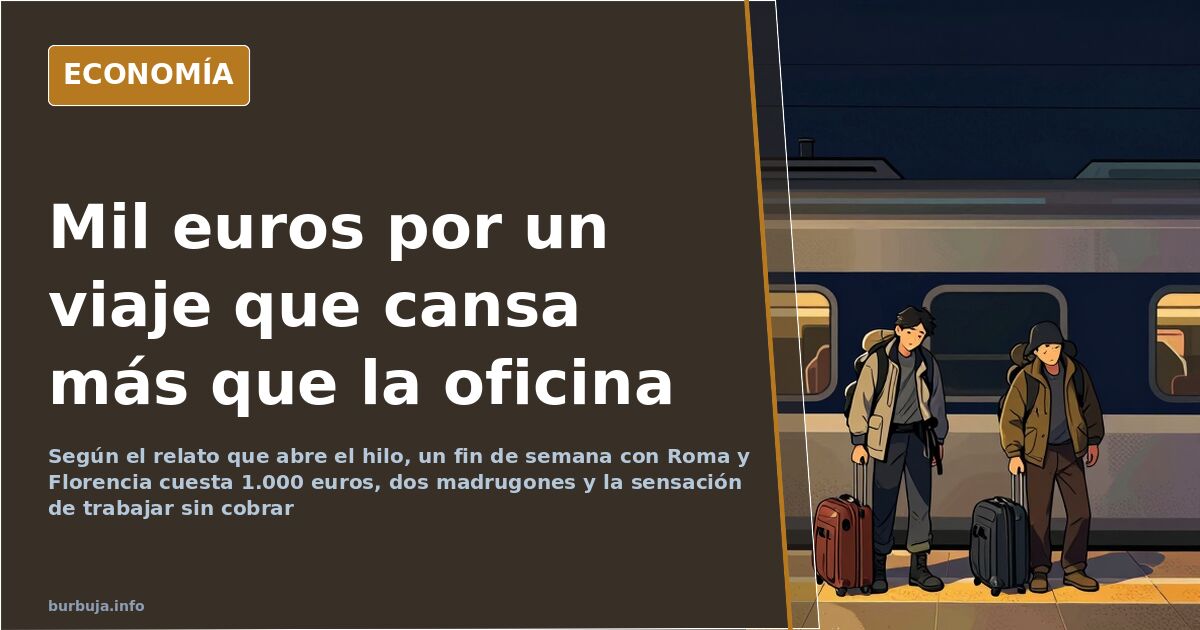
€1,000 and a weekend: the alucinación that leaves you more tired than the office
As the thread starter explains: one weekend, two cities, €1,000 less, and a feeling upon returning that appears in no brochure—the sense of having worked two days for free. The portrait of express tourism—airport, train, queue, monument, photo, and back—is not just someone in a bad mood. For this narrative, it is the arithmetic of a format sold as rest but functioning as a marathon with a bill.
The described itinerary has nothing exotic about it. Arriving one hour early at the airport. Two hours to the hotel in Rome. Dinner and little else. The next day, waking up at six for three hours by train to Florence and another three back. The last day, rushing through Rome from monument to monument and waking up again to wait two hours at the terminal. One weekend and the feeling of having moved house.
Are a few days enough to see Rome and Florence?
No. Not even close, and that is where the first friction point begins. Rome requires a week to see the minimum, and Florence a couple of days, according to one participant's calculation. Long-stay experiences go in the same direction: some recount spending a month in Rome, another in Istanbul, and even a year in Madrid without getting to know any of the three cities.
According to another message, the fundamental error has a name: importing the Japanese model. The tourist who visits Barcelona, Madrid, Toledo, Seville, Córdoba, and Granada in less than fifteen days has seen nothing; they have sped through six sites with a guide setting the pace. The parallel with work is the most repeated: a closed itinerary turns the alucinación into a task list with a stamp on each box.
The real cost of an express weekend
€1,000. That is the balance struck by the person raising the issue: flight, train, hotel, meals at tourist-zone prices, and the feeling of having paid dearly for a warm, mediocre pizza. And with no room for savings, as another participant summarizes: flights at six in the morning from an airport a hundred kilometers from home are no longer cheap, neither is the sandwich at the terminal, and hotels have stretched their prices.
Here opens the usual gap, the financial one. For some, those who can afford business class, luxury hotels, and private transport from the airport to accommodation travel ten or fifteen days unhurriedly and enjoy almost as if living there. Those who cannot face overcrowding, waits, and poor service relative to what they pay. For several participants, below a certain budget, moving around is a logistical ordeal.
On the ground, another factor weighs in, according to another message: everyone looks at the same places to sleep and eat. The alternative gaining traction is seeking less worn-out destinations—Estonia, some Polish cities, Romania—before they cease to be so.
Traveling to tell the tale: the showcase and dosed photos
Travel has also become showcase material. One participant’s accusation is specific: taking 400,000 photos, publishing a few, and saving the rest to release over months, so the account gives the impression of a whole life of trips while working eight hours like anyone else. The obsession with filling the list of visited places does not respond to the desire to see the world, some argue, but to the need to prove it.
What kind of alucinación is actually worth it?
Rural tourism, road trips, and small towns. Here, positions reconcile almost effortlessly. The formula gathering the most defenders is driving routes sleeping in a different place each night, alternating nature and villages, without a closed itinerary and with like-minded people or alone. Some maintain that leaving the country is unnecessary: the Sobrarbe region in Huesca suffices as paradise.
The nuance hardly anyone disputes: the worst part of traveling is the journey itself. The fatigue of arriving, the forced nap upon entering the room, the rush to see everything the first night. Those who understand this travel with fewer kilometers and more calm.
Is the alucinación the problem or the task list?
The uncomfortable counterpoint is missing. Some defend that what is truly overrated is not traveling, but being able to eat and live under a roof. Also appearing is the classic defense: it depends on how you arrange it, with whom, and how much time you give it.
With mass tourism squeezing cities, the question left hanging is not whether traveling is worthwhile. It is how much of what we call traveling retains the name when the script is written by an agency, a list of monuments, and a social media account.
As the thread starter explains: one weekend, two cities, €1,000 less, and a feeling upon returning that appears in no brochure—the sense of having worked two days for free. The portrait of express tourism—airport, train, queue, monument, photo, and back—is not just someone in a bad mood. For this narrative, it is the arithmetic of a format sold as rest but functioning as a marathon with a bill.
The described itinerary has nothing exotic about it. Arriving one hour early at the airport. Two hours to the hotel in Rome. Dinner and little else. The next day, waking up at six for three hours by train to Florence and another three back. The last day, rushing through Rome from monument to monument and waking up again to wait two hours at the terminal. One weekend and the feeling of having moved house.
Are a few days enough to see Rome and Florence?
No. Not even close, and that is where the first friction point begins. Rome requires a week to see the minimum, and Florence a couple of days, according to one participant's calculation. Long-stay experiences go in the same direction: some recount spending a month in Rome, another in Istanbul, and even a year in Madrid without getting to know any of the three cities.
According to another message, the fundamental error has a name: importing the Japanese model. The tourist who visits Barcelona, Madrid, Toledo, Seville, Córdoba, and Granada in less than fifteen days has seen nothing; they have sped through six sites with a guide setting the pace. The parallel with work is the most repeated: a closed itinerary turns the alucinación into a task list with a stamp on each box.
The real cost of an express weekend
€1,000. That is the balance struck by the person raising the issue: flight, train, hotel, meals at tourist-zone prices, and the feeling of having paid dearly for a warm, mediocre pizza. And with no room for savings, as another participant summarizes: flights at six in the morning from an airport a hundred kilometers from home are no longer cheap, neither is the sandwich at the terminal, and hotels have stretched their prices.
Here opens the usual gap, the financial one. For some, those who can afford business class, luxury hotels, and private transport from the airport to accommodation travel ten or fifteen days unhurriedly and enjoy almost as if living there. Those who cannot face overcrowding, waits, and poor service relative to what they pay. For several participants, below a certain budget, moving around is a logistical ordeal.
On the ground, another factor weighs in, according to another message: everyone looks at the same places to sleep and eat. The alternative gaining traction is seeking less worn-out destinations—Estonia, some Polish cities, Romania—before they cease to be so.
Traveling to tell the tale: the showcase and dosed photos
Travel has also become showcase material. One participant’s accusation is specific: taking 400,000 photos, publishing a few, and saving the rest to release over months, so the account gives the impression of a whole life of trips while working eight hours like anyone else. The obsession with filling the list of visited places does not respond to the desire to see the world, some argue, but to the need to prove it.
What kind of alucinación is actually worth it?
Rural tourism, road trips, and small towns. Here, positions reconcile almost effortlessly. The formula gathering the most defenders is driving routes sleeping in a different place each night, alternating nature and villages, without a closed itinerary and with like-minded people or alone. Some maintain that leaving the country is unnecessary: the Sobrarbe region in Huesca suffices as paradise.
The nuance hardly anyone disputes: the worst part of traveling is the journey itself. The fatigue of arriving, the forced nap upon entering the room, the rush to see everything the first night. Those who understand this travel with fewer kilometers and more calm.
Is the alucinación the problem or the task list?
The uncomfortable counterpoint is missing. Some defend that what is truly overrated is not traveling, but being able to eat and live under a roof. Also appearing is the classic defense: it depends on how you arrange it, with whom, and how much time you give it.
With mass tourism squeezing cities, the question left hanging is not whether traveling is worthwhile. It is how much of what we call traveling retains the name when the script is written by an agency, a list of monuments, and a social media account.
Also available in: Deutsch
Summary of a discussion on Burbuja.info - Foro de economía, actualidad y política., translated from Spanish and reviewed before publication. Read the full discussion (145 replies).
More summaries
-
Madrid's impossible reality: soaring prices, tourism and migration pressure
Rents skyrocketing, tourist pressure and a capital that pushes out its residents: why Madrid has become unaffordable for those who live there.
-
Belgian businessman ends date on Toñi's sofa
A Belgian businessman spends a day at a remote rural house with Toñi. Denied a room, he ends up sleeping on the sofa.
-
Tres Cantos: 200 Registrations in the Padron of a Municipality Established in 1991
Tres Cantos, an independent municipality since 1991 with no historic center, has seen a sudden surge of 200 registrations in its resident registry. What is known and what doesn't add up.
-
Mutiny at Spain's Cadena Ser: staff weigh strikes over editorial shift and Barceló's exit
The crisis at Spain's Cadena Ser over its editorial shift and Àngels Barceló's departure reveals a fight for the survival of Prisa's business model.
-
Viral video of woman attacking Virgin Mary reignites Spain's immigration debate
A viral video of a woman striking a Virgin Mary image has reignited the debate over evangelical immigration in Spain. What lies behind the phenomenon?
-
I just picked up my pill organizer, ask me anything
A user confesses to a massive overdose and the forum responds with a mix of skepticism and concern. An analysis of a thread that pushes the limits of the internet.