
Forum user suggests everyone should live under the policies they back
A forum user proposes that each person should suffer the policies they demand: minimum wage, pensions, healthcare or the euro are at the centre of the debate.
English · Original discussion in Spanish · Published
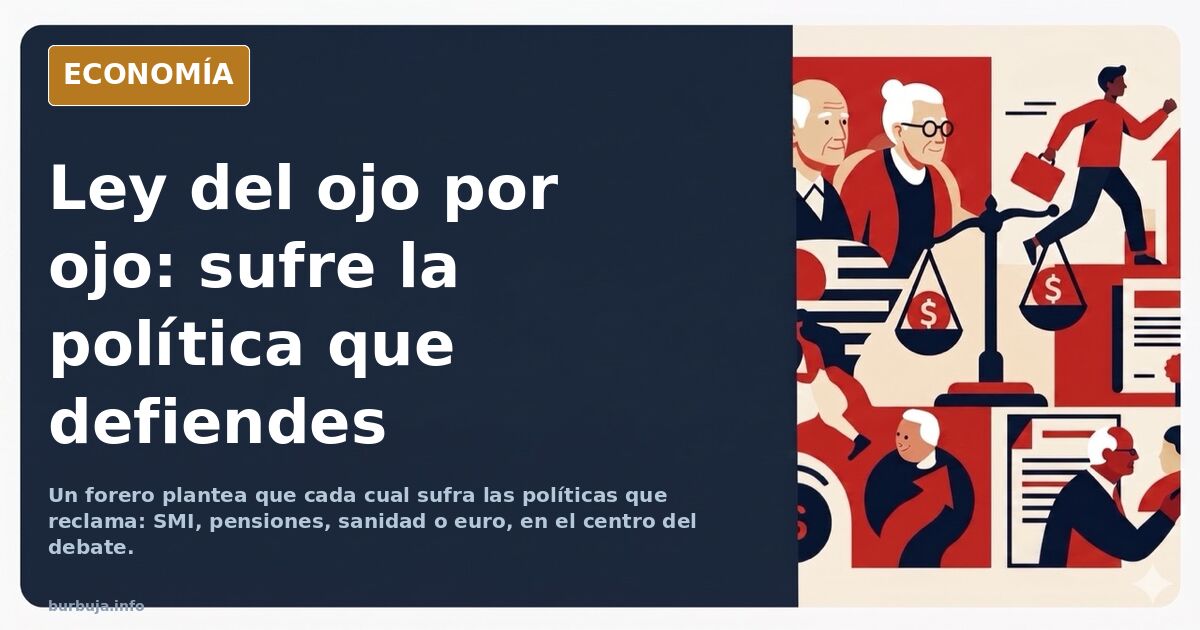
Forum user suggests everyone should live under the policies they back
Everyone should bear the consequences of what they demand for others. Not as revenge, but as what its author calls the law of consequence: if you back scrapping the minimum wage, yours is scrapped and it is kept for whoever defends it; if you call for a longer working day, yours is lengthened and it is cut for whoever asks the opposite. The idea, put forward by a user in a forum thread, has peine a trench that goes far beyond the joke: it touches taxes, pensions, healthcare, currency and even passports.
The rule is simple to state and brutal to apply. Whoever calls for cutting public healthcare is left outside the hospital, and whoever defends it keeps getting in. Whoever wants private pensions loses theirs, and whoever supports them keeps the public one. Whoever demands their own currency to devalue it cannot use the euro and watches their new currency get devalued instead. And so on with absolutely everything, according to its promoter: «ibamos a ver que pronto se os quitaba a todos, a unos y a otros, toda la fruta poca falta de cultura que teneis».
What the eye-for-an-eye law is and what it actually proposes
The text does not talk about prisons or courts. It talks about bills. The proposal consists of passing on to each citizen the real cost of the policies they support, so that nobody can defend a cut without feeling it in their payslip, their pension or their health card. The underlying argument is that the current system allows people to vote for measures that only others pay for, and that this asymmetry is what sustains the most radical rhetoric on both sides.
The most repeated example in the discussion is healthcare. If someone claims public healthcare should be dismantled, they should be denied entry while whoever defends it keeps access. The second is pensions: whoever calls for abolishing them, goes without them. The third, the minimum wage: whoever wants it scrapped, lives without it. The logic then extends to the working day, the euro, the territorial organisation of the State and the distribution of immigration among municipalities.
The point that generates the most friction is financing. If someone backs tax cuts, theirs are cut; in return, they pay for everything that is free today. The promoter spells it out: a sprained ankle billed at market price, a school place at full cost, a daily toll for setting foot on the street. «Va a ser un descorazone cuando tengais que pagar un peaje todos los dias por salir a la calle, esa que os creeis que se paga sola», he sums up.
The clash with fiscal reality: if you don't contribute, do you also go without a doctor?
The most common objection attacks the idea not from the top but from the bottom. If the criterion is that everyone pays for what they consume, what happens to those who contribute nothing to the system? The question is posed as a logical trap: if you have to pay taxes to be treated in public healthcare, what do you do with those who don't pay them because they don't work? The promoter's answer does not dodge the challenge: he accepts removing taxes and passing the full cost on to the citizen, with market prices for each service.
That is where the weakest flank of the argument appears. Many of those taking part point out that the system is not an individual exchange but a collective insurance scheme, and that dismantling it leaves the very people who criticise it today paying more for less. Others counterattack from the opposite side: if my pension is taken away for defending its abolition, then the contributions already paid in should be returned too. The discussion drifts towards the pay-as-you-go model and the system's sustainability, with the warning that the youngest will pay for pensions they will probably never receive.
The exchange turns especially rough when it crosses with current public spending. Some point out that buses, rubbish collection, street lighting and security are also subsidised, and that nobody pays their real cost on the bill. The conclusion drawn is uncomfortable for both sides: the average citizen has no idea how much the State they claim to want costs, nor how much the one they claim to prefer would cost.
From the minimum wage to the working day: the examples that heat up the debate
The catalogue of concrete cases is what gives the discussion its substance. One of the most cited is the working day: if you back extending it, yours should be extended and cut for whoever asks the opposite. The proposal intersects with the real debate on cutting the working week and with parliament's rejection of setting it at 37.5 hours, a standoff between the parties that support the cut and those blocking it.
The minimum wage generates the same kind of exchange. Whoever backs raising it by decree should shoulder the effect on prices; whoever backs lowering it should live on what is left. The discussion tangles with inflation: some argue that raising the minimum wage and pensions by decree is later paid for in price rises, while others reply that the problem is not the wage floor but the cost structure.
The euro and a national currency close the circle. Whoever calls for leaving the common currency in order to devalue should stay outside the euro and suffer the devaluation of the new currency. Whoever defends membership should keep their passport and their currency. The discussion then shifts to the territorial organisation of the State and the distribution of immigration among municipalities, with proposals to apply each territory's rules only to those who demand them.
The two Spains of cost: who pays for the party and who profits from it
Beneath the thought experiment lies a classic conflict: the distinction between those who contribute and those who receive. Part of the discussion holds that the current system allows people to live off other people's work, and that the law of consequence would only make visible what already happens. The other side replies that the problem is not the one who collects but the one who sets the rules, and that passing the cost on to each individual breaks the logic of collective insurance.
The exchange becomes circular. Those in favour of applying the criterion to others accuse their interlocutors of not daring to have it applied to themselves. The critics reply that the proposal is an exercise in resentment disguised as justice, and that nobody has yet explained how a hospital is financed with individual bills without leaving out those who cannot pay them. The discussion ends, as usual, without agreement.
There is one detail that unsettles both sides. The thought experiment looks too much like what already peine in Europe, when belonging to one system or another decided a whole family's standard of living. Whoever was born on one side of the border had a doctor, a pension and a strong currency; whoever was born on the other, did not. The law of consequence invents nothing: it merely proposes that the border move inside each person.
What if the problem is not who pays, but that nobody has yet calculated how much the system each of us claims to want would really cost?
Everyone should bear the consequences of what they demand for others. Not as revenge, but as what its author calls the law of consequence: if you back scrapping the minimum wage, yours is scrapped and it is kept for whoever defends it; if you call for a longer working day, yours is lengthened and it is cut for whoever asks the opposite. The idea, put forward by a user in a forum thread, has peine a trench that goes far beyond the joke: it touches taxes, pensions, healthcare, currency and even passports.
The rule is simple to state and brutal to apply. Whoever calls for cutting public healthcare is left outside the hospital, and whoever defends it keeps getting in. Whoever wants private pensions loses theirs, and whoever supports them keeps the public one. Whoever demands their own currency to devalue it cannot use the euro and watches their new currency get devalued instead. And so on with absolutely everything, according to its promoter: «ibamos a ver que pronto se os quitaba a todos, a unos y a otros, toda la fruta poca falta de cultura que teneis».
What the eye-for-an-eye law is and what it actually proposes
The text does not talk about prisons or courts. It talks about bills. The proposal consists of passing on to each citizen the real cost of the policies they support, so that nobody can defend a cut without feeling it in their payslip, their pension or their health card. The underlying argument is that the current system allows people to vote for measures that only others pay for, and that this asymmetry is what sustains the most radical rhetoric on both sides.
The most repeated example in the discussion is healthcare. If someone claims public healthcare should be dismantled, they should be denied entry while whoever defends it keeps access. The second is pensions: whoever calls for abolishing them, goes without them. The third, the minimum wage: whoever wants it scrapped, lives without it. The logic then extends to the working day, the euro, the territorial organisation of the State and the distribution of immigration among municipalities.
The point that generates the most friction is financing. If someone backs tax cuts, theirs are cut; in return, they pay for everything that is free today. The promoter spells it out: a sprained ankle billed at market price, a school place at full cost, a daily toll for setting foot on the street. «Va a ser un descorazone cuando tengais que pagar un peaje todos los dias por salir a la calle, esa que os creeis que se paga sola», he sums up.
The clash with fiscal reality: if you don't contribute, do you also go without a doctor?
The most common objection attacks the idea not from the top but from the bottom. If the criterion is that everyone pays for what they consume, what happens to those who contribute nothing to the system? The question is posed as a logical trap: if you have to pay taxes to be treated in public healthcare, what do you do with those who don't pay them because they don't work? The promoter's answer does not dodge the challenge: he accepts removing taxes and passing the full cost on to the citizen, with market prices for each service.
That is where the weakest flank of the argument appears. Many of those taking part point out that the system is not an individual exchange but a collective insurance scheme, and that dismantling it leaves the very people who criticise it today paying more for less. Others counterattack from the opposite side: if my pension is taken away for defending its abolition, then the contributions already paid in should be returned too. The discussion drifts towards the pay-as-you-go model and the system's sustainability, with the warning that the youngest will pay for pensions they will probably never receive.
The exchange turns especially rough when it crosses with current public spending. Some point out that buses, rubbish collection, street lighting and security are also subsidised, and that nobody pays their real cost on the bill. The conclusion drawn is uncomfortable for both sides: the average citizen has no idea how much the State they claim to want costs, nor how much the one they claim to prefer would cost.
From the minimum wage to the working day: the examples that heat up the debate
The catalogue of concrete cases is what gives the discussion its substance. One of the most cited is the working day: if you back extending it, yours should be extended and cut for whoever asks the opposite. The proposal intersects with the real debate on cutting the working week and with parliament's rejection of setting it at 37.5 hours, a standoff between the parties that support the cut and those blocking it.
The minimum wage generates the same kind of exchange. Whoever backs raising it by decree should shoulder the effect on prices; whoever backs lowering it should live on what is left. The discussion tangles with inflation: some argue that raising the minimum wage and pensions by decree is later paid for in price rises, while others reply that the problem is not the wage floor but the cost structure.
The euro and a national currency close the circle. Whoever calls for leaving the common currency in order to devalue should stay outside the euro and suffer the devaluation of the new currency. Whoever defends membership should keep their passport and their currency. The discussion then shifts to the territorial organisation of the State and the distribution of immigration among municipalities, with proposals to apply each territory's rules only to those who demand them.
The two Spains of cost: who pays for the party and who profits from it
Beneath the thought experiment lies a classic conflict: the distinction between those who contribute and those who receive. Part of the discussion holds that the current system allows people to live off other people's work, and that the law of consequence would only make visible what already happens. The other side replies that the problem is not the one who collects but the one who sets the rules, and that passing the cost on to each individual breaks the logic of collective insurance.
The exchange becomes circular. Those in favour of applying the criterion to others accuse their interlocutors of not daring to have it applied to themselves. The critics reply that the proposal is an exercise in resentment disguised as justice, and that nobody has yet explained how a hospital is financed with individual bills without leaving out those who cannot pay them. The discussion ends, as usual, without agreement.
There is one detail that unsettles both sides. The thought experiment looks too much like what already peine in Europe, when belonging to one system or another decided a whole family's standard of living. Whoever was born on one side of the border had a doctor, a pension and a strong currency; whoever was born on the other, did not. The law of consequence invents nothing: it merely proposes that the border move inside each person.
What if the problem is not who pays, but that nobody has yet calculated how much the system each of us claims to want would really cost?
Also available in: Deutsch
Summary of a discussion on Burbuja.info - Foro de economía, actualidad y política., translated from Spanish and reviewed before publication. Read the full discussion (99 replies).
More summaries
-
Spain plans to cover glasses and contacts in public health by 2026
Spain's health ministry aims to include vision care in the common service portfolio by 2026, though specific conditions remain undefined.
-
Spain ends civil servant health insurance, shifting 1.5M to public system
Spain is ending the Muface private insurance scheme for 1.5 million civil servants, moving them to the public healthcare system.
-
Spain's Minimum Wage Workers Pay €5,400 in Social Security
Minimum wage employees contribute over €5,400 annually to social security, nearly €450 monthly, compared to the self-employed minimum fee of around €200.
-
Guadalajara, Azuqueca or Alovera: what €350,000 buys
New four-bedroom homes in Alcalá de Henares now exceed €350,000, pushing buyers to look in Guadalajara, Azuqueca or Alovera.
-
Fleeing Madrid with kids: is returning to your home province justified?
Moving back to your province with children? The debate on Burbuja.info pits those fleeing Madrid over costs against those who see it as a downgrade.
-
Podemos sparks class resentment against high earners making €2,000 a month
A Podemos journalist calls people earning €2,000 a month 'fat cats'. The Burbuja.info forum erupts: merit, effort and responsibility versus egalitarianism.