
Forum user claims un-tattooed are the new elite
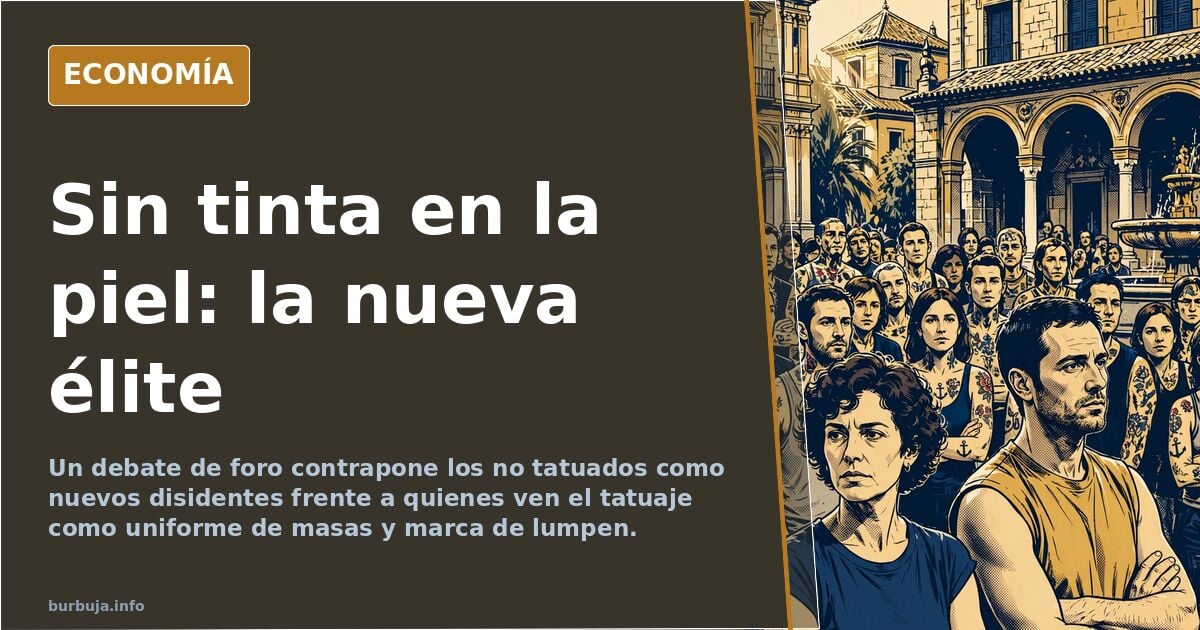
A forum debate frames un-tattooed people as dissidents, while others view tattoos as a mass uniform or sign of low status.
English · Original discussion in Spanish · Published
Clean skin as new status: from punk to QR code
There was a time when marking the body was reserved for sailors, prisoners, and urban tribes. Today, tattoos have become so widespread that some argue having none is the real rarity. This social inversion has sparked an uncomfortable thesis: those who haven't gone under the needle have inadvertently become the new dissenters in a system that no longer needs inked rebels, but consumers with barcodes on their skin. The discussion, peine on a forum, evolved from a joke into a sociological after-dinner analysis.
From neighborhood rebellion to vaccination QR codes
The starting point was a provocation: since we don't have any tattoos, are we the new revolutionaries? The majority response at the outset was a qualified yes. It was argued that tattoos have ceased to be a sign of belonging to the margins and have become a mass uniform, and that many people get tattooed today precisely to blend in with the herd. The most repeated comparison was the QR code: a mark that identifies, classifies, and exposes. "A symbol ties the mind to the past," one user wrote, positioning the tattoo as a direct heir to ancient religious marketing.
Against this interpretation, another current held the opposite view: that tattoos remain, in many cases, a legitimate aesthetic choice, and reducing them to submission is as simplistic as saying anyone wearing a tie is a slave. The discussion drifted toward aesthetics and social class, mixing arguments about taste, hygiene, and status with openly acknowledged prejudices based on upbringing.
Tattoos as class markers: chav, hipster, or lumpen
One of the most recurrent lines linked tattoos to specific social profiles. It was said they act as a "detector for chavs, hipsters, people with no taste, and retarded individuals with zero personality," and that an un-tattooed body is "an immaculate, clean body." Launched without subtlety, this claim summarizes a trend that sees tattooed skin as a sign of lumpenization. Others nuanced that such prejudice stems from upbringing and that, over time, they have met valuable people with ink, even if they still dislike tattoos.
The debate drifted toward aesthetics and social class, mixing arguments about taste, hygiene, and status with openly acknowledged prejudices based on upbringing.
The health argument: lymphoma, ink, and epidemiology
In the final part of the exchange, a different angle emerged: health. Two pieces of information were linked—an epidemiologist complaining that her government failed to warn of potential risks, and a study associating tattoos with malignant lymphoma—to reinforce the idea that fashion is not just aesthetic but can have health consequences. The connection was made indirectly, without asserting causality, but the message landed: getting tattooed involves assuming a risk that isn't always publicized.
Fashion fades: footballers and the aesthetic pendulum
The closing stages of the exchange introduced an interesting hypothesis: that tattoo fashion is already declining. It was observed that new generations of top-division footballers have stopped getting tattooed, and it was predicted that when cleanliness becomes trendy again, many will rush to remove what they currently display. The argument of the aesthetic pendulum—what is rebellious today is tacky tomorrow—was one of the few points of cross-cutting consensus: fashion passes, skin remains.
The analysis doesn't reach a definitive conclusion. The question of whether un-tattooed people are the new anti-establishment figures remains unanswered unanimously, and the answer likely depends less on the needle than on the bank account. What is clear is that skin, like almost everything else, has become a symbolic battlefield where status, class, and belonging are contested.
There was a time when marking the body was reserved for sailors, prisoners, and urban tribes. Today, tattoos have become so widespread that some argue having none is the real rarity. This social inversion has sparked an uncomfortable thesis: those who haven't gone under the needle have inadvertently become the new dissenters in a system that no longer needs inked rebels, but consumers with barcodes on their skin. The discussion, peine on a forum, evolved from a joke into a sociological after-dinner analysis.
From neighborhood rebellion to vaccination QR codes
The starting point was a provocation: since we don't have any tattoos, are we the new revolutionaries? The majority response at the outset was a qualified yes. It was argued that tattoos have ceased to be a sign of belonging to the margins and have become a mass uniform, and that many people get tattooed today precisely to blend in with the herd. The most repeated comparison was the QR code: a mark that identifies, classifies, and exposes. "A symbol ties the mind to the past," one user wrote, positioning the tattoo as a direct heir to ancient religious marketing.
Against this interpretation, another current held the opposite view: that tattoos remain, in many cases, a legitimate aesthetic choice, and reducing them to submission is as simplistic as saying anyone wearing a tie is a slave. The discussion drifted toward aesthetics and social class, mixing arguments about taste, hygiene, and status with openly acknowledged prejudices based on upbringing.
Tattoos as class markers: chav, hipster, or lumpen
One of the most recurrent lines linked tattoos to specific social profiles. It was said they act as a "detector for chavs, hipsters, people with no taste, and retarded individuals with zero personality," and that an un-tattooed body is "an immaculate, clean body." Launched without subtlety, this claim summarizes a trend that sees tattooed skin as a sign of lumpenization. Others nuanced that such prejudice stems from upbringing and that, over time, they have met valuable people with ink, even if they still dislike tattoos.
The debate drifted toward aesthetics and social class, mixing arguments about taste, hygiene, and status with openly acknowledged prejudices based on upbringing.
The health argument: lymphoma, ink, and epidemiology
In the final part of the exchange, a different angle emerged: health. Two pieces of information were linked—an epidemiologist complaining that her government failed to warn of potential risks, and a study associating tattoos with malignant lymphoma—to reinforce the idea that fashion is not just aesthetic but can have health consequences. The connection was made indirectly, without asserting causality, but the message landed: getting tattooed involves assuming a risk that isn't always publicized.
Fashion fades: footballers and the aesthetic pendulum
The closing stages of the exchange introduced an interesting hypothesis: that tattoo fashion is already declining. It was observed that new generations of top-division footballers have stopped getting tattooed, and it was predicted that when cleanliness becomes trendy again, many will rush to remove what they currently display. The argument of the aesthetic pendulum—what is rebellious today is tacky tomorrow—was one of the few points of cross-cutting consensus: fashion passes, skin remains.
The analysis doesn't reach a definitive conclusion. The question of whether un-tattooed people are the new anti-establishment figures remains unanswered unanimously, and the answer likely depends less on the needle than on the bank account. What is clear is that skin, like almost everything else, has become a symbolic battlefield where status, class, and belonging are contested.
Summary of a discussion on Burbuja.info - Foro de economía, actualidad y política., translated from Spanish and reviewed before publication. Read the full discussion (140 replies).
More summaries
-
Empty Riazor stadium highlights women's football attendance gap
Debate on empty stands for Deportivo's women's team versus past male crowds in Segunda B, questioning economic sustainability and TV rights.
-
Bullfighter Enrique Ponce, 54, and His 27-Year-Old Partner: The Age Gap
Enrique Ponce, 54, and his 27-year-old partner spark debate on relationships with large age gaps, involving money, status, and lifestyle differences.
-
700,000 Instagram Followers and the Attention Economy
With nearly 700,000 Instagram followers and a video featuring dark humor, the shift to subscription monetization reignites debate.
-
Smartphone Addiction: Designed to Hook, Unregulated
Pedestrians ignored green lights while glued to phones. Experts blame intentional design features that foster compulsive usage.
-
Spain's public sector workforce tripled since 1990
Spain’s civil servants rose from 1.2 million in 1990 to nearly 3 million. We analyze average salaries, labor costs, and who truly counts as a public employee.
-
Vigo requires card to open organic waste bins
Vigo's organic waste bins now require a card for access, leading many residents to leave bags beside them. This aligns with upcoming 2025 waste fees.