
Forum user claims only humans have hands and eat with their mouths
A forum user claims only humans have hands and eat with their mouths. The debate dismantles it: primates, raccoons, octopuses and elephants all use limbs to…
English · Original discussion in Spanish · Published
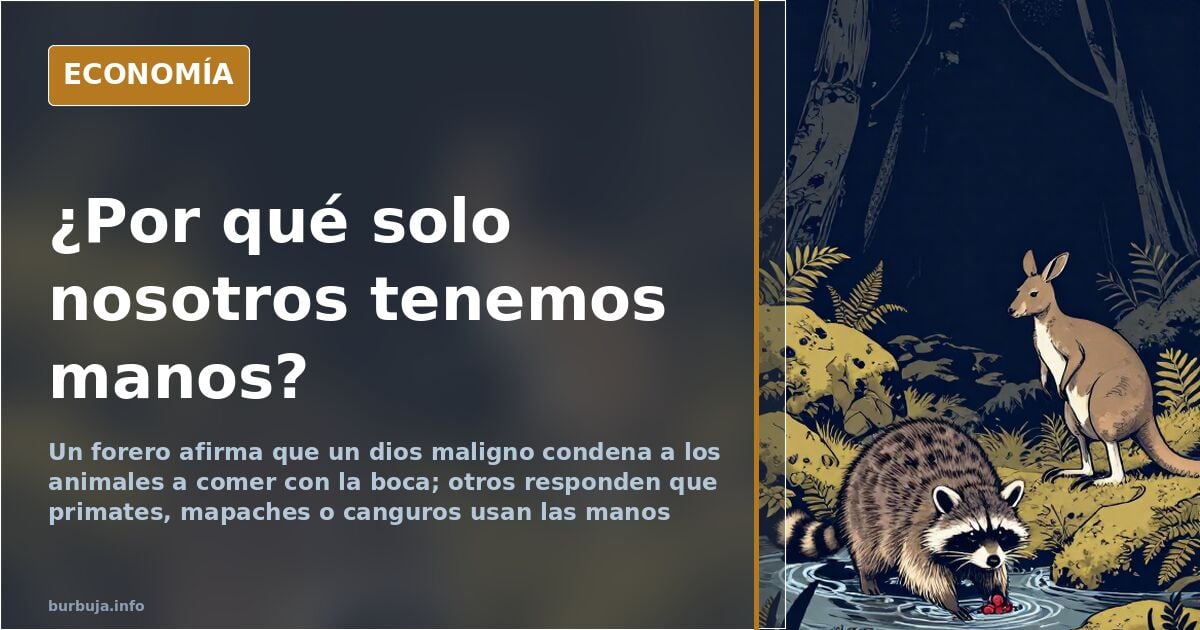
Forum user claims only humans have hands and eat with their mouths
There is a question that, asked out loud, sounds like a silly dinner-table remark and, asked seriously, strikes at the heart of evolutionary biology: why do only humans have arms and hands while every other species does everything with its mouth? The short answer is that it is not true. The long answer is that the question hides a far more interesting discussion about what it means to be the only species with technology.
The starting point is a blunt claim from one participant: animals without hands would be doomed to eat off the ground, tear flesh with their snouts and live on all fours. The conclusion he draws is theological: a perverse god would have designed an animal kingdom full of suffering. The body of the debate dismantles that premise with a list ranging from the raccoon to the octopus.
Which animals use hands and are not human
The most frequent answer is an inventory. Primates, raccoons, pangolins, platypuses, lemurs, bears and kangaroos use hands. Mones use hands, feet and tail. Elephants use their trunk. Mantises use their front legs. Crabs and lobsters use their claws. Octopuses, cuttlefish and squid use their tentacles. The list is long and dismantles the initial premise: the hand is not a human invention, it is an evolutionary solution that appears in very different lineages.
The raccoon case has its own etymological curiosity. According to one participant, the word comes from a Native American language and means "the one who takes everything with its hands." The animal not only has functional hands: it uses them to manipulate, wash and examine things. The anecdote serves to close the argument: if an indigenous word names an animal after its hands, the idea that only humans have them does not hold up.
Why the hand is not what made us human
The second line of the debate is more interesting. Having hands is not enough. Primates have them and do not build technology. The difference is not in the hand, it is in what the brain does with it. Technology requires hands, yes, but also a brain capable of planning, transmitting knowledge and accumulating improvements. A dolphin or an octopus may be intelligent, but without hands there is no industry. The hand is a necessary condition, not a sufficient one.
The nuance is introduced by a participant who points out that cats use their claws to hook pieces of food and bring them to their mouths. It is not a hand, but it is a tool. The boundary between hand and non-hand is blurrier than it seems. Evolution does not design clean categories: it recycles what it has.
The theological objection and its economic answer
The original message is not biological, it is theological. It claims that a perverse god created millions of species condemned to eat with their mouths. The debate's response does not engage with theology: it engages with data. If many species do not have hands, the right question is not why god allowed it, but why evolution did not need hands for those lineages to thrive. The mouth, the trunk, the tentacles and the claws are efficient solutions. The hand is just one more.
There is an economic offshoot that appears sideways. One participant suggests that if humans had no hands, cooperation would be mandatory for basic tasks. The hand allows individual autonomy; without it, survival would depend on the group. It is a hypothesis nobody develops, but it connects with the discussion about why technology emerged where it did.
The closing: the question remains open
The conversation does not reach a conclusion. Some insist that the hand is the key to technology; others point out that there are hands in half a dozen lineages that never built anything. The hedged prediction is that the question will keep being asked at dinner tables and on forums because it touches a real nerve: the discomfort of being the only species that wonders why it is the only one. The answer, if there is one, is not in the hand. It is in the brain that uses it.
Key facts from the debate
- Primates, raccoons, pangolins, platypuses, lemurs, bears and kangaroos use hands.
- Monkeys use hands, feet and tail; elephants, the trunk; mantises, the front legs.
- Crabs and lobsters use claws; octopuses, cuttlefish and squid, tentacles.
- According to one participant, "raccoon" comes from a Native American word meaning "the one who takes everything with its hands."
- Cats use their claws to hook food and bring it to their mouths.
Also available in: Deutsch
Summary of a discussion on Burbuja.info - Foro de economía, actualidad y política., translated from Spanish and reviewed before publication. Read the full discussion (45 replies).
More summaries
-
Why Only Humans Built Spacecraft: Evolution's One-Off Success
500 million species, 99.99% extinct, yet only one built spacecraft. Hands, posture, and a costly brain explain this unique evolutionary path.
-
Spanish E-LIX patent recovers 90% copper without emissions
E-LIX extracts over 90% of metals from complex sulfides without water or emissions. Atalaya Mining invests €12M in Riotinto, with the patent held by Eva Laín.
-
US Hunter Crushed by Elephants Dies in Gabon
Ernie Dosio died in Gabon after being attacked by five elephants while funding a hunt. An analysis of the human and economic costs of big game hunting.
-
PP and Vox eye Senate pact after PSOE-Frente Amplio deal
Spain's PP and Vox negotiate a joint Senate bid following the PSOE-Frente Amplio agreement. The deadline for candidate lists is October 26.
-
Flash poll: Vox slightly ahead of voter abstention
A flash poll without quotas puts Vox slightly ahead of abstention, as parties negotiate their candidacies and Compromís and Adelante Andalucía announce solo runs.
-
Spain's Ciudadanos to run as Democracia 21 in the 29N election
Ciudadanos will stand under the Democracia 21 banner in Spain's 29 November election, an announcement welcomed by some and met with mockery by others in the debate.