
Spanish E-LIX patent recovers 90% copper without emissions
E-LIX extracts over 90% of metals from complex sulfides without water or emissions. Atalaya Mining invests €12M in Riotinto, with the patent held by Eva Laín.
English · Original discussion in Spanish · Published
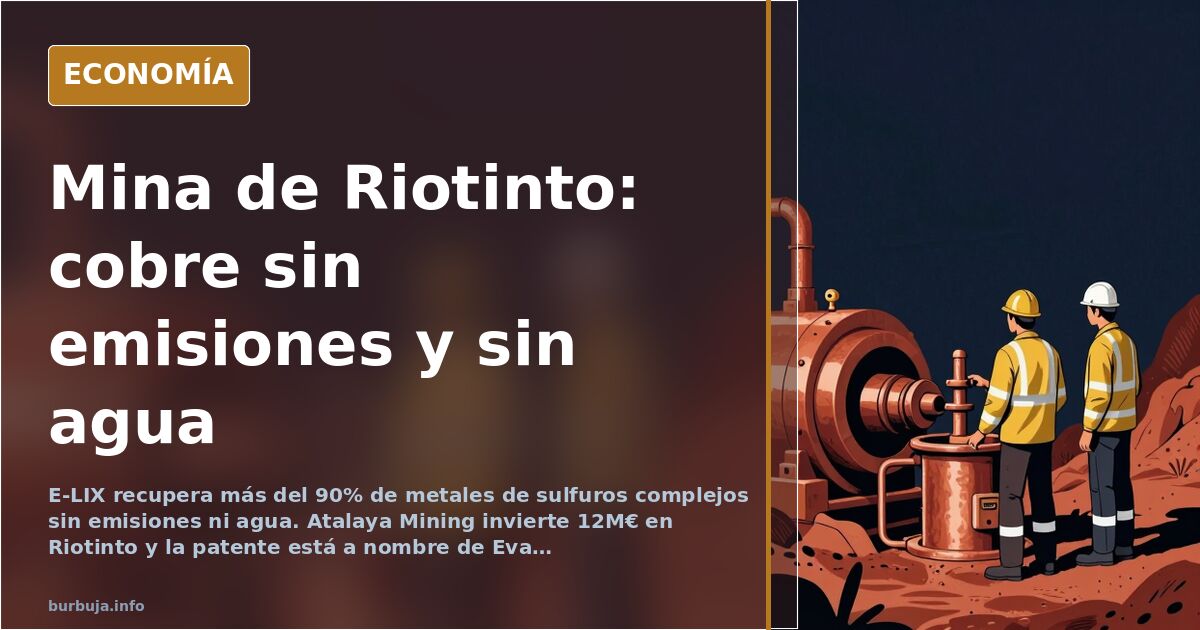
E-LIX: The Spanish Patent Promising Zero-Emission Copper from Riotinto
An industrial plant in the Iberian Pyrite Belt has been producing high-purity copper and zinc cathodes since December 2023, without smelting, acids, or water. The system is called E-LIX, patented in 2014 by electrochemist Dr. Eva Laín, and funded by Atalaya Mining with €12 million. It recovers more than 90% of metals from complex sulfides previously considered worthless. This is where the controversy begins.
What is the E-LIX system and what does it recover?
The technology combines electrochemical leaching with solvent extraction and electrowinning (SX-EW), operating at atmospheric pressure and ambient temperature while avoiding surface passivation that hinders traditional methods. According to company data, it exceeds 90% recovery in short timeframes and produces copper and zinc cathodes with 99.99% purity. Initial plant capacity ranges between 3,000 and 10,000 tons annually, with modular design allowing scaling from five tons per day in the pilot phase.
The underlying argument is geological and economic. The Iberian Pyrite Belt is rich in polymetallic minerals containing penalizing elements—such as arsenic—that European smelters reject or surcharge. E-LIX transforms these into sellable products at the mine site. Laín summarizes it thus: "This is the first time a hydrometallurgical process is competitive at an industrial scale."
No water, no acids, and a 95% lower carbon footprint
The environmental narrative is the other pillar. The process generates no waste or emissions, uses no hazardous reagents, and independent studies cited in documentation show it reduces the carbon footprint by 95% compared to traditional smelting. In Riotinto, it integrates with solar energy. For Laín, this makes Andalusia a strategic actor for supplying Europe with critical raw materials without compromising aquifers or soil.
However, distrust starts there. When a technology is presented with trendy adjectives—sustainable, efficient, green—economically skeptical audiences raise alarms. "It smells like advertorial," they summarize. Others go further, arguing it is merely image management rather than an industrial leap.
The patent: Original invention or improvement on known methods?
Here the issue becomes technical and requires precision. Patent WO2016027158 is registered under Laín's name. Readers acknowledge it describes prior problems, solutions, and advantages; it is not trivial. But critics argue it is not a revolution from scratch: it is a practical improvement on existing leaching methods, focused on selective metal depassivation.
Harsh criticisms suggest the patent covers untested methods and that the actual process may be less novel than media packaging implies. Defenders respond simply: a listed mining company would not invest €12 million if the paper didn't support scaling. The objective fact is that the plant exists, started in December 2023, and is in the ramp up phase, with full scaling projected within two to four years.
Industrial scaling and the shadow of propaganda
Laín’s personal history also circulates in the material. She left a comfortable life in the UK in 2015, moved alone to Aracena, contacted three mines, received two rejections, and bought lab materials out of pocket from a hardware store. Without salary. In 2019, she founded Lain Tech. This story reinforces project credibility but coexists with suspicion that news circulated only through receptive outlets, not international mineralogy journals.
Some recall the Riotinto mine has used this process for years, noting relevance lies in sustained profitability, not announcements. Others compare the case to episodes of overexposure of female scientists—like the black hole photo—to conclude it is propaganda. The comparison is flawed: here there is a plant, a patent, and verifiable industrial investment.
Full scaling is projected for a horizon of two to four years. If successful, Andalusia gains its own mining value chain and Europe reduces external dependence on copper. If not, another pretty patent remains in the drawer. With €12 million already invested in Riotinto, the question is not whether the invention is brilliant, but whether it withstands the electricity bill when no one is watching.
Also available in: Deutsch
Summary of a discussion on Burbuja.info - Foro de economía, actualidad y política., translated from Spanish and reviewed before publication. Read the full discussion (104 replies).
More summaries
-
Adamuz: The Broken Joint, the Double Derailment Hypothesis
Railcar 23117 and its joint failure at km 318.7, cited as evidence regarding the double derailment of two trains in Adamuz.
-
Almería Pushes for Separate Autonomy Four Decades On
Spain's Almería province seeks distinct autonomy, reigniting debates over the disputed 1981 referendum results.
-
Andalusia among Europe's ten poorest regions
Andalusia ranks among the top ten European regions with highest poverty risk, comparable to parts of Romania, though the indicator is calculated within each country.
-
La Vanguardia fires columnist over article accusing PSOE of seeking civil conflict
La Vanguardia suspends Lacasta for criticising the PSOE's drift. A reflection on the limits of journalism.
-
The theory that sees immigration as a wealth advantage
A forum user prices 50 m² flats in a working-class neighbourhood: from €60,000 to €120,000 in two years. The theory that sees immigration as a wealth advantage for the…
-
Limoges city hall burns during riots across France
Limoges city hall, a historic building, went up in flames during riots; the forum debate criticizes public spending and blames the fire on the destruction of…