
Forum stories of divorced 40-year-old women trying drugs
A forum thread describes cases of divorced women in their 40s who, according to the accounts, become hooked on cocaine or ecstasy after their divorce.
English · Original discussion in Spanish · Published
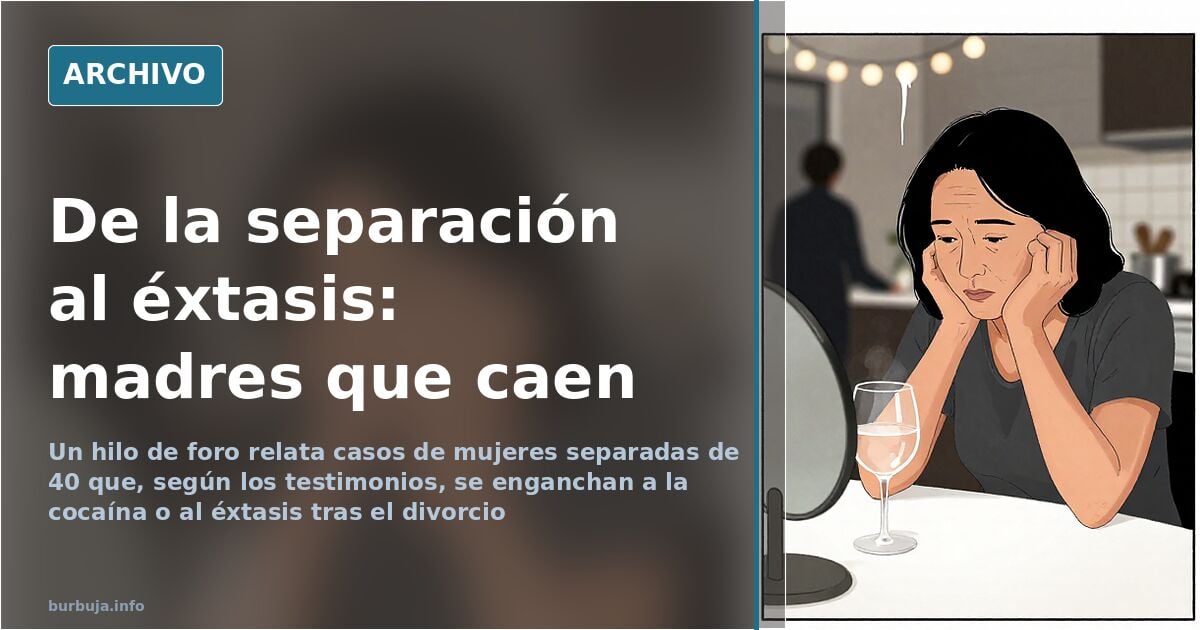
Divorced mothers in their 40s who discover drugs after their divorce
What happens when a woman who never went beyond the occasional joint gets divorced at forty and meets a jobless guy? The answer that keeps coming up in the stories told here is uncomfortable: within a few months she goes from knowing nothing about substances to using every weekend. The pattern is described in detail in several accounts: women who had been married all their lives, with children, a steady job, who after the divorce spiral into dating and drug use they cannot stop.
The case of the nurse who can't quit
The most repeated story is that of a nurse with a public-sector post, studious and hardworking, who got hooked on ecstasy at 41. According to the account that opens the thread, a man she started seeing after her separation got her to try it, and since then she only conceives of sens under the influence of the substance. Over two and a half years she is said to have met around 60 different people, with weeks of up to four. Her mother covers for her absences with her eight-year-old daughter, and her relationship with the girl is described as practically nonexistent.
Some argue these cases are nothing more than a badly managed midlife crisis. Others point to a more specific pattern: women who went from a controlling mother to a controlling husband and who, left alone for the first time, have no internal brake. The environment hypothesis gains weight when you notice that all the friends in her circle are in the same phase.
From cocaine to ecstasy: which substances come up
The cases mentioned include cocaine and ecstasy, known in slang as "eme" (MDMA). Anti-anxiety pills, sleeping pills, alcohol and tobacco are also cited as more common gateways. Descriptions of the after-effects vary: ecstasy and amphetamines supposedly leave a hangover of a couple of days, while good-quality cocaine leaves hardly any symptoms, though what is usually sold is cut with other substances.
The warning issued is clear: the problem is not just the substance, but the combination with family responsibilities. A person with minors in their care who uses regularly is in no condition to look after them, and that is what repeats in every story.
Free fall: from a black eye to disappearing
Another case described is that of a married woman with two children who met a drug user in the park while walking her dog and moved in with him. She lost contact with her children, started missing work, showed up with an injury to her eye that she blamed on an attempted robbery, and ended up borrowing money from coworkers. The description matches other trajectories: first the neglect of obligations, then physical and professional deterioration, and finally a complete break with her surroundings.
In the nurse's case, the deterioration got to the point that supposed thieves took every electronic device from her home, including her daughter's tablet, which later turned up in a second-hand shop. The grandmother continues to look after the girl while the mother disappears.
Can you get out? The case that made it
The most recent update on the thread is hopeful: the nurse addicted to ecstasy quit. According to the account, she needed at least four attempts, but she is now more focused on her daughter and on keeping her job. She no longer looks for a new partner whenever she feels like it, and her physical appearance has improved. The conclusion drawn is that you can get off that substance too, even if the process is long and includes relapses.
The question remains whether the damage done to her daughter during those years is reversible. The girl cried every time she came back from her father's home, and her school performance is described as disastrous. The mother's recovery does not erase the lost time.
The repeating pattern: separation, dating carousel and substances
The common thread in several accounts is that drug use does not appear before the separation, but after. Women who had tried nothing in their youth throw themselves into a carousel of dating and use at forty. The explanation given is that separation releases behavior that had been repressed, and that the circle of friends reinforces the conduct.
Against this, some argue this is a minority and that most divorced women do not fall into drugs. The criticism of that argument is that the problem is not the number of cases but their severity: a single case with neglected minors is already reason for alarm.
The unavoidable conclusion is that no one is safe. A woman with a steady job, an education and an orderly life can end up taking ecstasy every weekend at forty. And the most unsettling part is not that she falls, but that no one around her seems able to stop it.
Also available in: Deutsch
Summary of a discussion on Burbuja.info - Foro de economía, actualidad y política., translated from Spanish and reviewed before publication. Read the full discussion (467 replies).
More summaries
-
Brad Pitt's San Sebastián Look: €14,000 or €14 at Pepco
Brad Pitt arrived in San Sebastián sporting an outfit valued at over €14,000, including a Zegna jacket priced around €9,000. The same look at Pepco would cost just €14.
-
World Cup and identity crisis: is Spain in decline?
Some say this will be Spain's national team's last World Cup. Claims of Russian interference and political memes fuel the debate over Spain's future.
-
Women in public office: inefficiency or bias?
A former civil servant criticises women's performance in public office. Structural problem or bias? The debate over Spain's public administration reignites without data.
-
Russia orders arrest of Telegram owner Pavel Durov
Russian authorities have ordered the arrest of Pavel Durov, founder of Telegram. The move reignites the debate over the app's real privacy and its cooperation with law enforcement.
-
Spain stands alone against Morocco: the geopolitics no one wants to see
As NATO and the EU look the other way, Morocco applies pressure with the backing of the US and Israel. The data point to Spain's strategic isolation.
-
Video of migrant eating a rat sparks backlash in Spain
A video of a migrant eating a raw rat has triggered mockery, disgust and calls for Spain's Health Ministry to respond. No verified data, only hunger.